Just since the holidays, I have had three opportunities to help someone learn to quilt or sew. The director of the agency where I volunteer is having a new grand baby and wants to make it a quilt. A young Church member has quit her full time job and has time on Wednesday to join us at quilting. My precocious great niece reminded me that I promised to help her learn to sew last summer so I really must this summer. And after decades of teaching sewing/quilting to high school students you would think this would be a breeze. But I am a bit apprehensive about each situation. Helping a peer is very different than the teacher/student role of a formal classroom. My very smart great niece is still very young and I am not sure she can even reach the pedal on my machine and I certainly will wait a few years before introducing her to the rotary cutter! So how do I start? After many dog walks–I do my best thinking then–I came up with six guidelines.
- Discover what the person knows and go from there. In the formal classes I taught, we had to all start at the very beginning no matter the experiences or skill level. Twenty four students in a classroom required conformity at first–so I had some bored students and some students struggling to complete the first assignments. Our new quilting member has sewn costumes before so I start with the differences between sewing garments and patchwork, for example, using 1/4 inch seam allowances instead of 5/8″. My niece will start with “safety” first!
- Provide tools that help make the process go smoothly. Dull scissors–cheap ones or heaven forbid, paper scissors will cause the most motivated person to throw in the towel. I would rather loan my tools than have a want-to-be sewer/quilter purchased new but cheap ones that will ultimately frustrate them. I have hundreds of dollars in rulers, shears, rotary cutter and mats etc, but one really only needs four or five items to start–shears, pins, acrylic ruler, rotary cutter and a mat. One of the advantages of joining an established group is that most established quilters have multiples they are willing to share.
- Start with a goal–making a quilt or bag–but something real. Again, in public school classes all the students had to make a “learn to sew” bag which was met with huge differences in enthusiasm. Personally, I am willing to re-do and perhaps re-do again on something I will gift or plan to use than on something that is just a practice piece.
- I am a firm believer in “She believed she could, so she did”. Attitude is everything! I had a student who created the pattern for a Parisian theme quilt as her second or third project. I really had my doubts when it was presented to me as her Senior project, but she was confident she could do it in nine weeks. Granted she was a very talented person with an artistic eye but all these years later, I believe she made the quilt as planned because she had faith in herself.
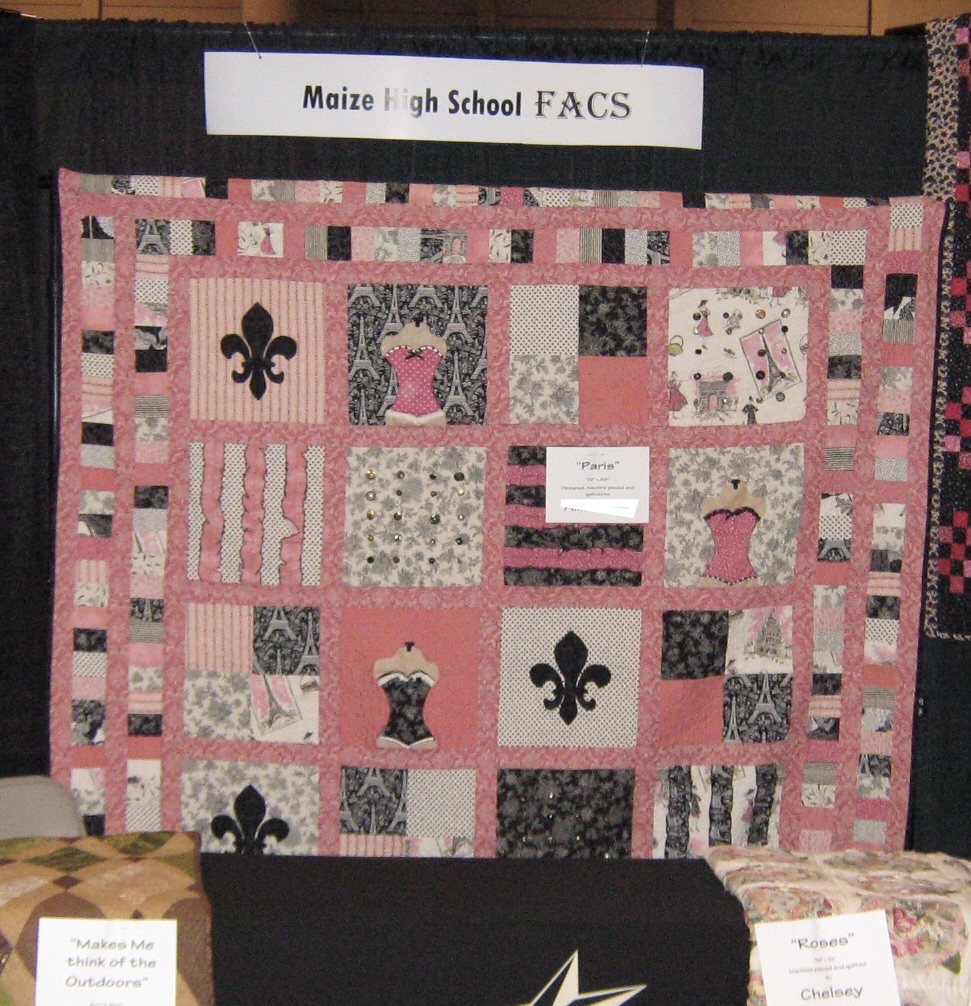
This the quilt at the Prairie Quilt Guild Show in June, 2010. (I really appreciated the Prairie Quilt Guild leadership that year–they recognized and encouraged high school quilters.)…..and as a side note, this young lady has traveled all over the world; to all those places she dreamed about in high school.
For the instructor, it is a balancing act between being realistic and letting the student dream. Dreams shouldn’t be squashed but as the saying goes, “don’t bite off more than you can chew” which can discourage one from ever trying again.
5. Both mentor and mentee should have fun…sewing/quilting allows creativity , creates a sense of pride, a feeling of accomplishment and overall it is a stress reliever. Now, that is not to say, occasionally, sewing can be so frustrating that bags of M&Ms are consumed and naughty words are used. But oh, when you have conquered that curved seam or your points match, what a feeling! Also, sewing/quilting takes your mind off some of those world issues that you have little control over–a mental health breather.
6. Most importantly, your passion may not become their passion. Just because one wants to make a baby quilt for a new family member does not mean that they want a new hobby or interest that consumes their free time! If my niece learns to operate a sewing machine and sew straight seams it might just be one more ability she adds to her arsenal of life skills. At another point in someone’s life, sewing may again become an interest or it may not. Either way, sewing is there for them and you both were successful.
These guidelines could be used for almost any new venture–learning to cook or gardening, using oil paints or photography. It is a new year , a perfect time to learn a new skill or share one of your skills.
❄️❄️❄️❄️❄️❄️❄️❄️❄️❄️❄️❄️
We had a full house at quilting Wednesday but very few finished projects to share.

Embroidered tea towels-$9
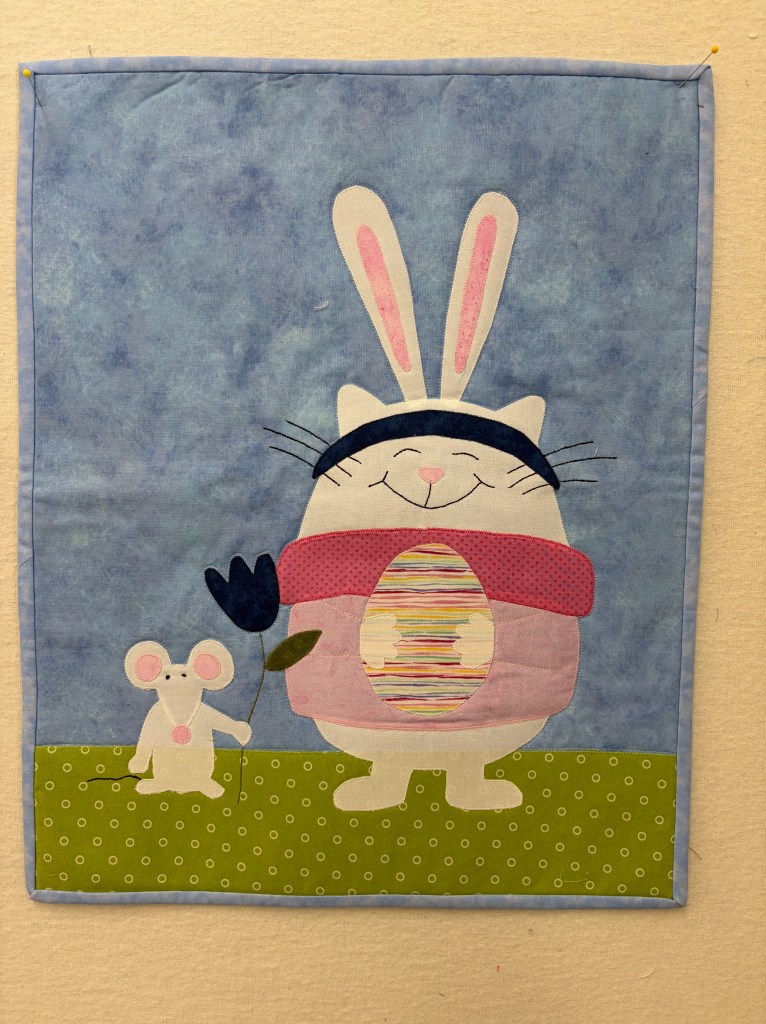
This appliquéd kitty masquerading as an Easter Bunny would be a fun addition to your spring decorations. The wall hanging is 16″ x 20″, easy fit in most homes. $40
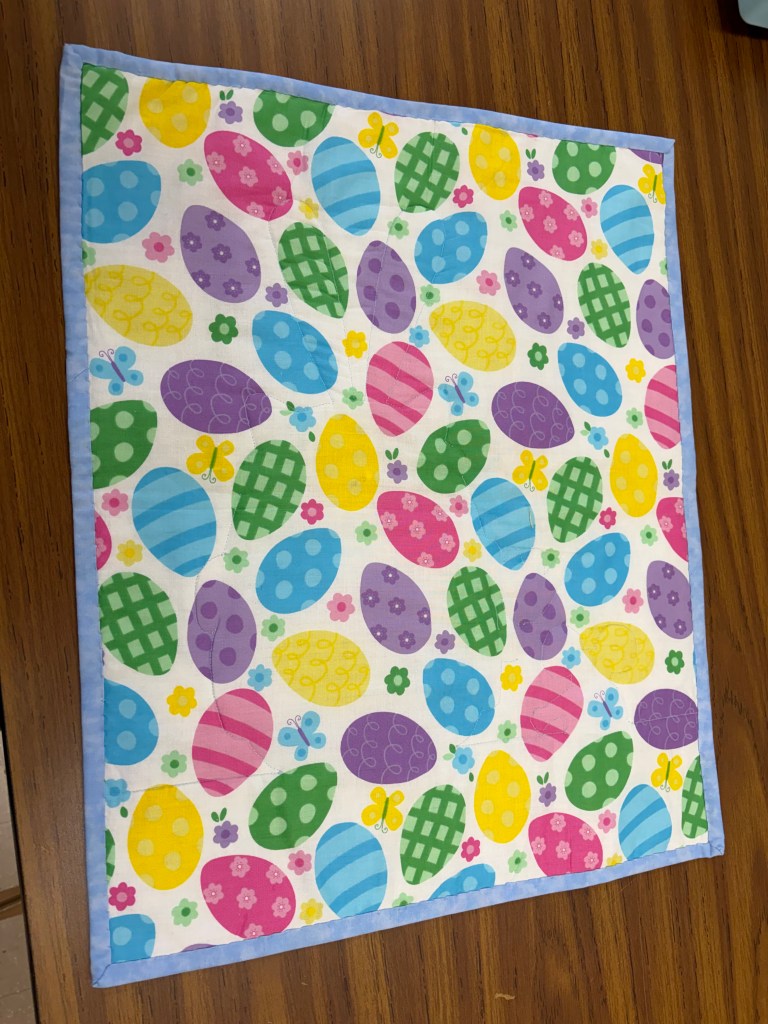
The backing could serve as a table topper also.
Since we all are busy getting quilts ready for the long arm quilter or sewing on bindings, I thought I would re-introduce you to one of the quilts we have hanging on our walls, ready to go home with someone.

Muted floral and geometric prints from one layer cake (forty 10 inch squares from one fabric line) were used to piece this “plus + square” quilt. It measures 68″ x 68″ and is $160. The soft colors would fit right in many color schemes. The binding is a black and white stripe with the slightest hint of blue, but it too has a muted feel which is perfect for the over all quilt.
Stay warm and enjoy your passions.
 Quilts, Etc.