Four Full days in Arizona

We just returned from a few days in Arizona. In case you didn’t know, Phoenix is home to 15 Major League Baseball teams and ball parks during the six weeks of Spring Training. These teams belong to the Cactus League–the other 15 teams are part of the Grapefruit League in Florida. The proximity of professional ball teams is nearly heaven for fans like my husband. In three days, he saw three games and since it was the last week of Spring Training, the starting lineups usually played the first half of each game. We have been to Phoenix many times but this year we had an added bonus. Our oldest grandson is a freshman at Embry-Riddle Aeronautical University in Prescott, two hours north of Phoenix. So as proud grandparents, we visited his new school.
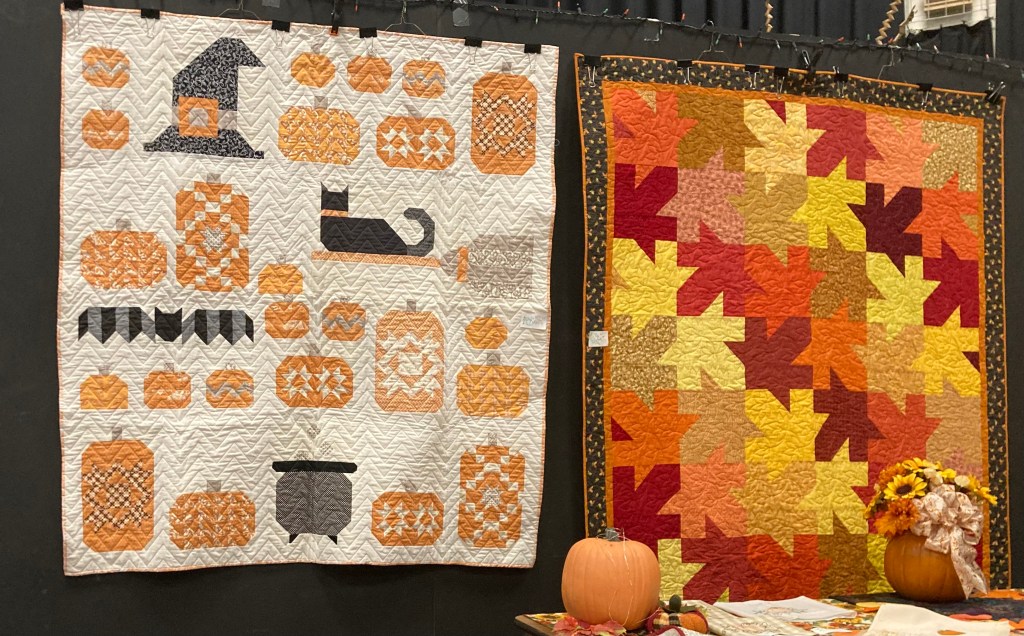
When we were first planing the trip, my husband discovered the Arizona Quilt Show was being held in Mesa during our visit to the metropolitan area. So one morning before a game we saw hundreds of beautiful quilts and visited 40 venders. A good trade off for attending a baseball game.

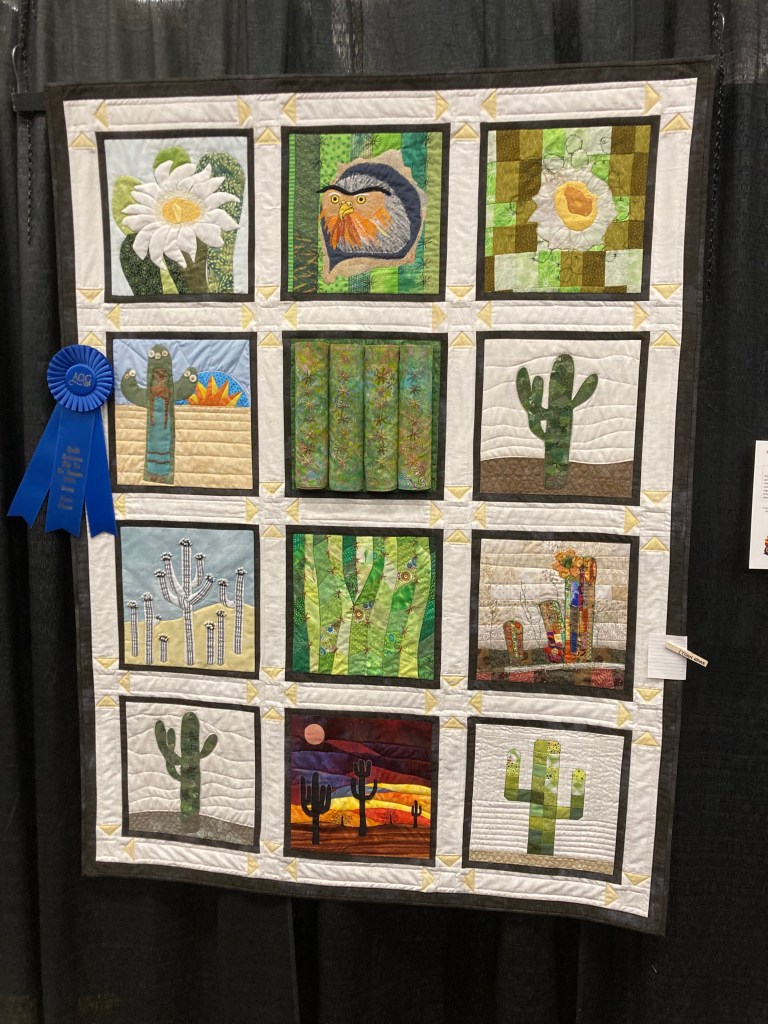
“The Beauty of Saguaros” by a German quilting group.

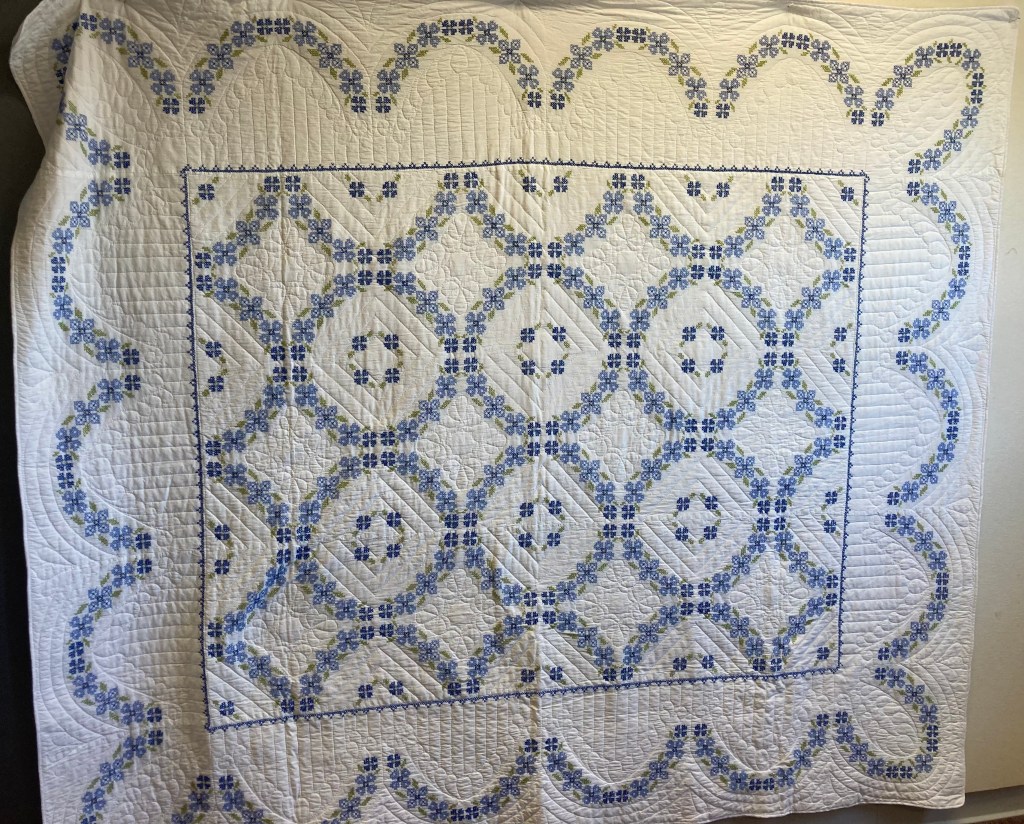
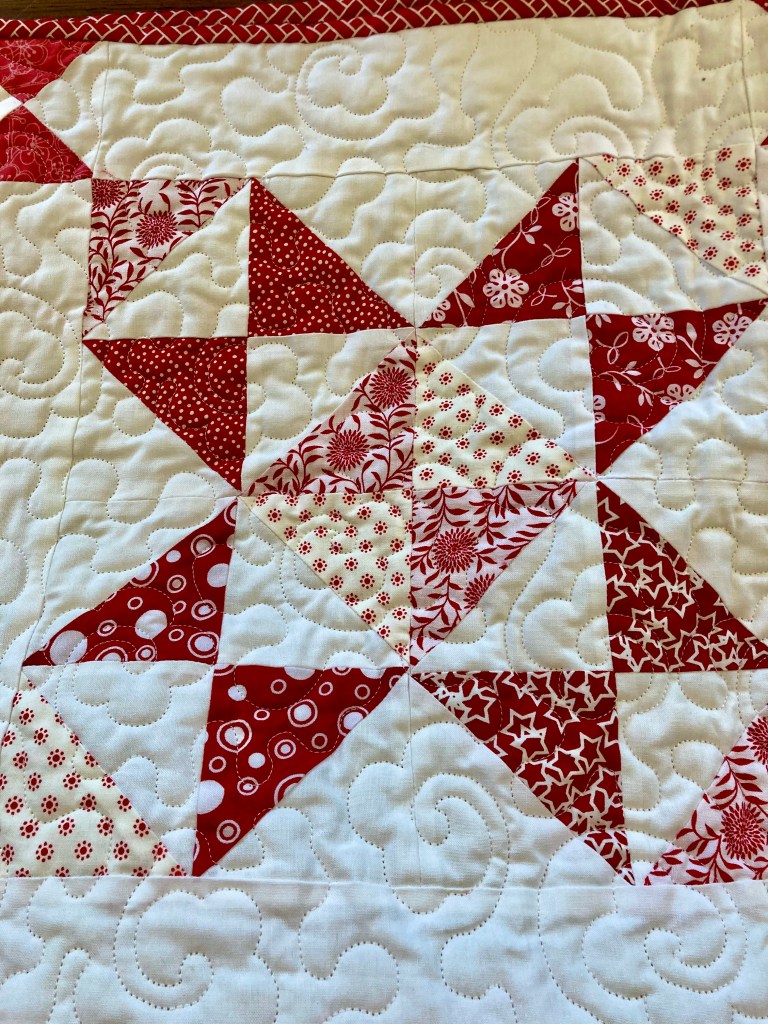
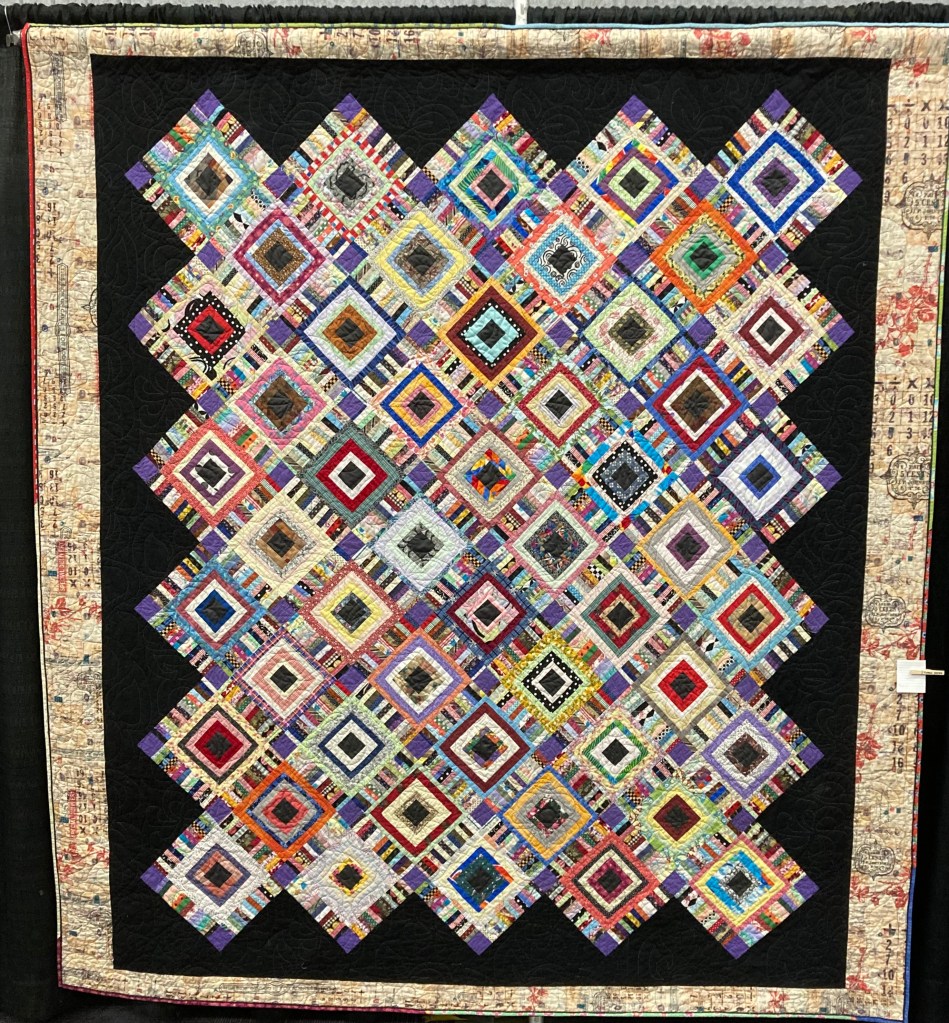
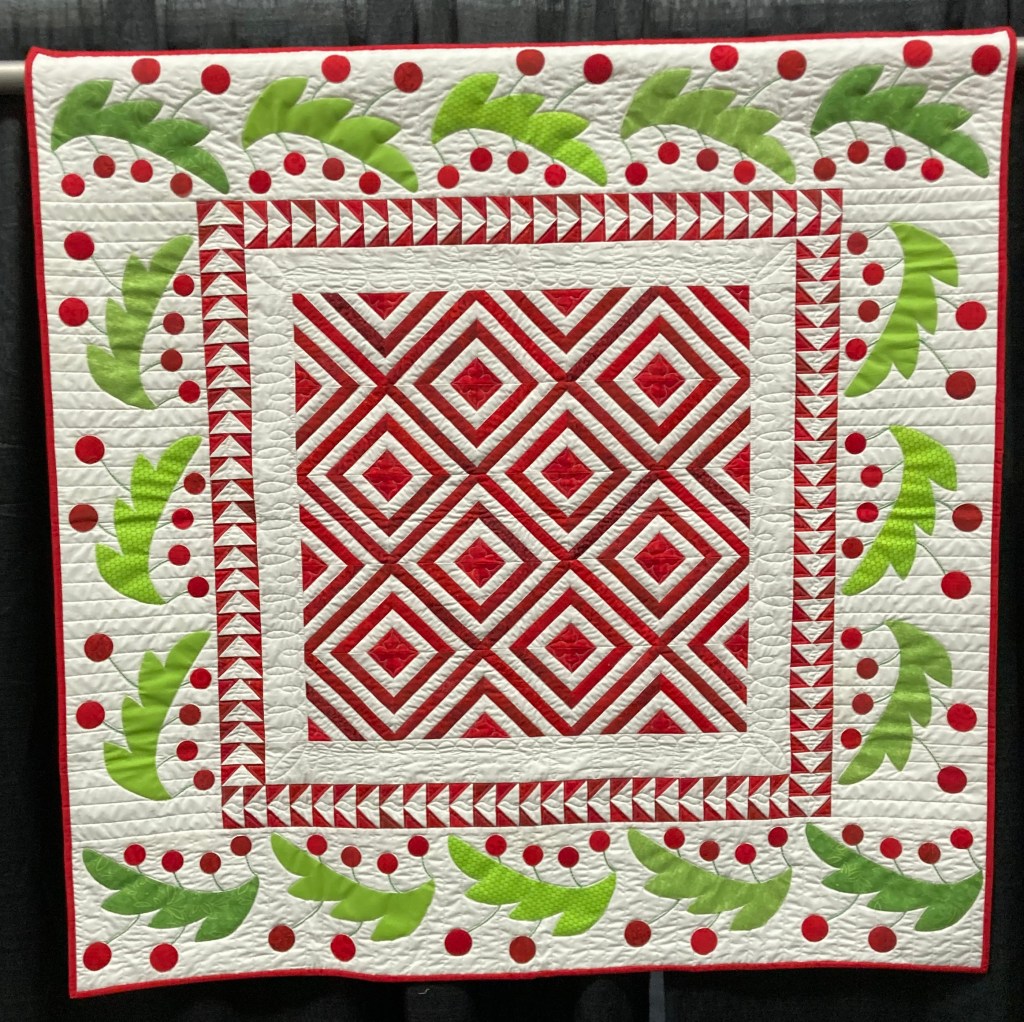
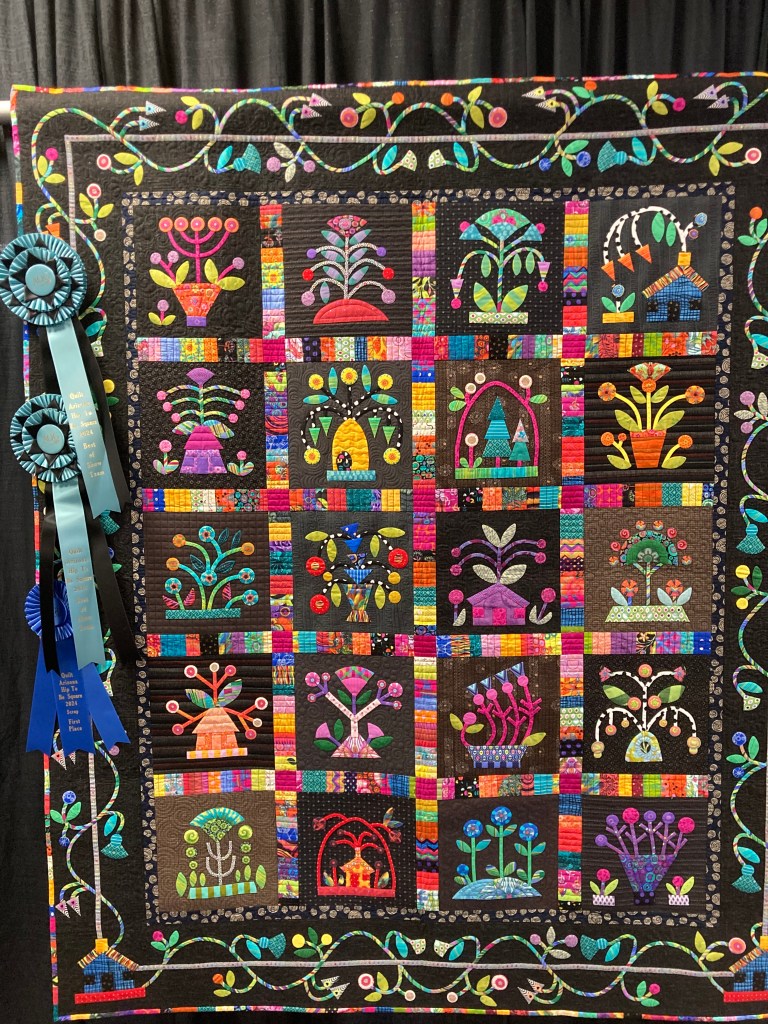
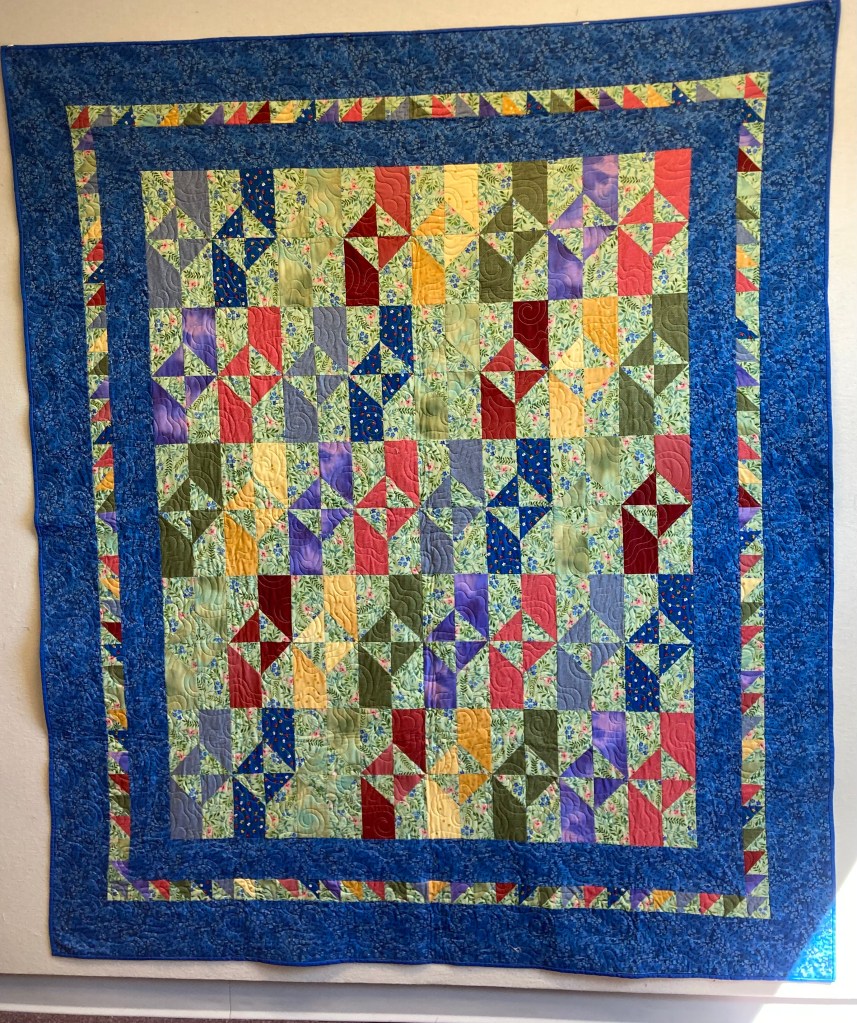
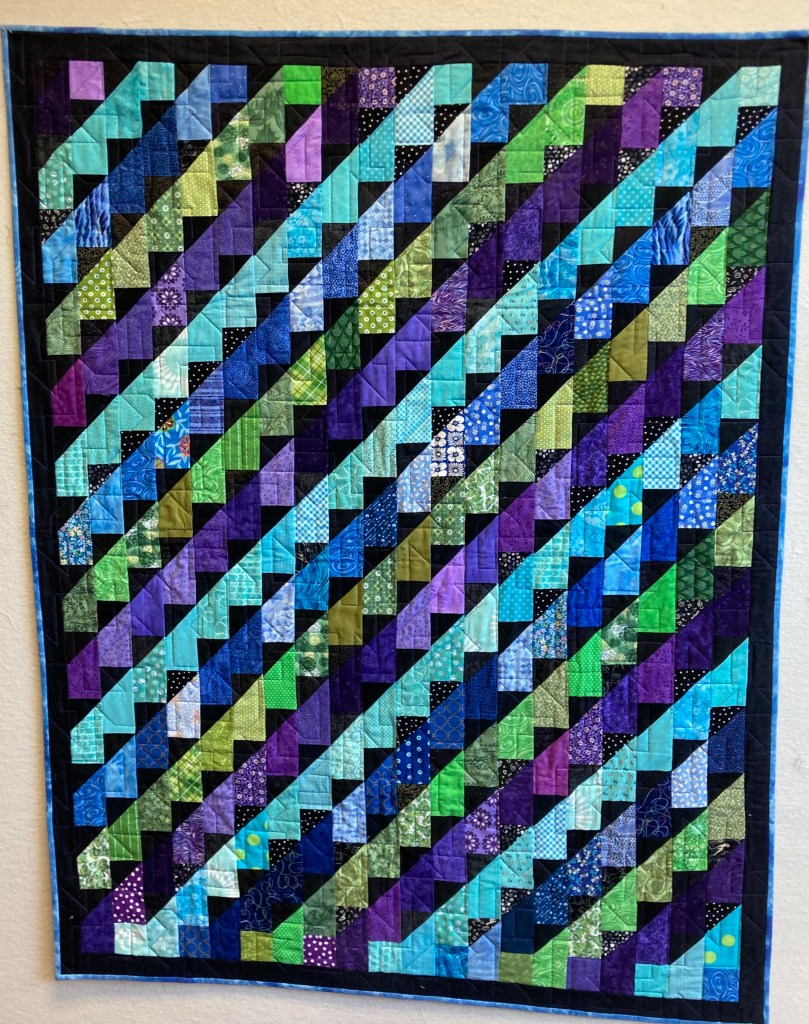
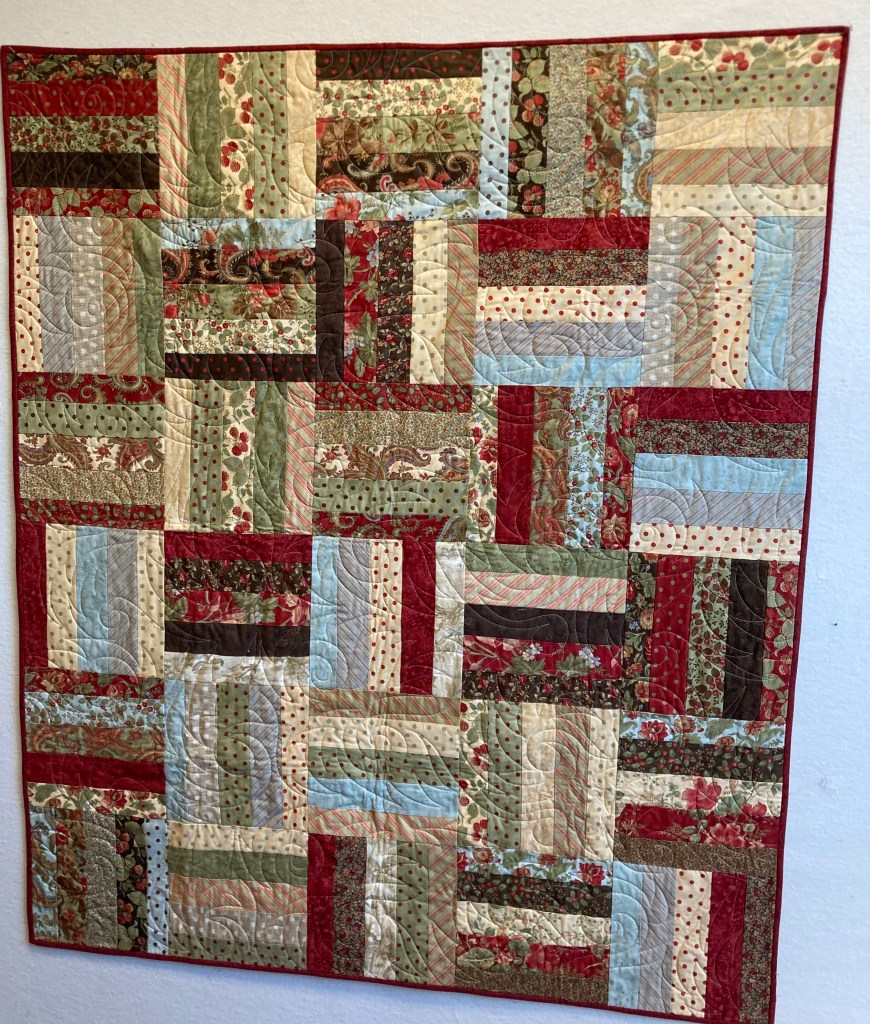
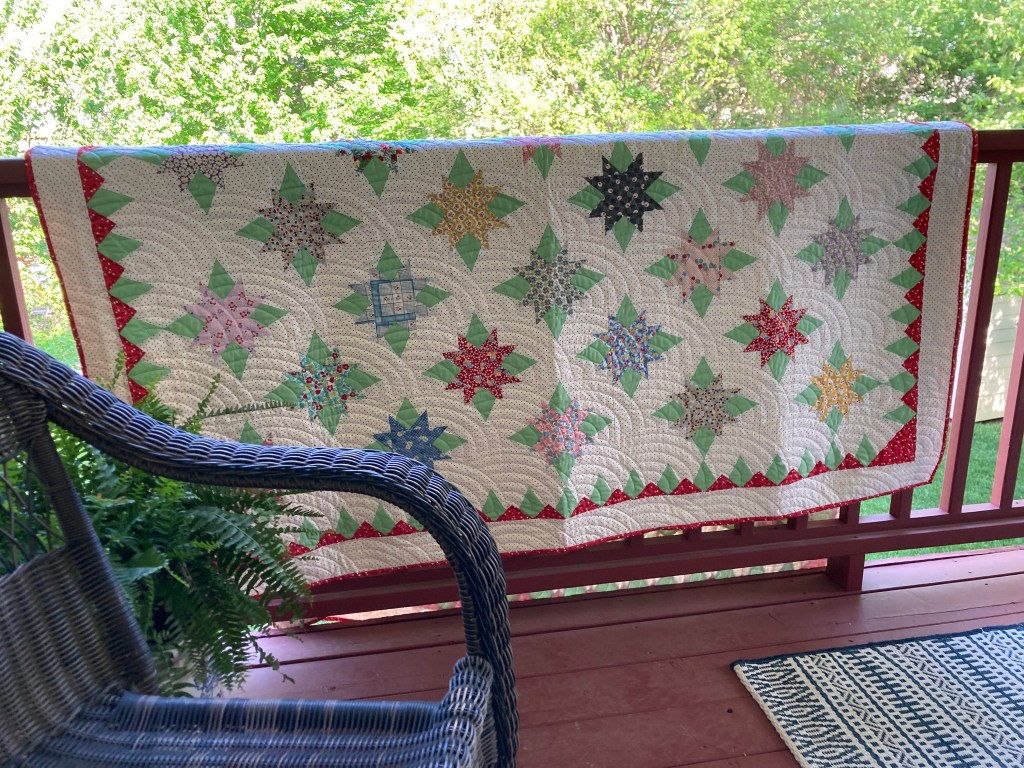
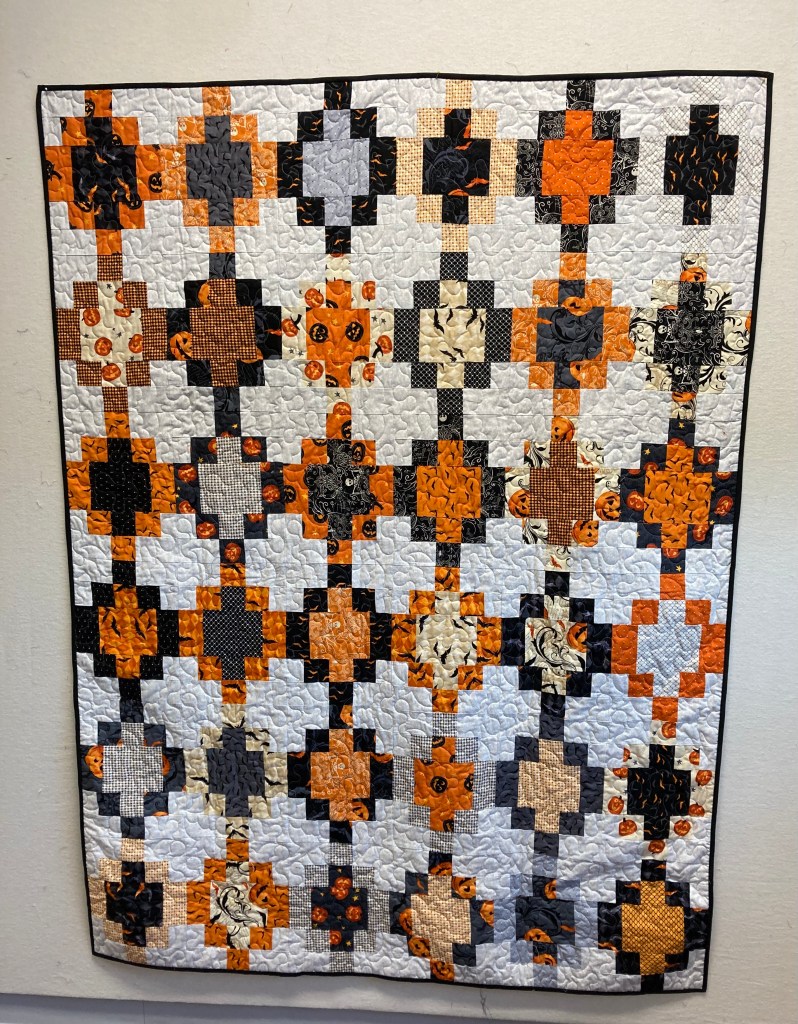
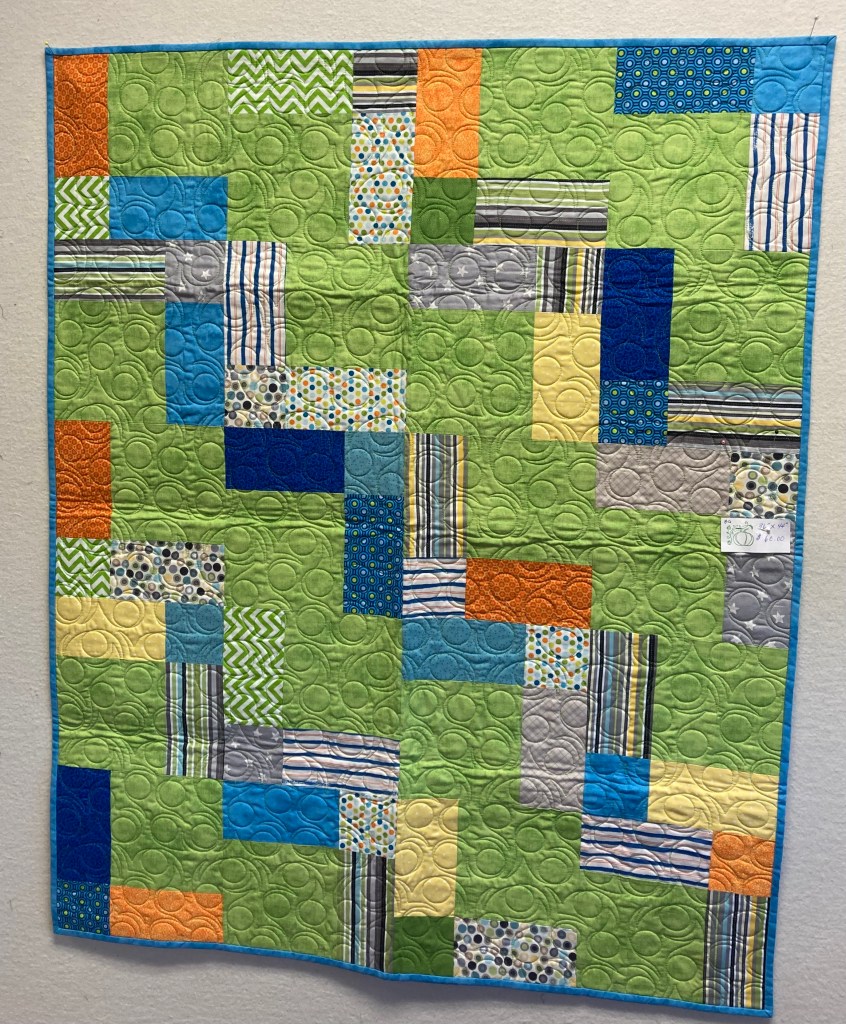
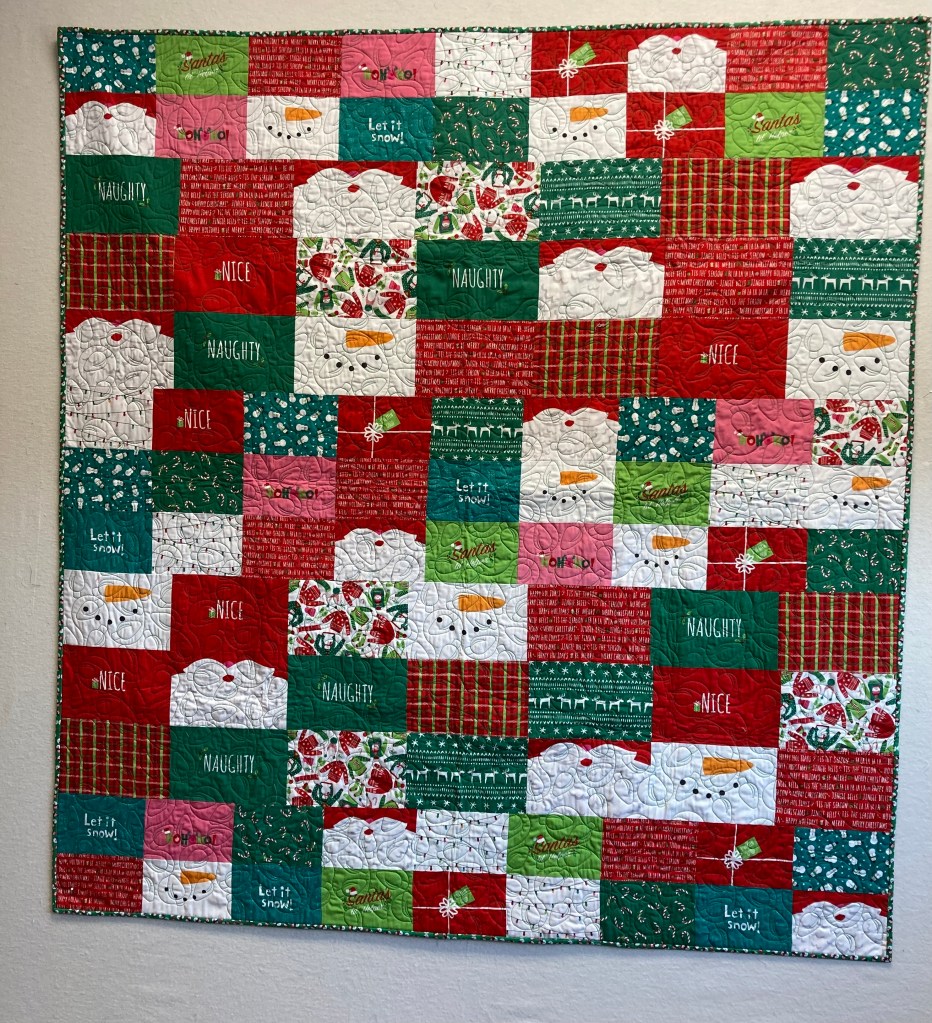
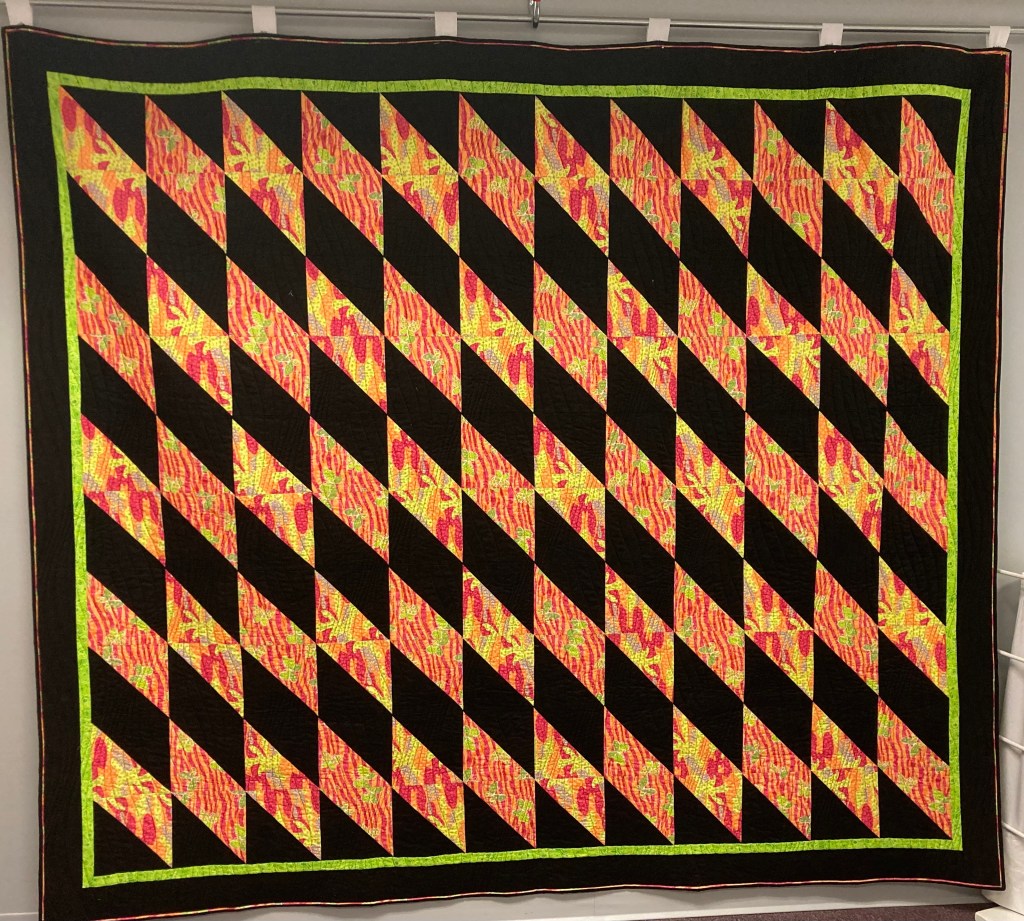
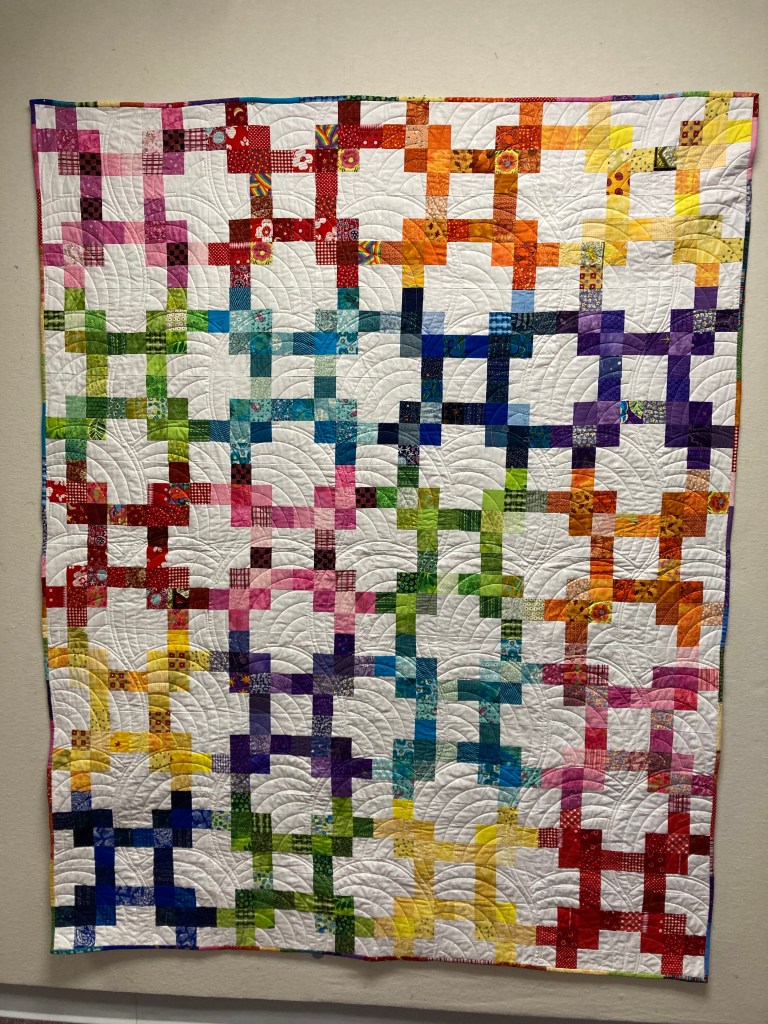
These are some of my favorites–the first photo is a tribute to the creator’s Mennonite mother. Each block has 77 different fabrics and each block is different! The middle quilt is red and white with cherries-perhaps. My favorite motifs! The last photo is the Best of Show. It is all hand turned appliqué. It sparkled. My shopping observations were— 1. Most of fabric was precuts. 2. Most of the fabric was saturated–dark colors or very bright colors. I had given myself permission to look for a yard of pastel dots/stripes/flowers for a border but found nothing. Also, given I am still on my “fabric diet”, I did not want to buy a bundle of precuts. But it was fun to look.
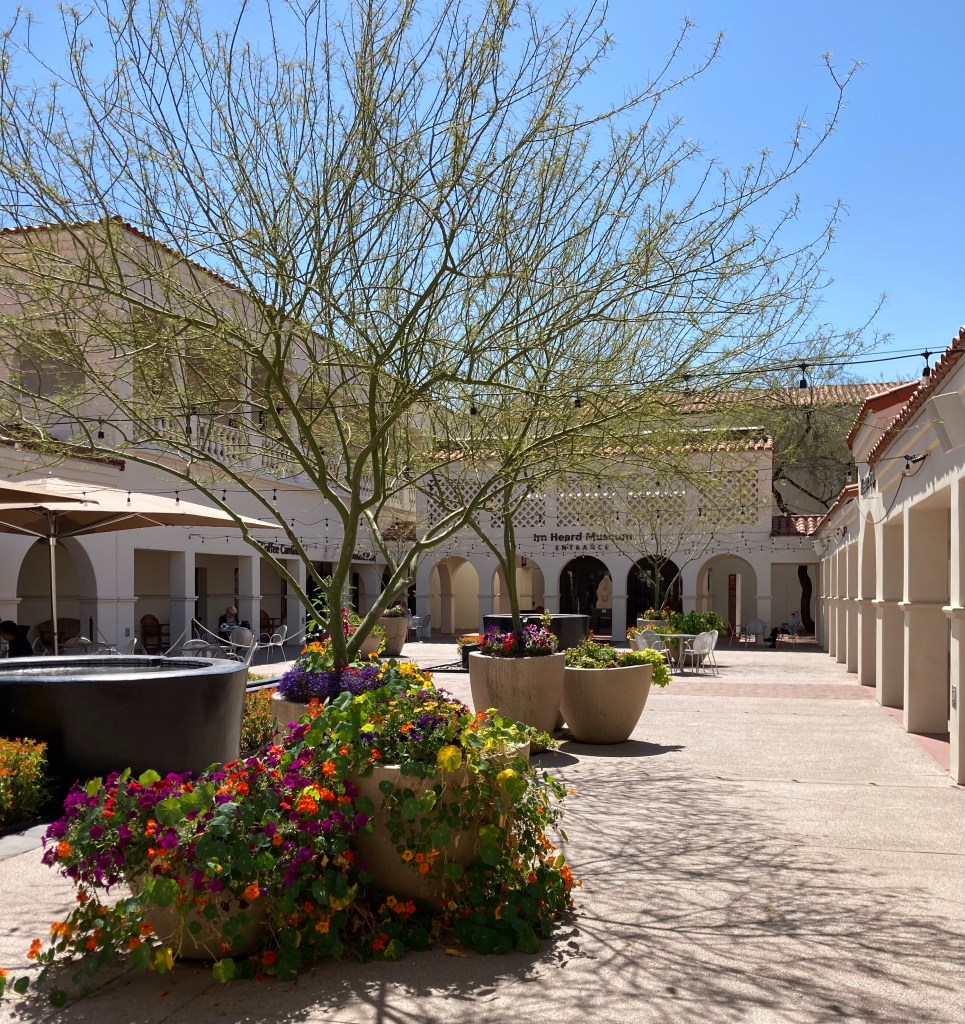
The second morning before a game, we visited the Heard Museum–“dedicated to the advancement of American Indian art.”

This oasis in downtown Phoenix was an unexpected treat. The grounds are lovely, the docents are friendly and the exhibits are fascinating. The gift shop is an art gallery of jewelry, textiles and folk art, all guaranteed authentic.
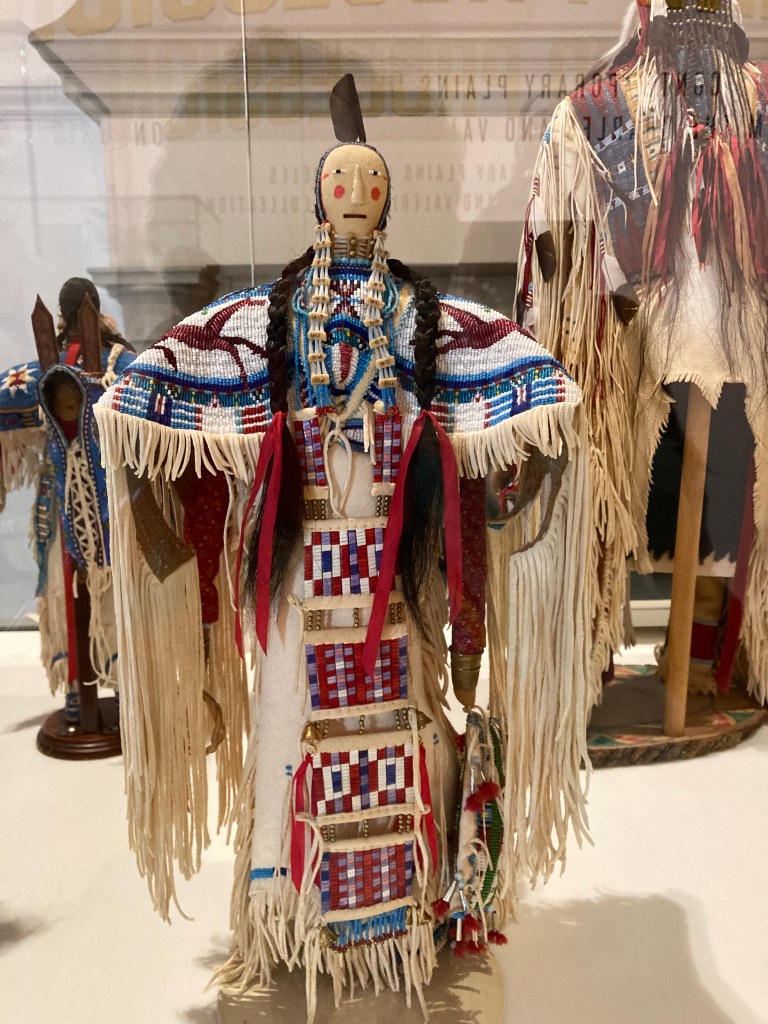
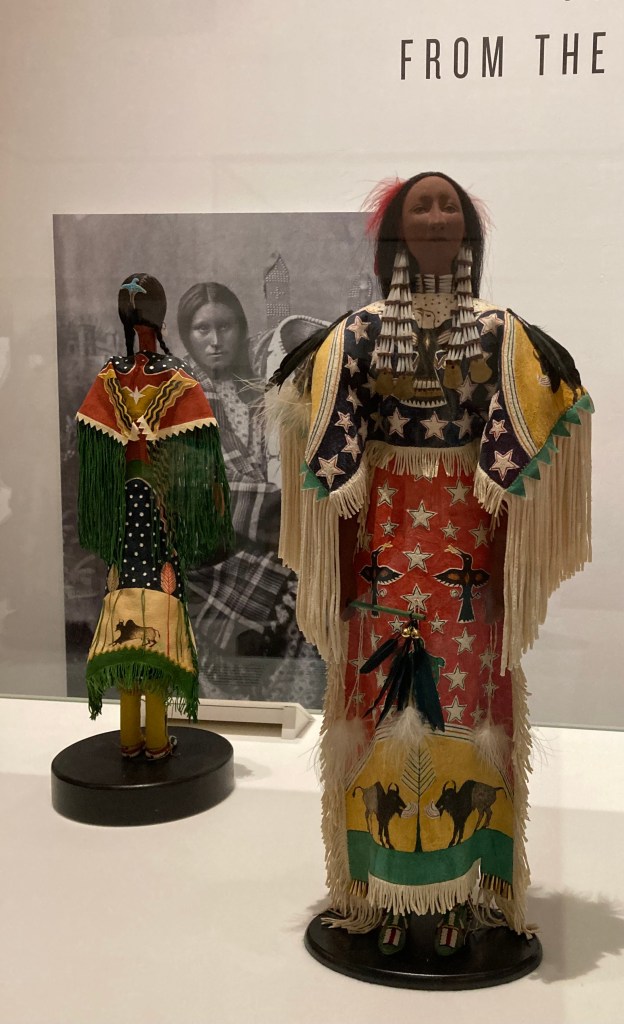
I was most impressed with the soft sculpture and bead work.

Many of the sculptures were modeled from people in old photos. As a quilter, I was in awe of the hours and hours spent creating perfect details.

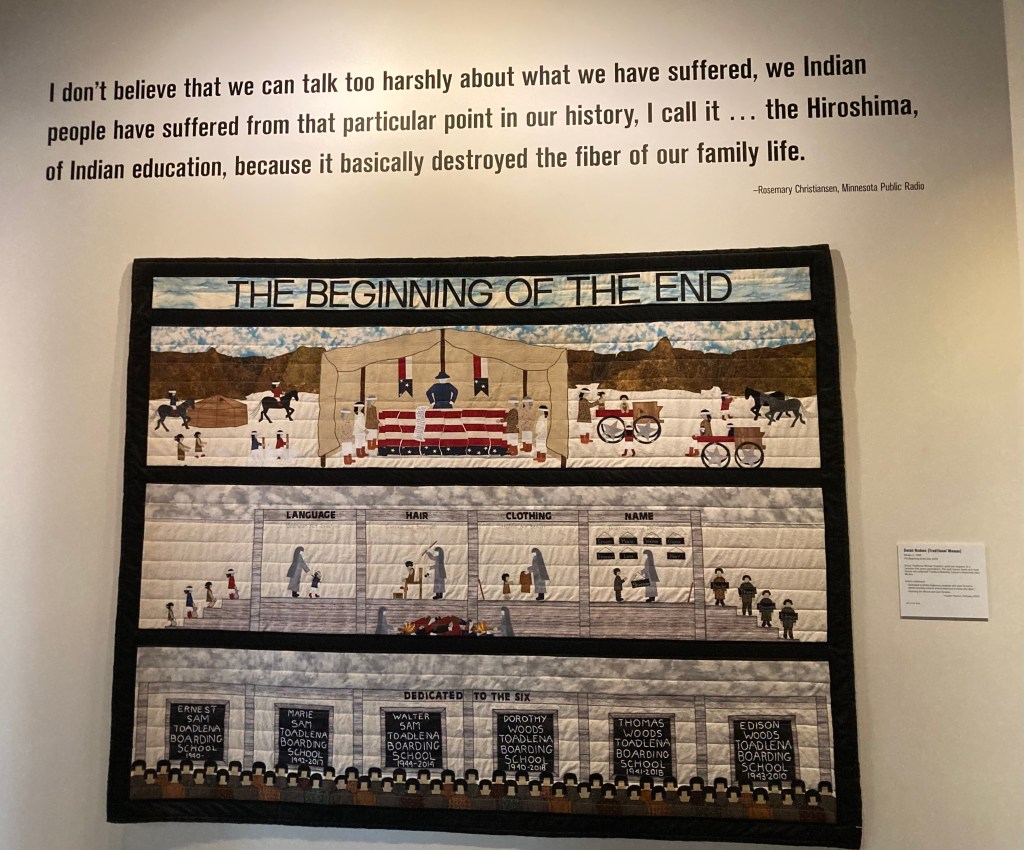
The Galleries were spacious with a great variety of art mediums, but we spent most of our short time in an educational exhibit about the Indian Boarding Schools. Well done, it gave a balanced history of the inexcusable motives for the school and the tragedies as well as personal success stories.

The only quilt in the museum was here–a story quilt.

I have more photos of ball parks on my photo than you might suspect, but no photos this year that didn’t feature my husband. I prefer minor league or spring training games to the professional games in the summer..but I have no photos to share.

I have travelled south out of Phoenix many times but this was my first time to go north. My husband keep reporting “the temperature just dropped another degree” the entire two hour trip to Prescott.

Spring had not arrived and the campus is compatible to its surroundings–so very different to the college campuses with which I was familiar. The emphasis is aviation with reminders everywhere. I was most impressed with the library–libraries certainly have evolved in fifty years!!

He is training to be a pilot, so of course we saw those “tiny” (grandmother’s viewpoint) planes he is flying. We stood on a mesa and watched the planes lined up waiting to take off —where he did his first solo landing.

My little boy is almost a grown up! But I am happy to report he still consumes food like the teen ager he is!

Flights to and from AZ were fine and our luggage came home with us! So I will count this mini vacation a success. Count on us being back next year!

🌵🌵🌵🌵🌵🌵🌵🌵🌵🌵🌵🌵🌵🌵

Even though quilters take vacations, we still have new items for sale.

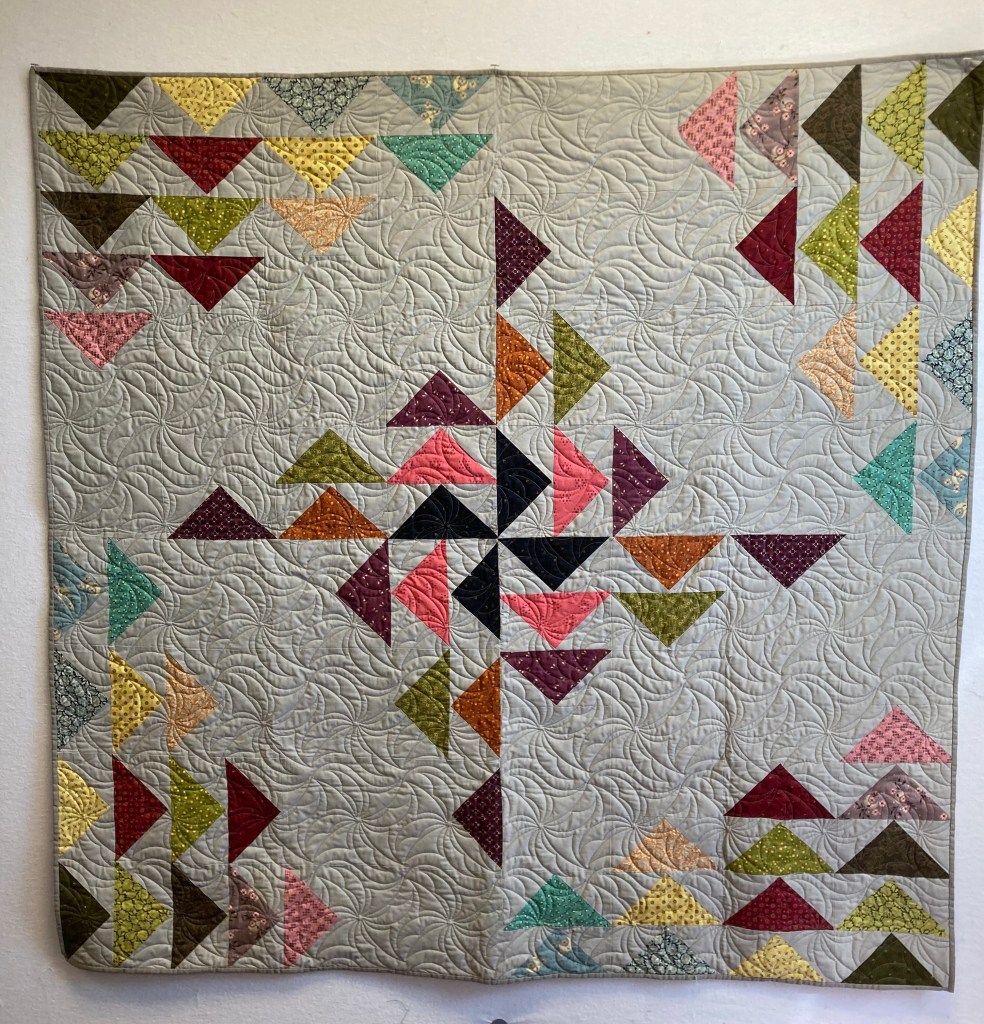
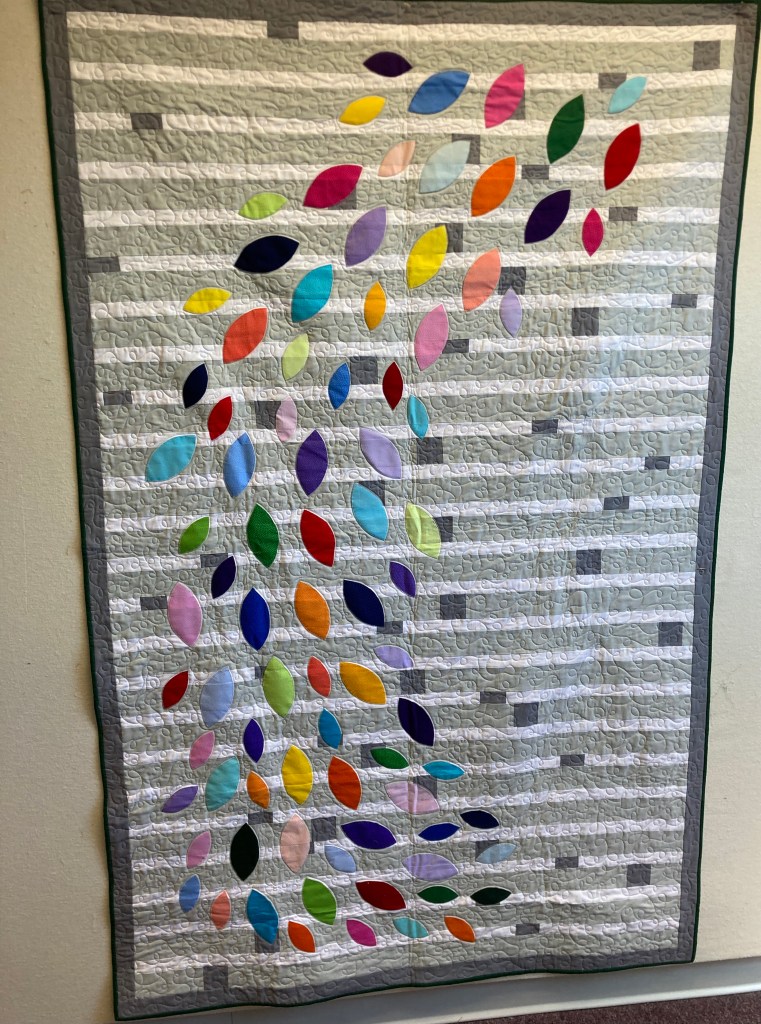
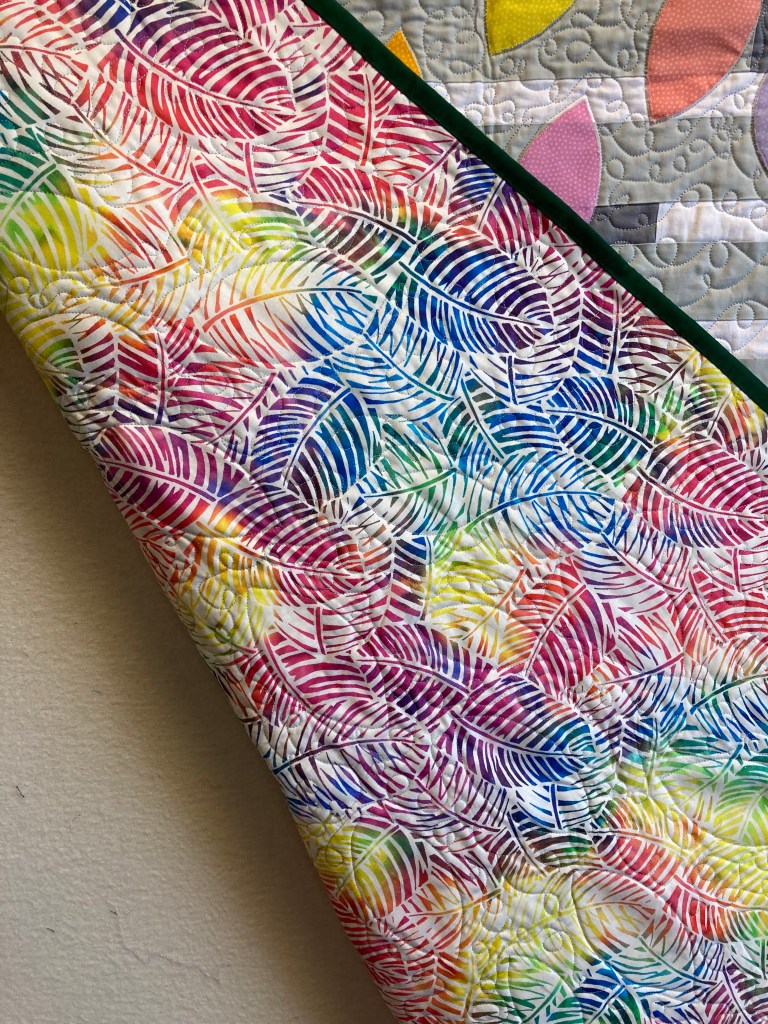
This contemporary quilt could be falling leaves or confetti thrown in a parade. The 41″ x 76″ quilt is machine quilted in a side to side pattern. The dark green finding frames this wall hanging or twin bed coverlet. Machine appliqué secures the bright splashes of color. $200

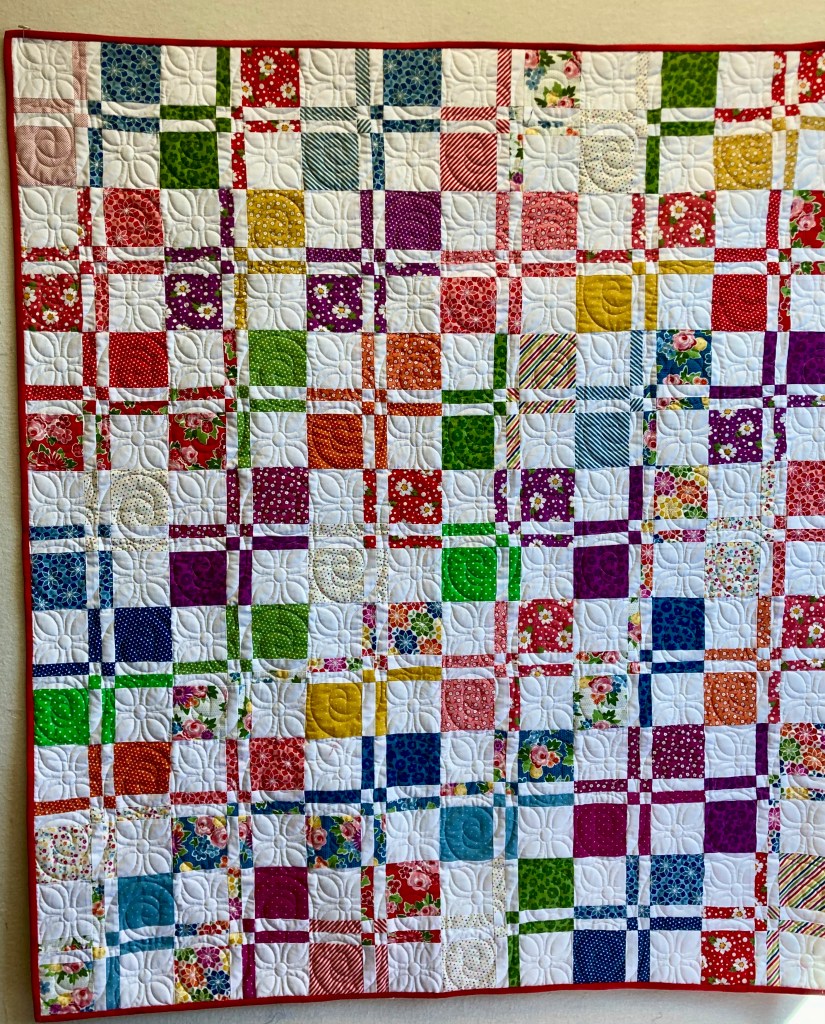
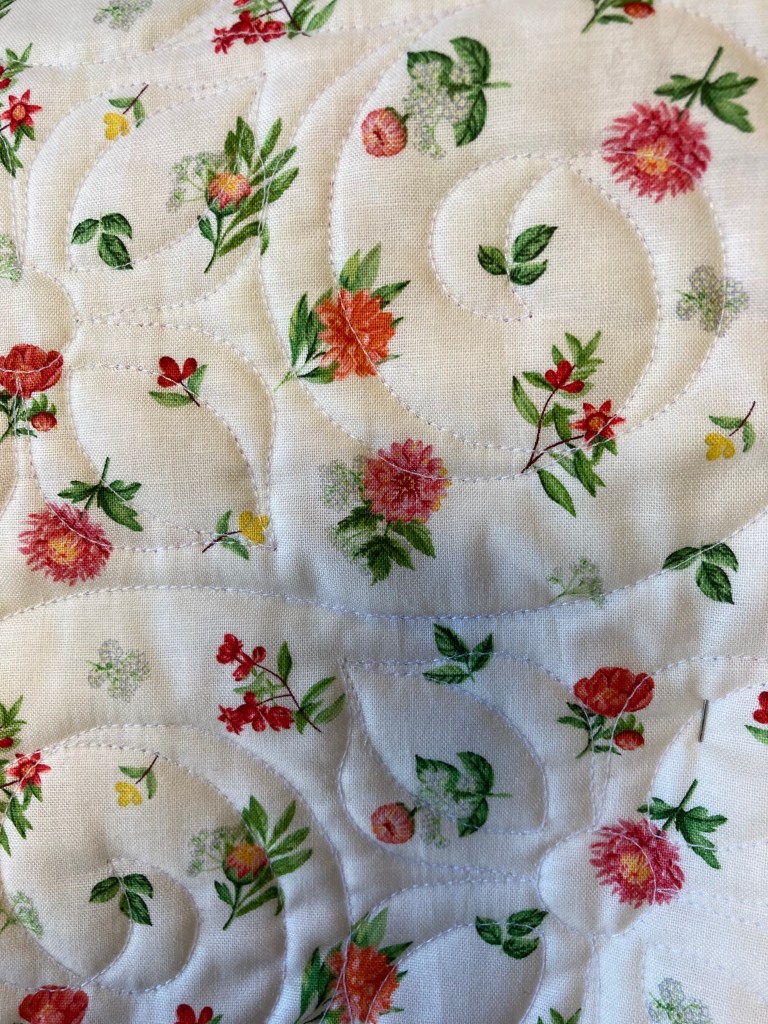
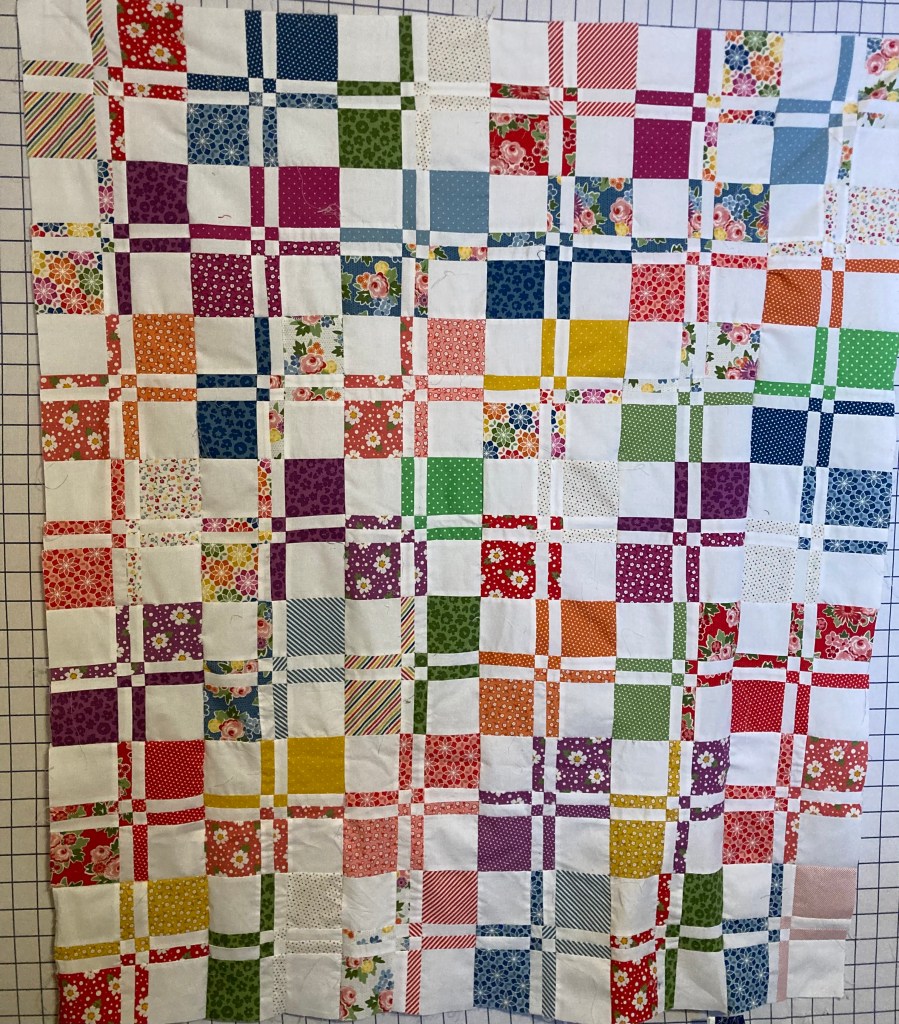
The fabric line is called Zinnias and the block is the “disappearing four patch. Celebrating spring and summer, the 47″ x 48” quilt is $150. The machine quilting and the backing are also floral.

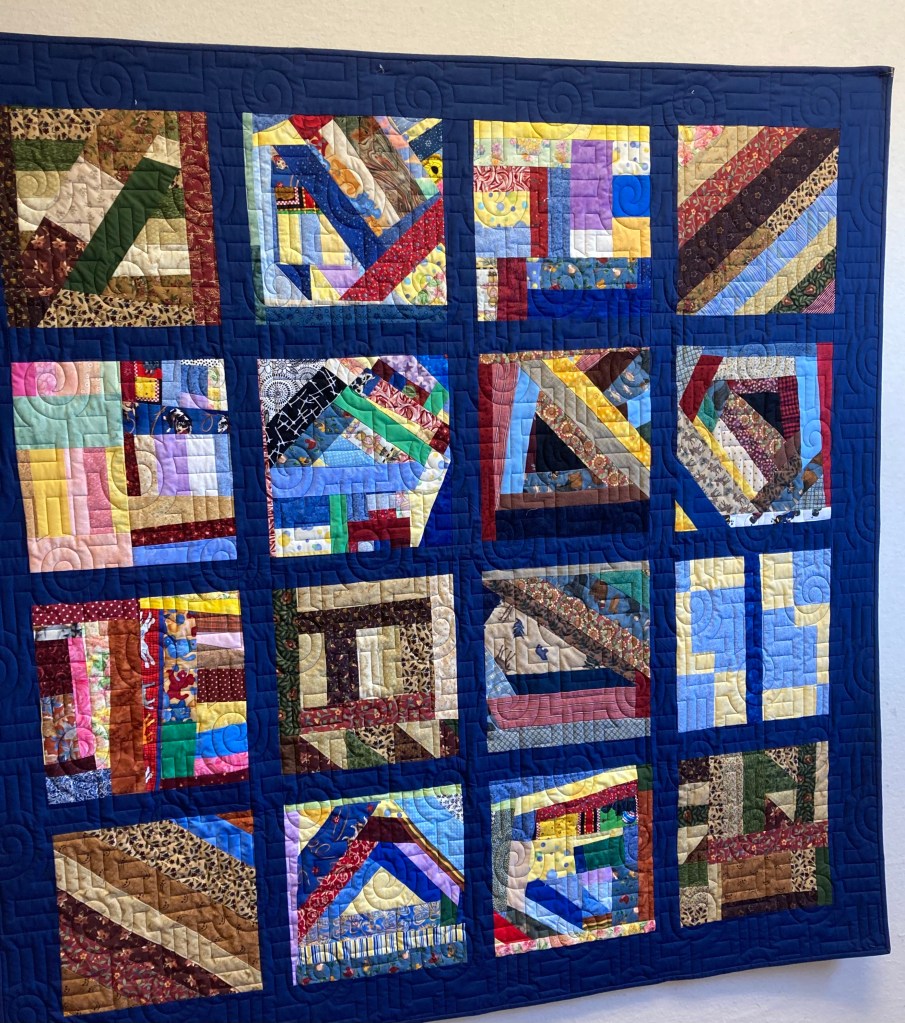
The blocks may be “wild and crazy” but they work together. Paulette set these donated blocks with a navy blue sashing in a four by four pattern. It is machine quilted with curves and sharp corners continuing the “wild and crazy” look. It is 60″ x 60″ and would make a great gift for only $150.

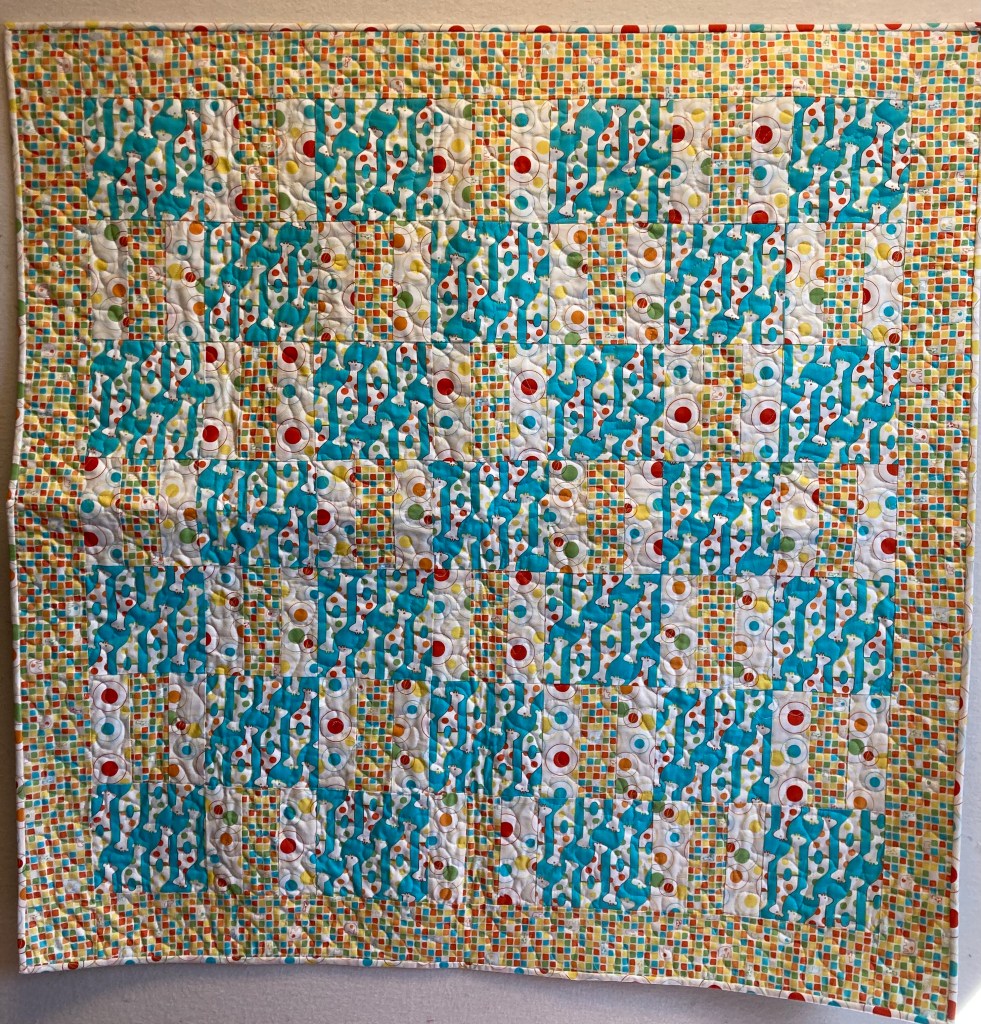
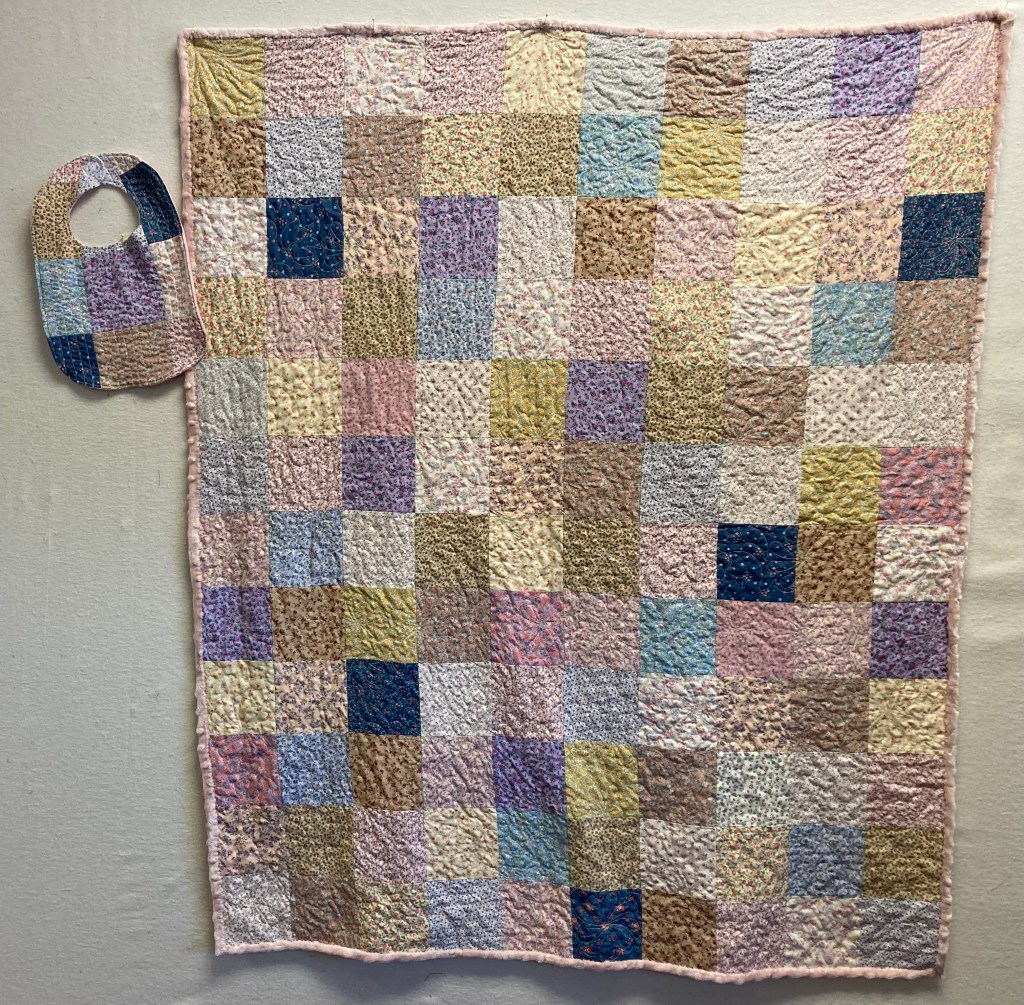
Three coordinating fabrics were used in this baby/child quilt. The backing is a cozy aqua flannel. It is machine quilted and hand bound. 47″ x 48″. $75

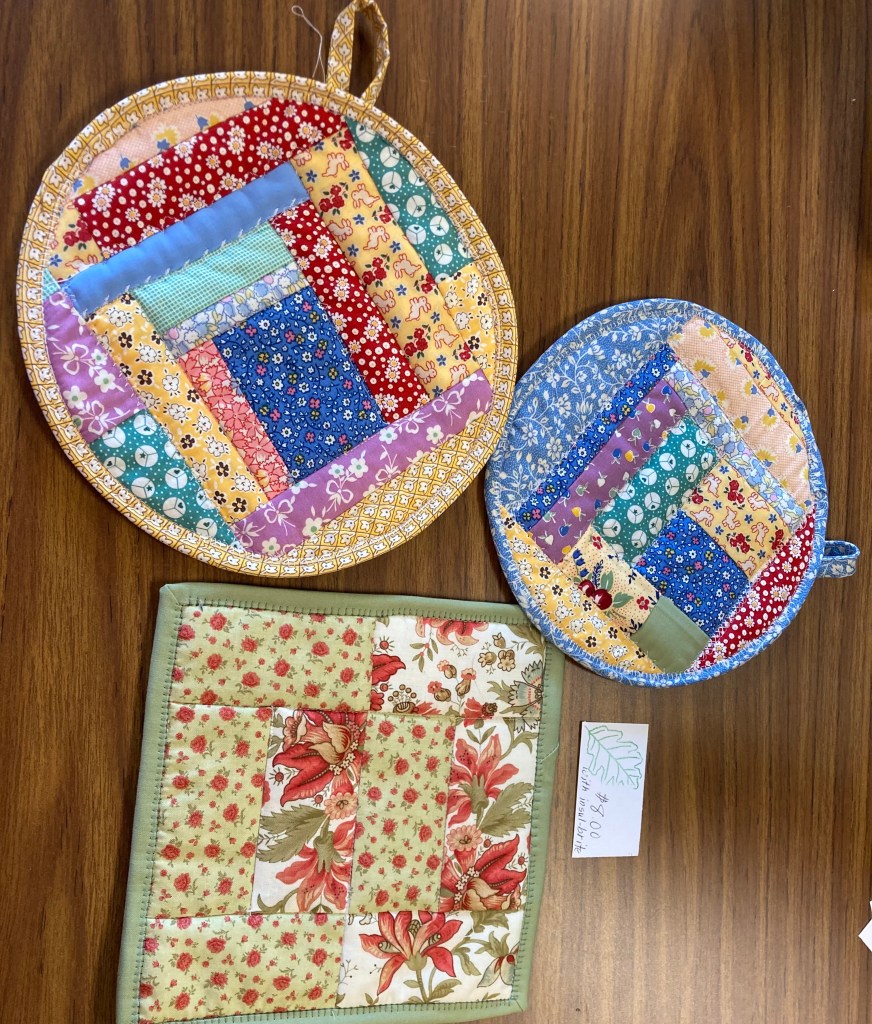
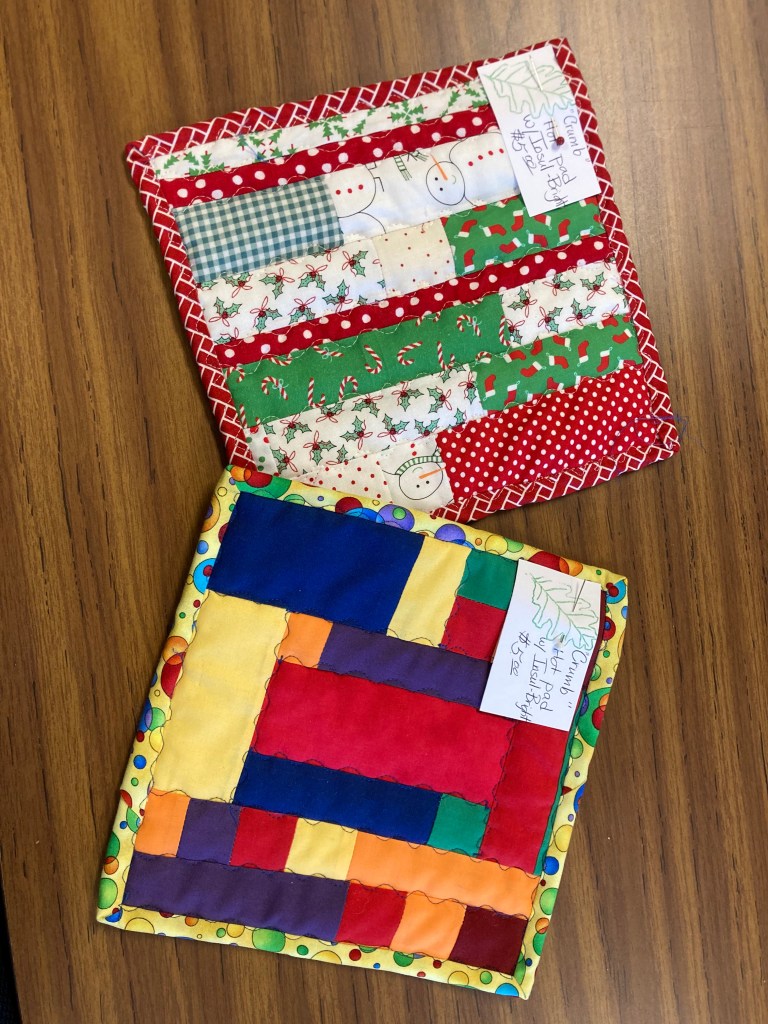
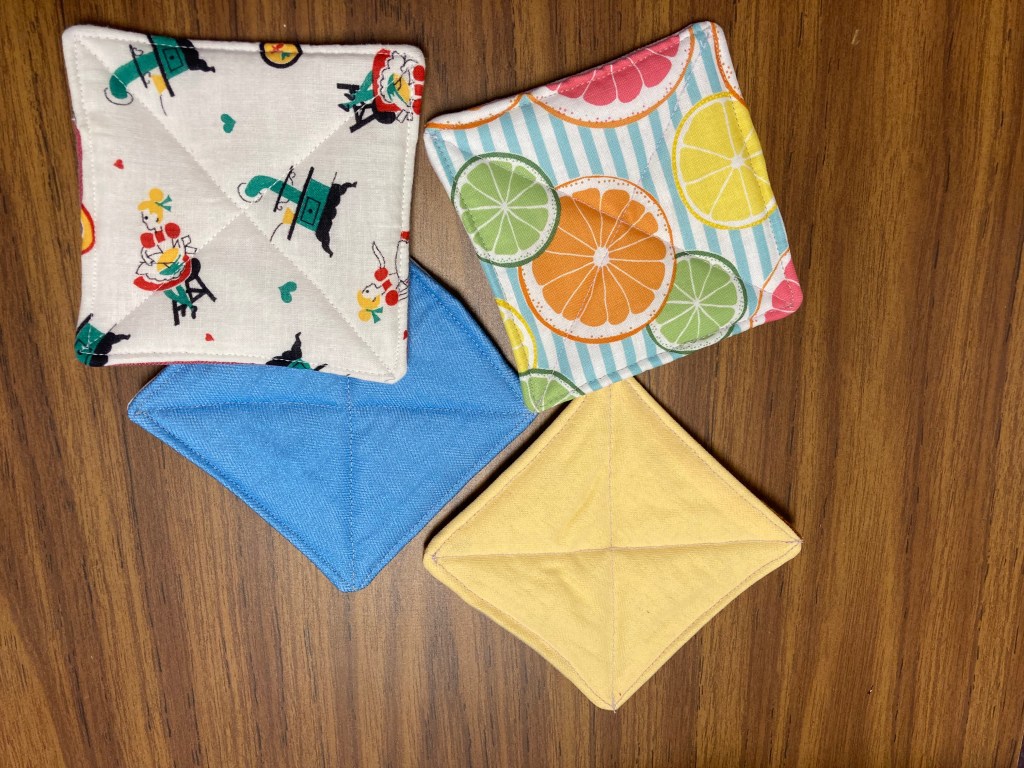
Do you use hot pads or trivets to protect you table top from a hot bowl or pan? The 8.5″ square trivets have Insul Bright as one of its layers, making it heat resistant. This is an example of “crumb” quilting. The very last scrap, no matter how small was used. Machine quilted and bound –$5 each

We have so much fun creating and sewing — and it is even more fun showing off our work . Thank you for being a reader.

.

Preparing for an Estate Sale

A friend of a friend recently ask me for tips on pricing her mother’s quilts for an estate sale. My only experience is pricing donated quilts for our annual Quilts Etc Sale in October and that is a group project—I am not a professional appraiser, but I shared some guidelines we use.

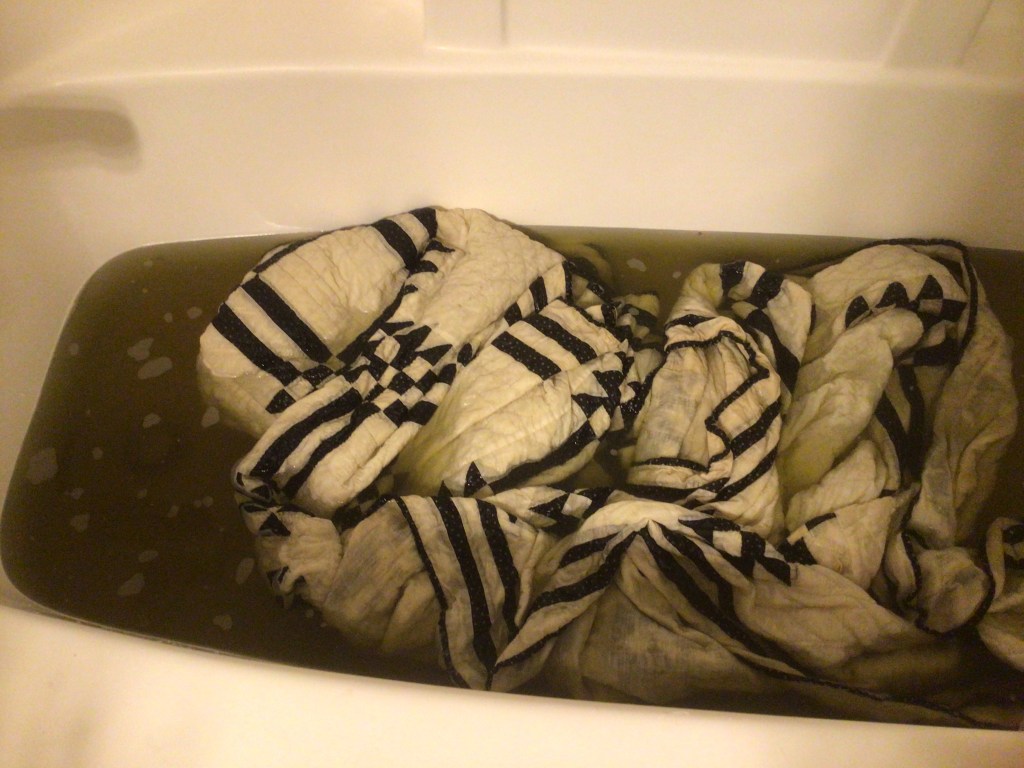
  1. What is the condition of the quilt? Are there stains, tears, worn edges? Some fabrics in a pieced quilt just wear out before the rest of the fabric. Don’t give up on stained or dirty quilts. A good soaking in the bath tub can do great things.

The gross photo is the quilt on the right being soaked in Soak overnight. There are several commercial soaps designed especially for vintage and antique linens. OxiClean can be used as well as recipes found on the internet. Rinse many times–a water soaked quilt is difficult to handle but patience is the key. Fill the tub with clean water, stir it around and let the water drain. Repeat!

At the very least, give the quilts a good airing over the deck rail to get rid of some that funky “old” smell.

2. How large is your quilt? That is not to say a pristine vintage baby quilt is not worth more than a shabby twin. A very large “cutter” quilt (more on that term later) is worth more than a small “cutter” because you can get more projects from it.

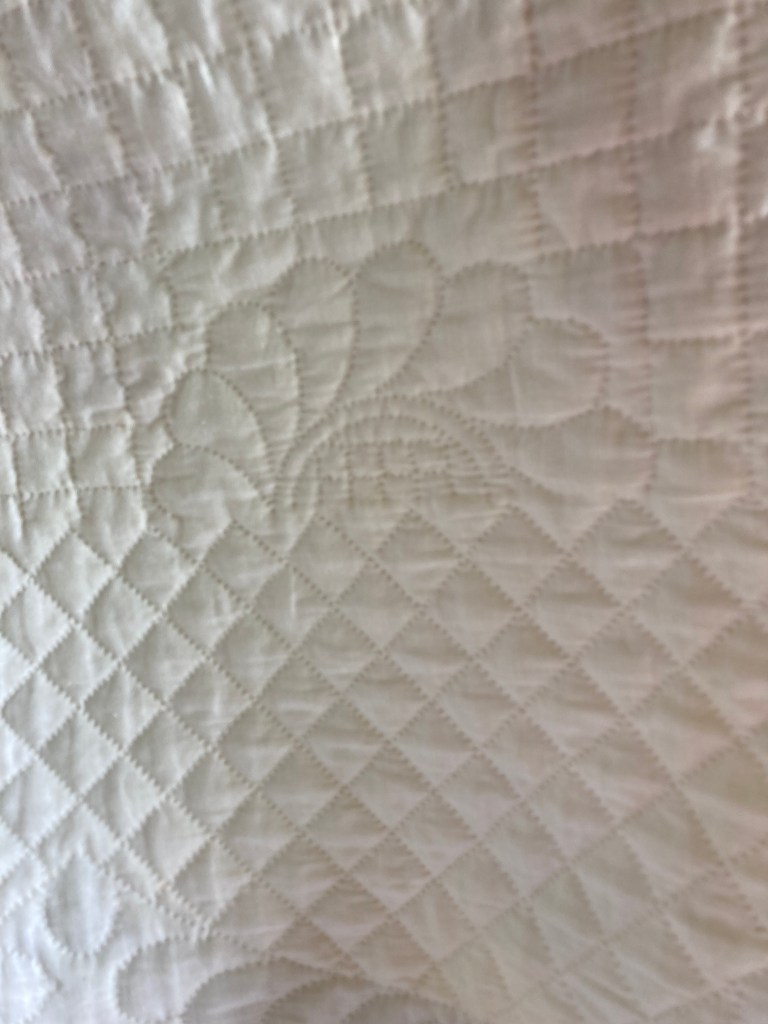
3. Is it machine or hand quilted? Usually, hand quilting bring more than a machine quilted project. If it is hand quilted, be honest about the quality of hand quilting. Just because it is an antique, it doesn’t necessarily mean the quilting was great.

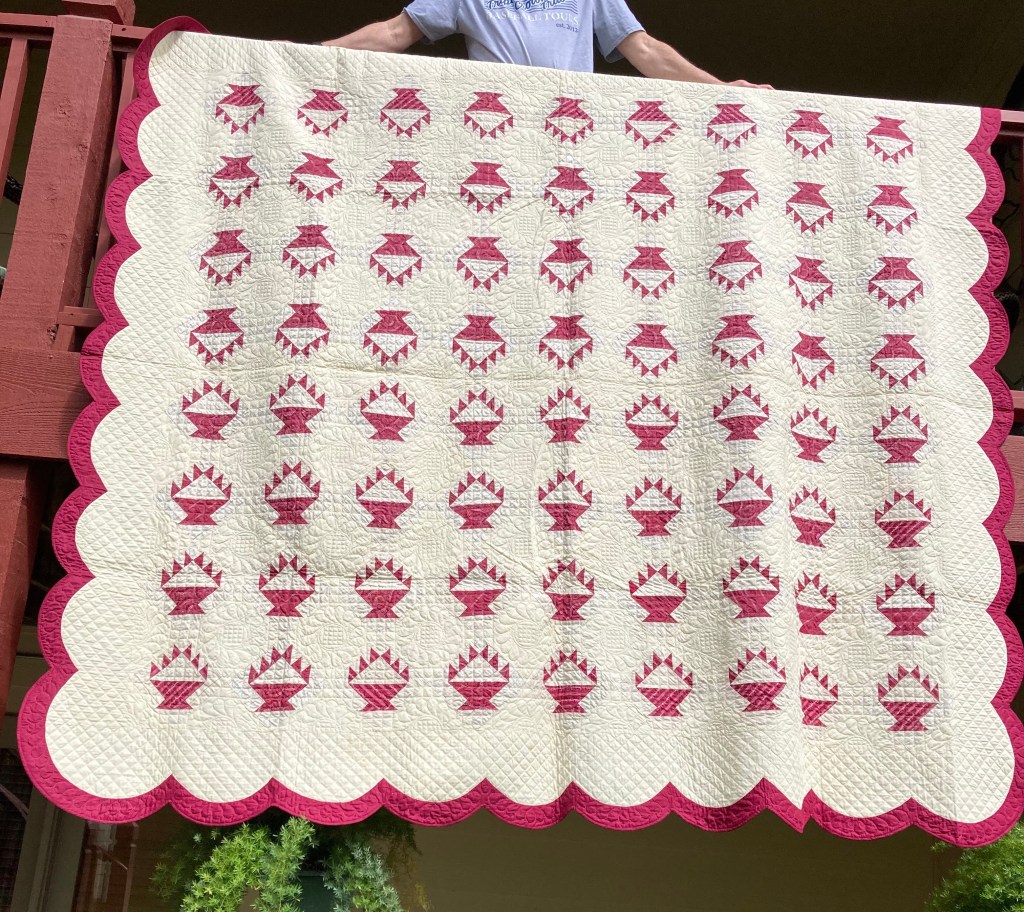
This quilt was sold for $400 –nearly perfect condition and look at the hand quilting. The stitches are small and even and the design is complex rather than an all over design such as Baptist Fan or Cross Hatch.

4. Are the colors and patterns attractive today? I have several quilts from my grandmother made in the 1950-1960’s ; pieced and quilted on a machine using garment scraps from that period. Very utilitarian but unless you are into that particular time period, not very attractive. But…….your tastes are different than others!

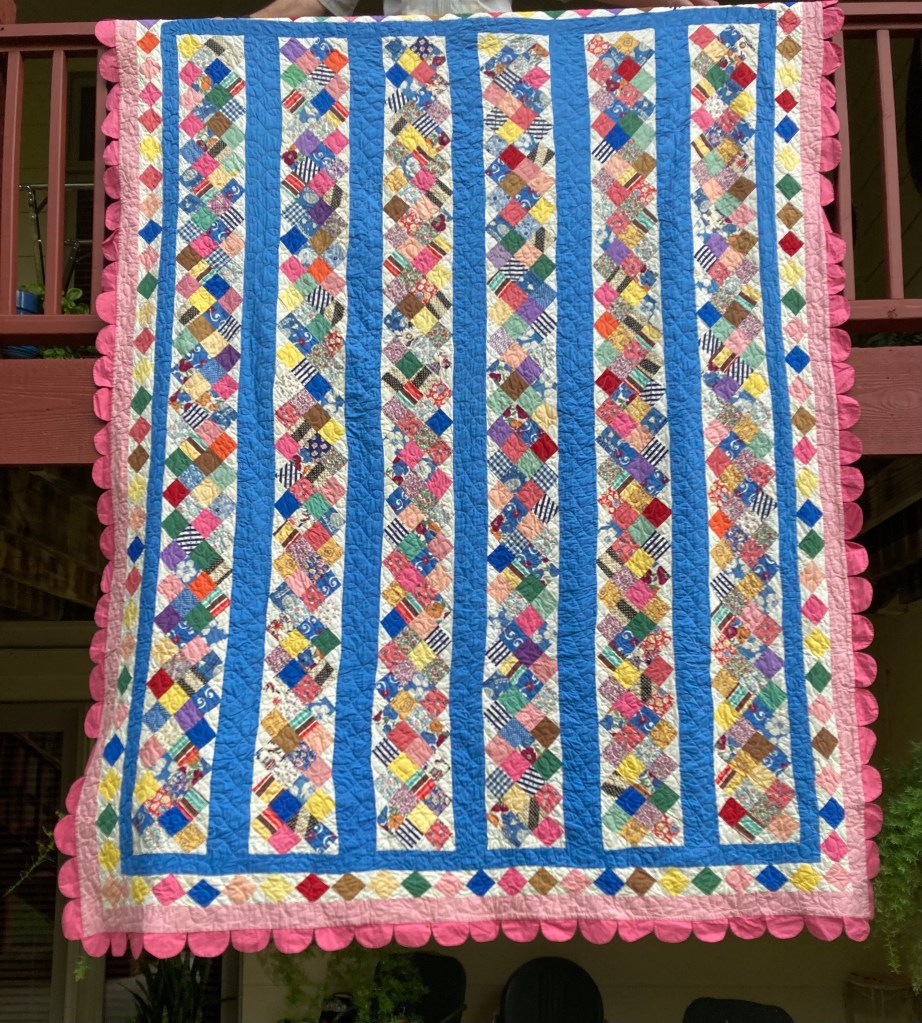
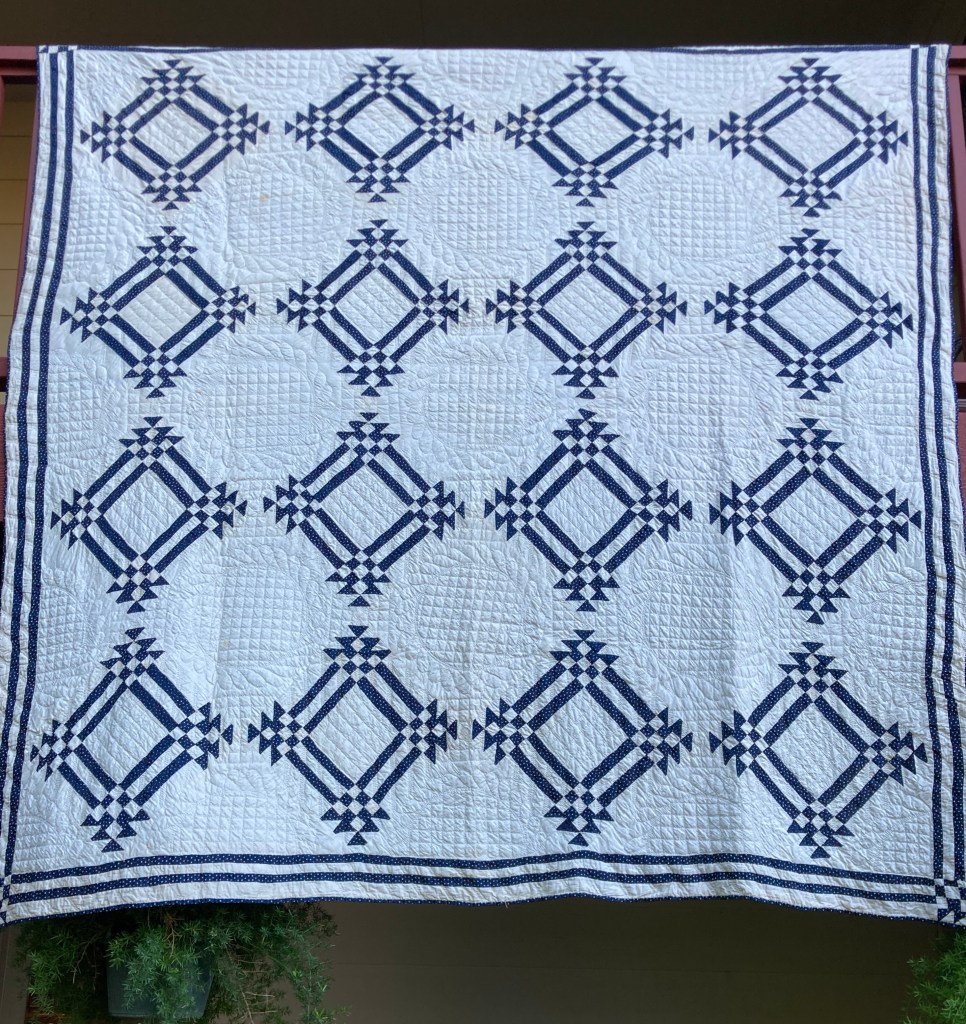
This vintage quilt was the first thing sold at the sale last fall by someone buying it for their teen daughter –at her request. She arrived early to snatch it up! I was really, really surprised–not my cup of tea!!

This quilt made almost a century ago would fit into a very contemporary bedroom. So price it accordingly.

4. Do you have information about the quilt? Proof of the date it was made? Do you have the story behind the creation—a “Hope Chest” quilt, a wedding gift or the maker. This is helpful in “upping” the price.

5. Where is the sale? How is it being advertised? Probably advertising that quilts are available will bring in a “buying” group. Will other vintage and antique items be for sale, also? I have friends that will drive a hour to purchase their “collectible” because they read online that it was available. Don’t post your prices on line though.

6. Did you know folks look for raggedy/worn quilts to make other items? The quilts that are in sad shape but have enough useable inches are called “cutters”.

Shirley made pillow covers, pennants and Christmas trees from one very loved “cutter

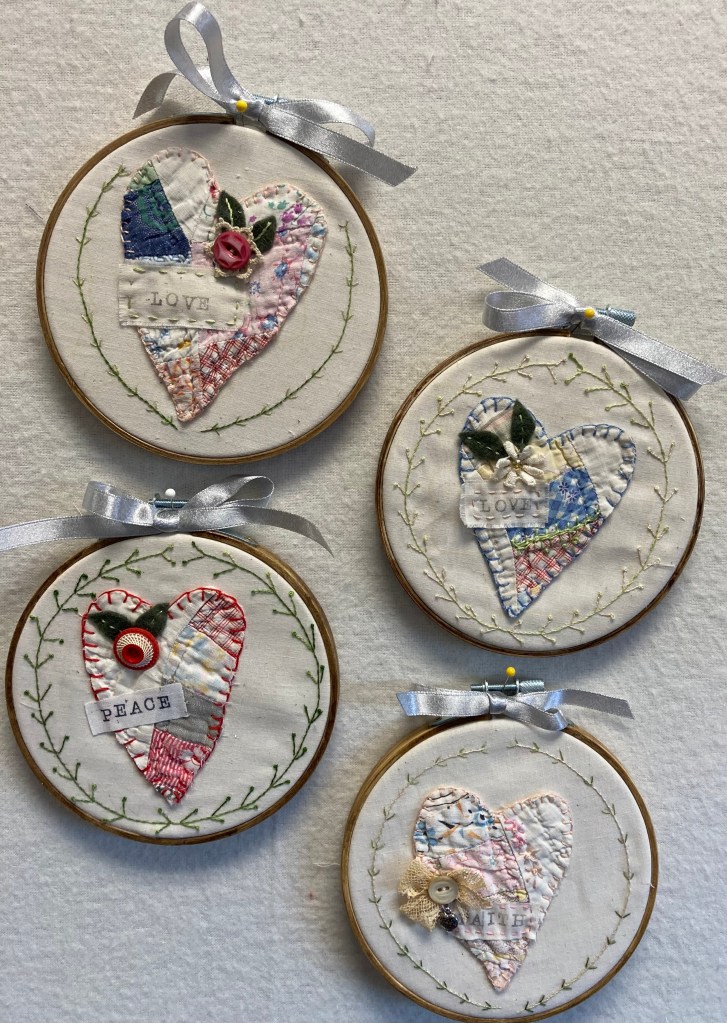
Diane used scraps from a cutter quilt to create wall art. She also embellishes some bibs cutter quilt hearts.

7. How badly do you want to get rid of your quilts? If you just want them gone after you have selected what ones you will be keeping (which I certainly hope you keep at least one!) Then price them to sell. It is an estate/garage sale. The prices should be a great deal lower that at a vintage shop. I was at a garage sale in my neighborhood this morning where the marked prices were much too high….didn’t buy anything. Folks expect bargains at these sales.

If you have storage room and don’t mind keeping them a while longer, price them accordingly.

Most of the quilts we receive at FUMC are in good to great shape and we have no incentive to store them so we price the quilts to sell. Any $$ for our cause is better than no money. We sell our super star quilts from $200 to $500. The cutters we receive are in the price range of $10 to $50.

Lastly, show off the quilts…maybe in a different way than most folks think about quilts.

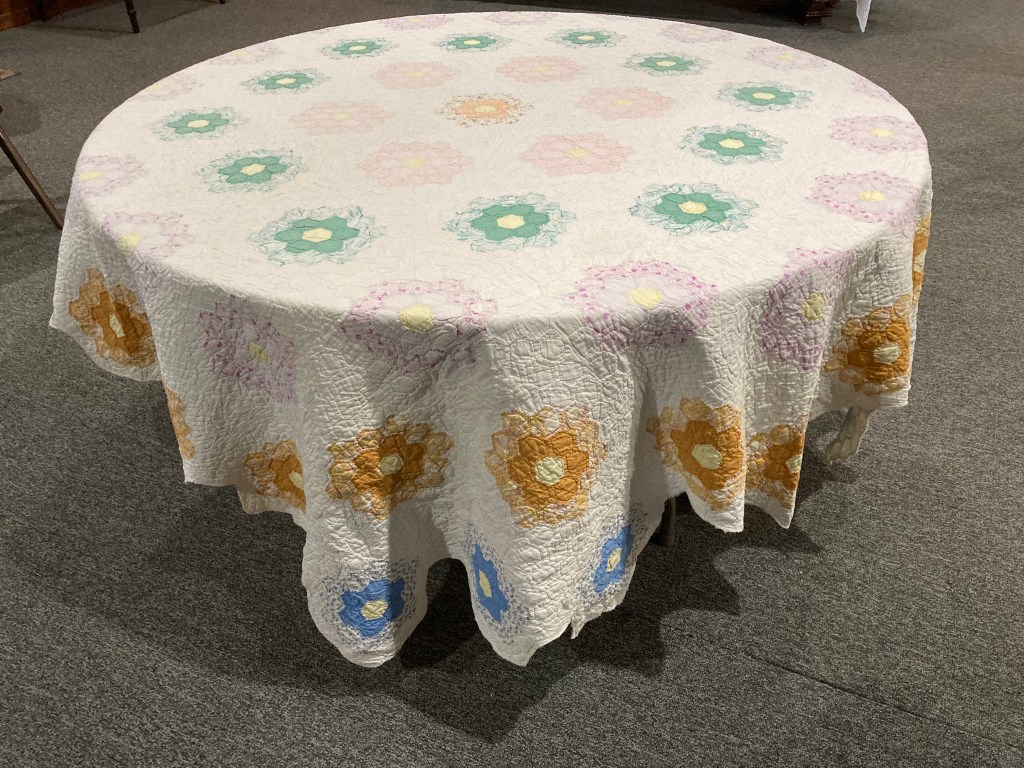
This very strange quilt was photographed as a table covering and snapped up immediately.

A quilt can have many lives. And just like us, the older we get the more interesting we become!

Remember we accept donations if you don’t want to go through the hassle of selling or you want to support a two great missions!

**********************************************************

I had been on vacation and missed a week of quilting. When I returned my fellow quilters had a table full of finished projects.

This Spring/Summer quilt is 72″ x 80″ $200

“Racing”. 42.5″ x 55.5″. $125

Rail Fence Adaptation. 48″ x 58″. $125

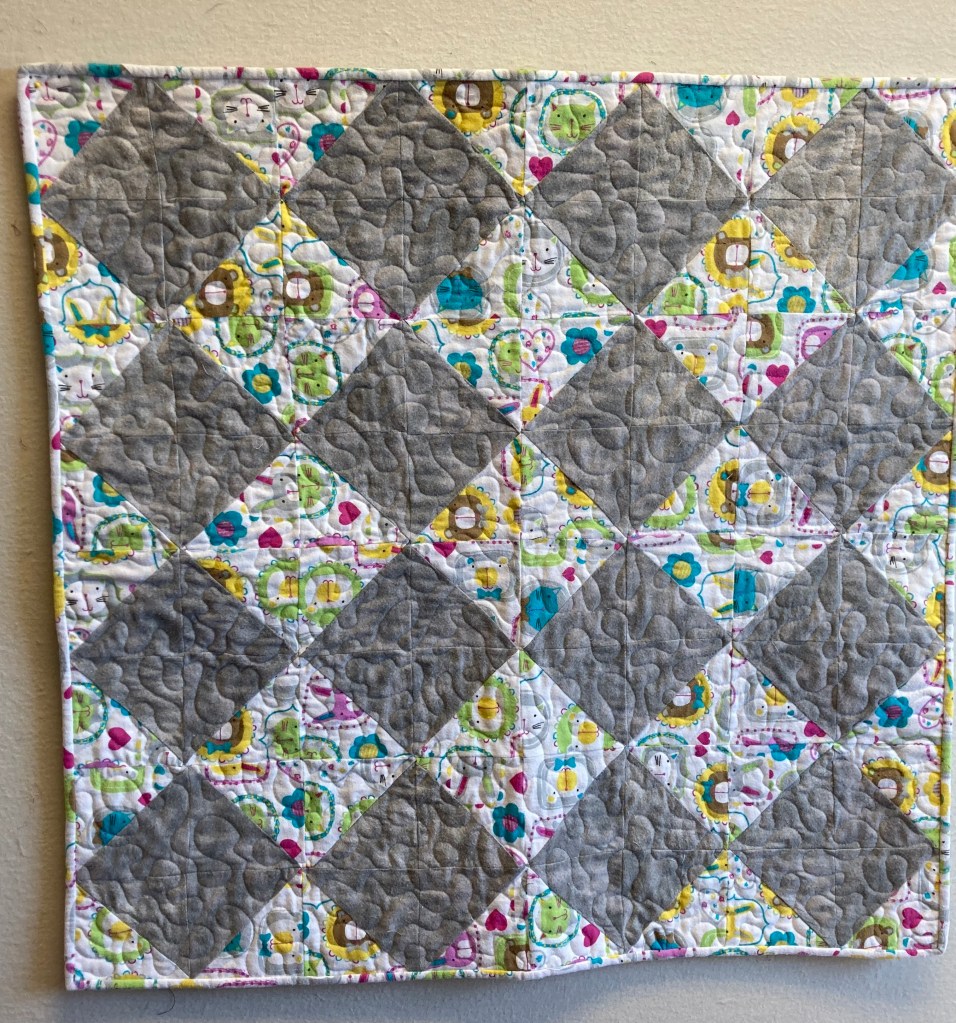
Flannel baby quilt. 34″ x 35″ $40

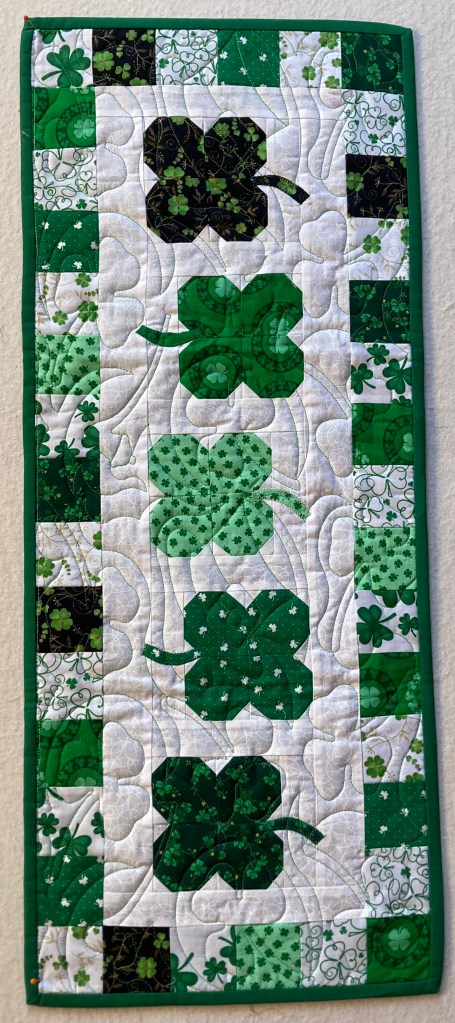
Luck of the Irish table runner

12″ x 30″. $40

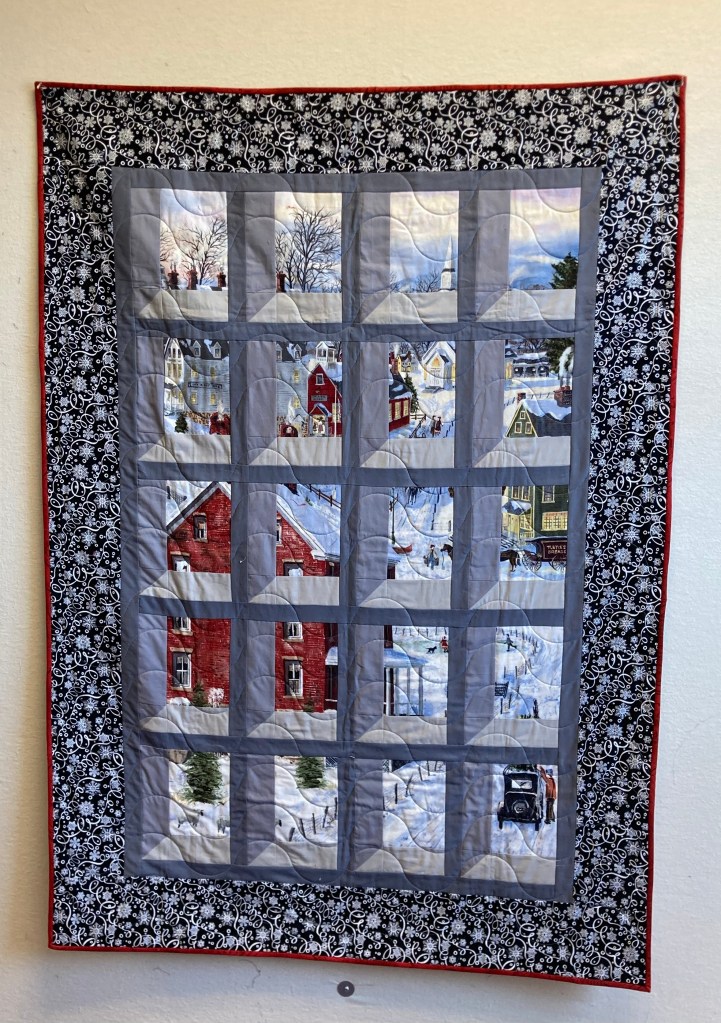
Winter Scene through a window. 43″ x 60″. $125

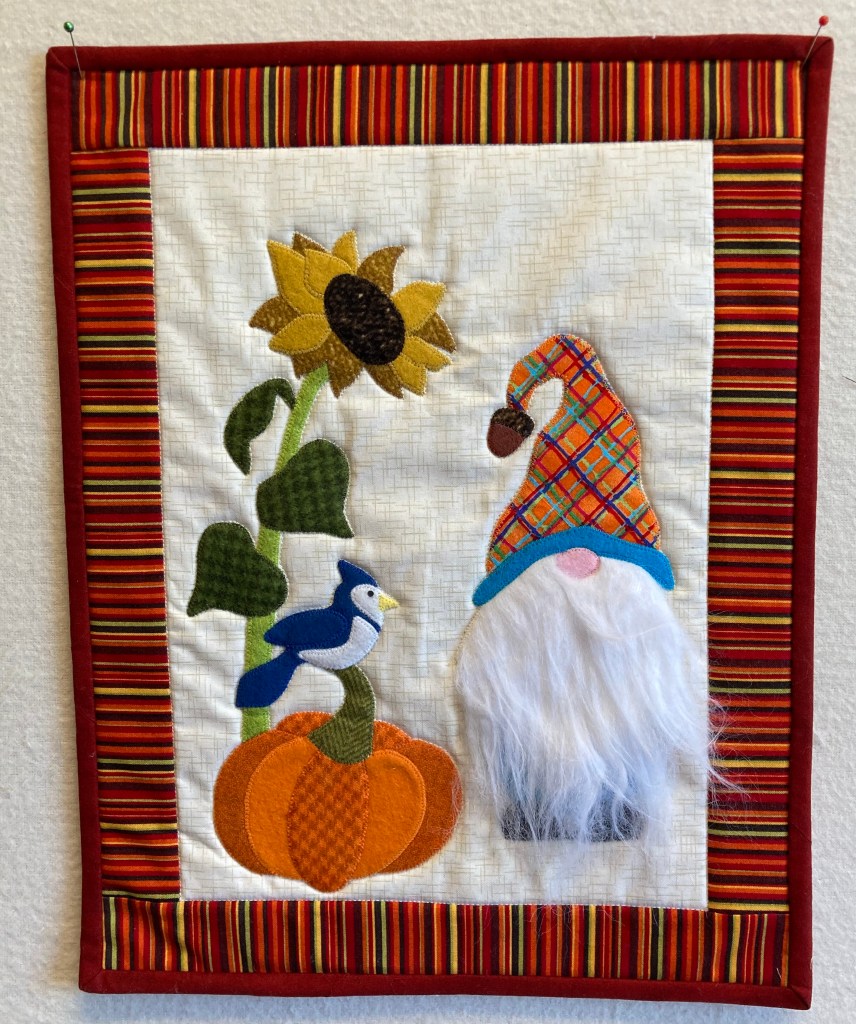
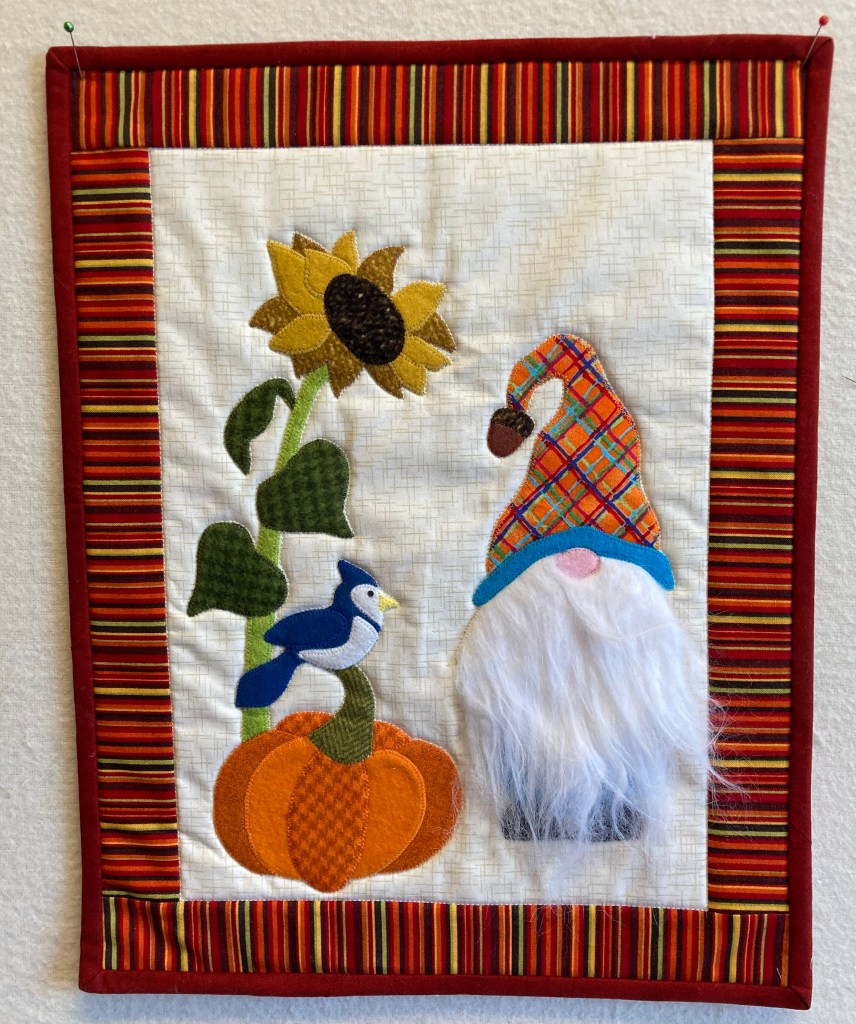
A Gnome, a pumpkin and a blue jay

12.5″ x 16.5″. $45

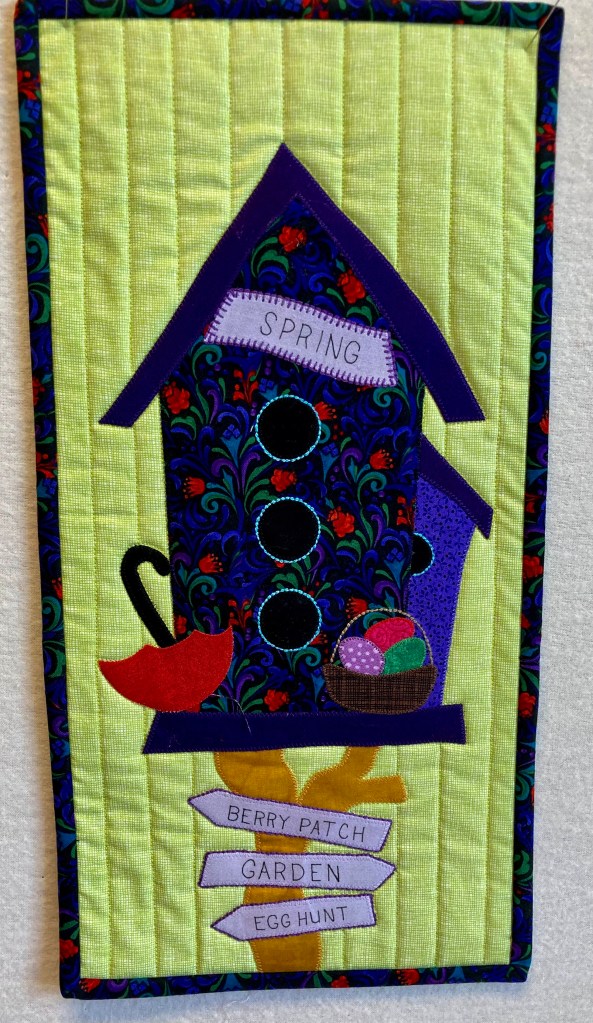
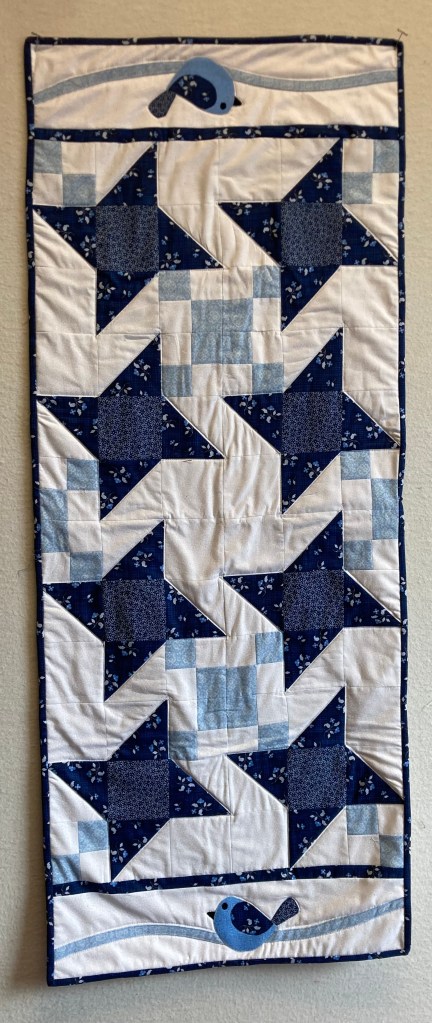
Spring-Bird House 9″ x 15″. $40

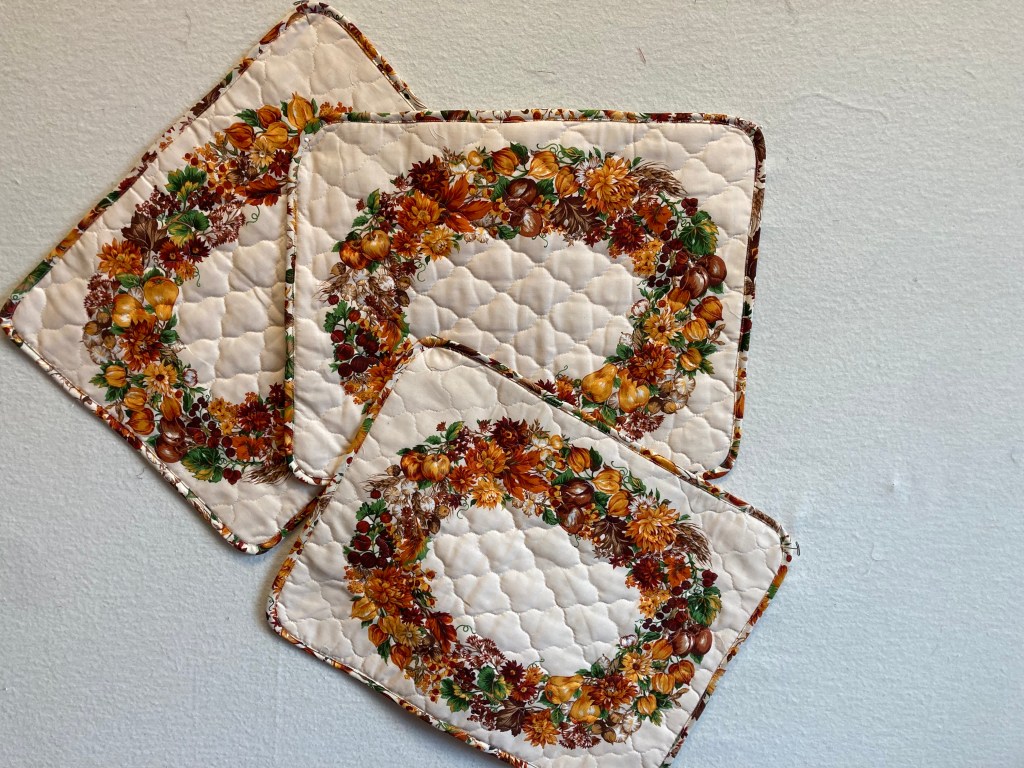
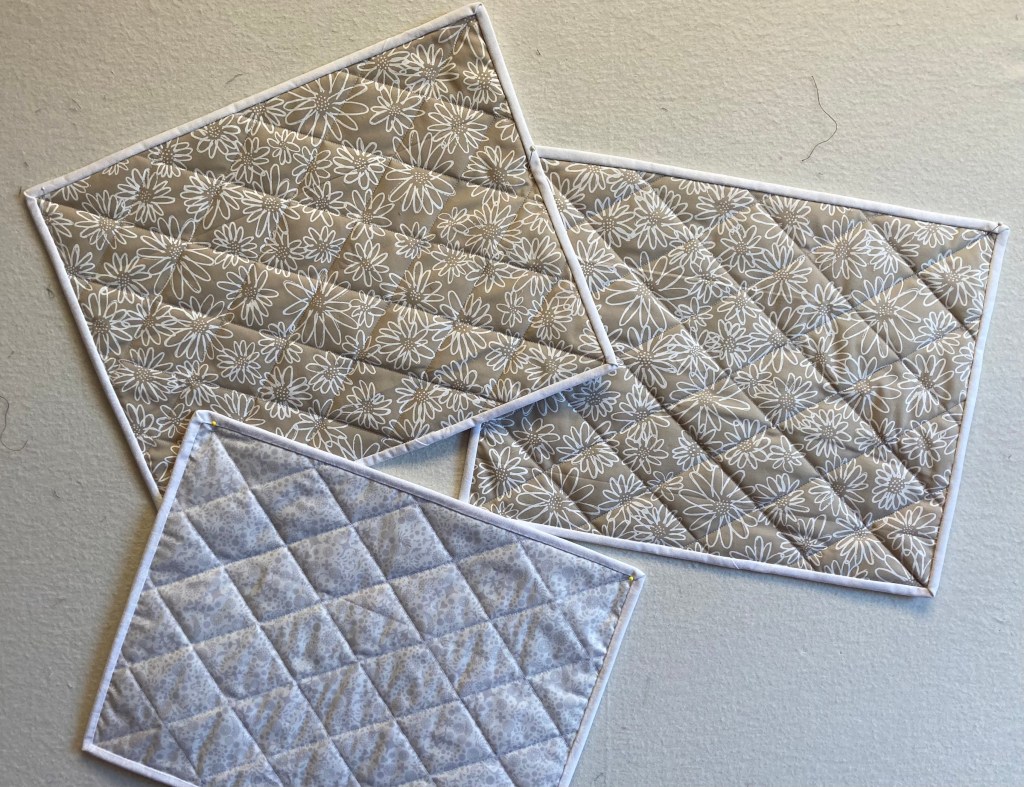
Neutral Floral placemats. 14″ x 18″. 4 for $40 or 8 for $70

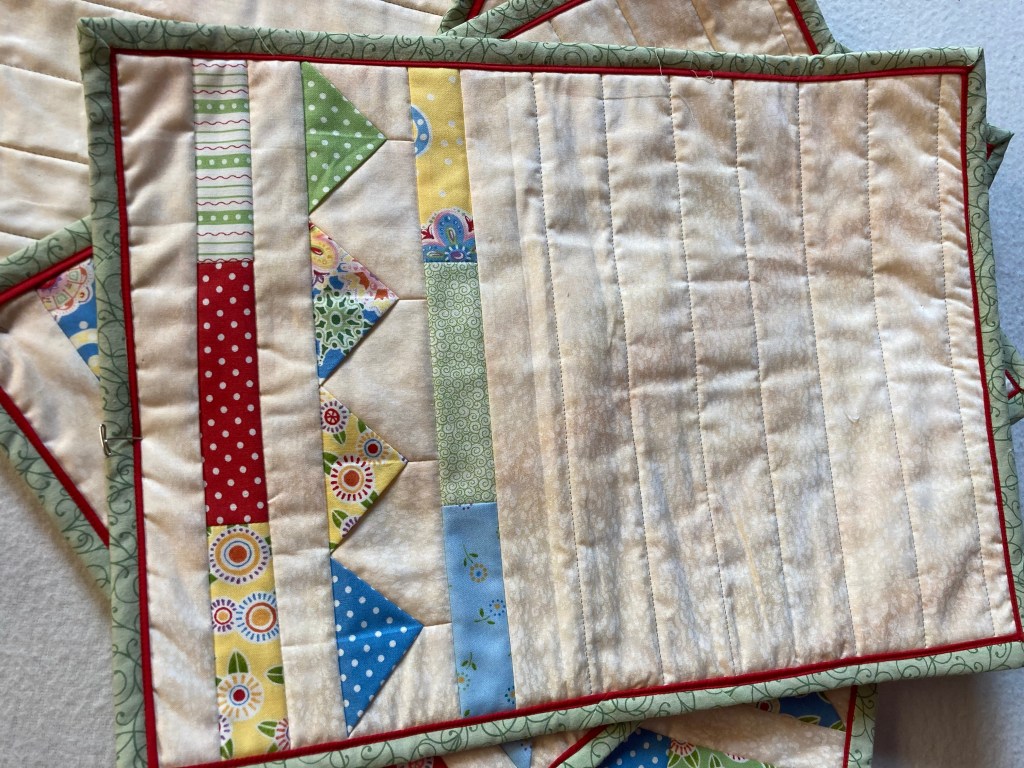
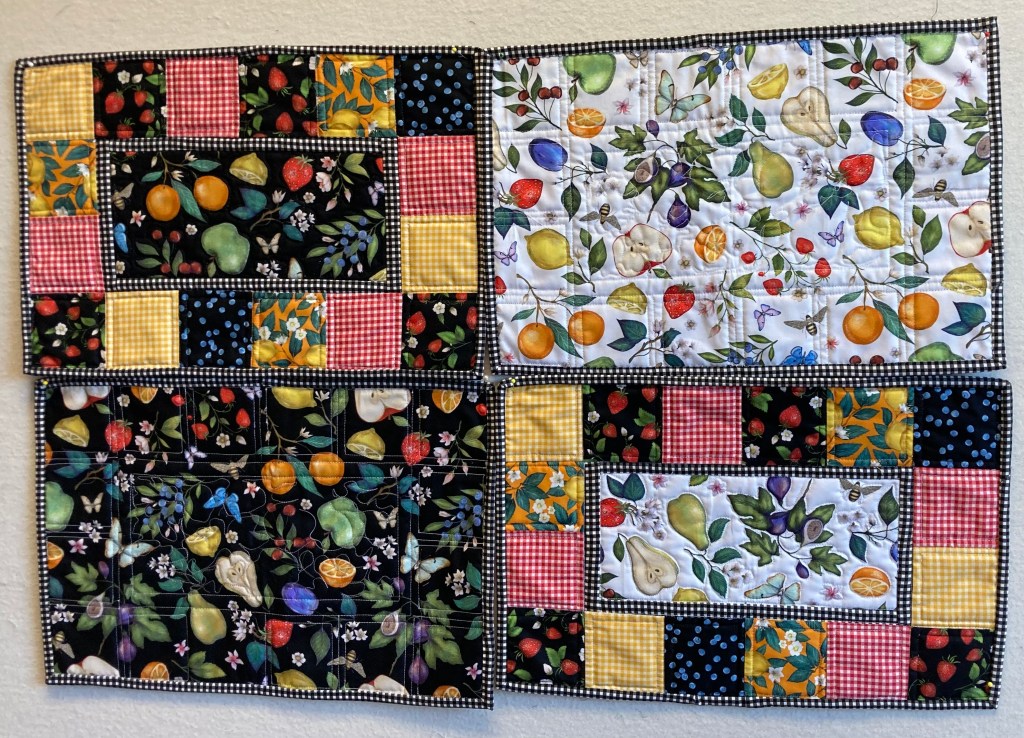
Four summer placemats–two have white print backing and two have black print backing. 4 for $40. 12″ x 18″

12″ x 18″. 4 for $40

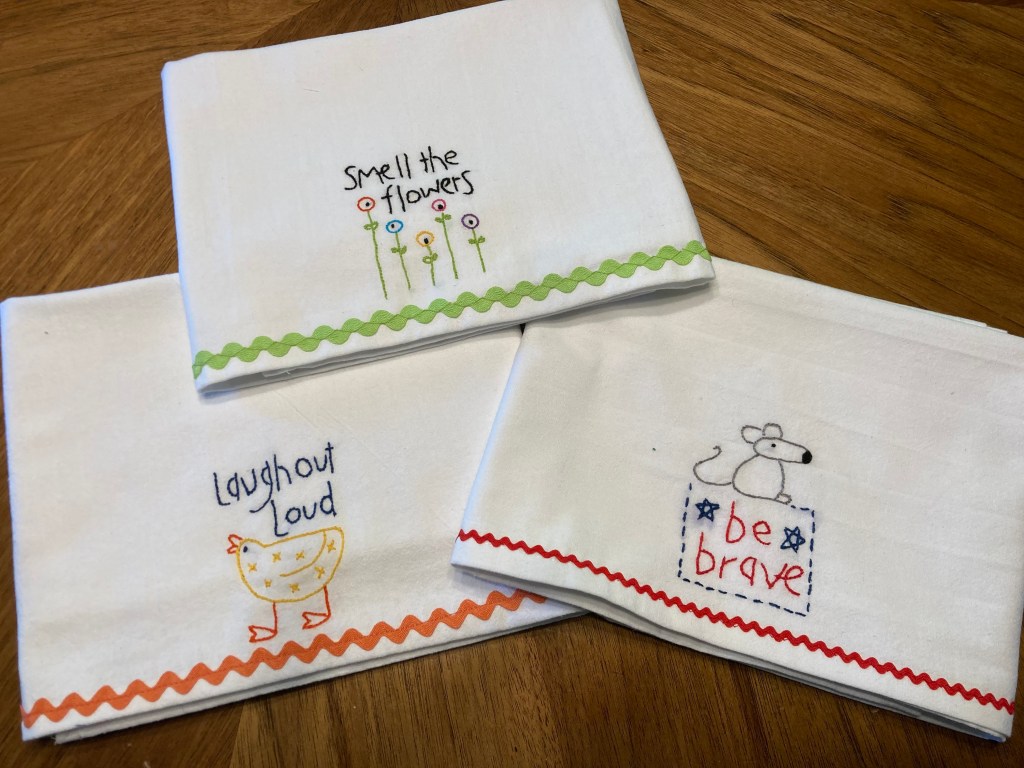
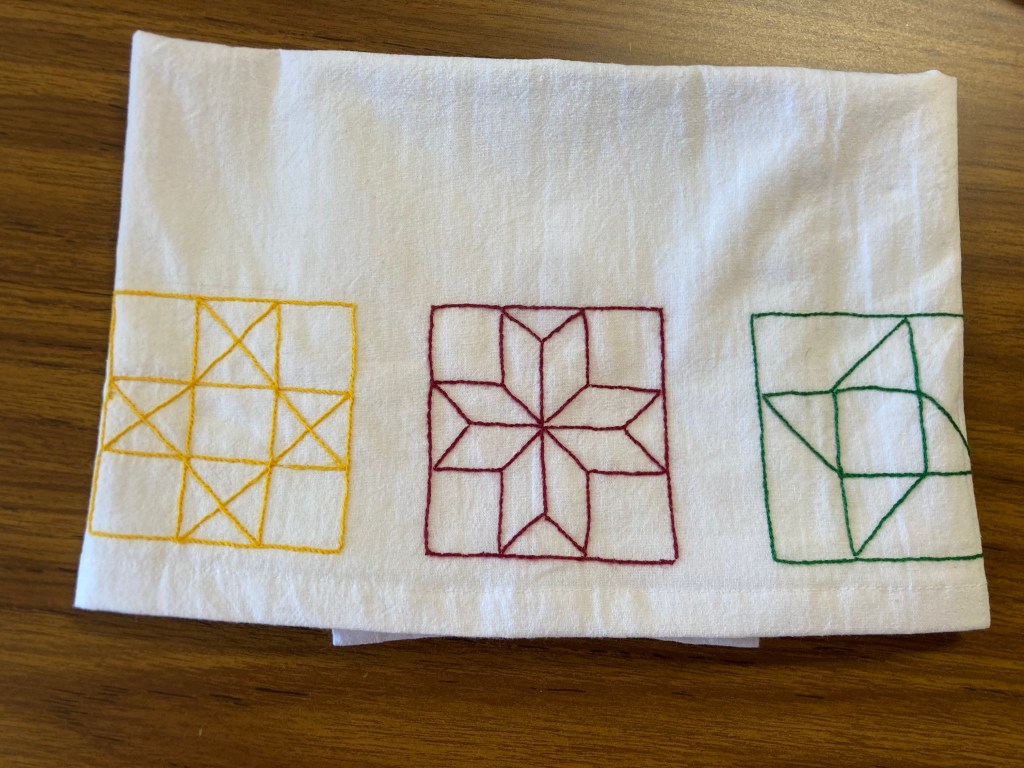
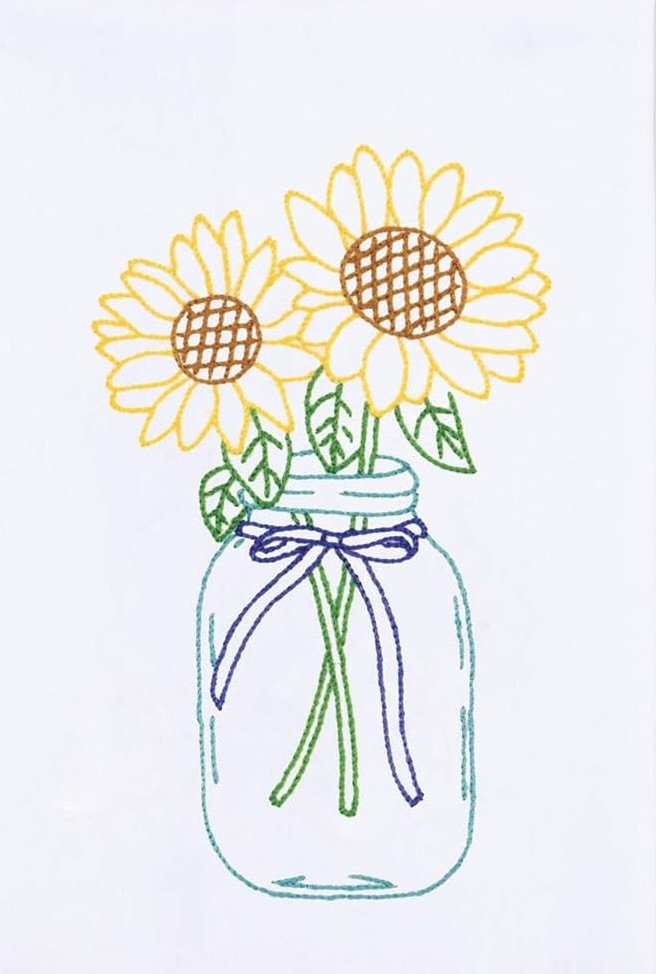
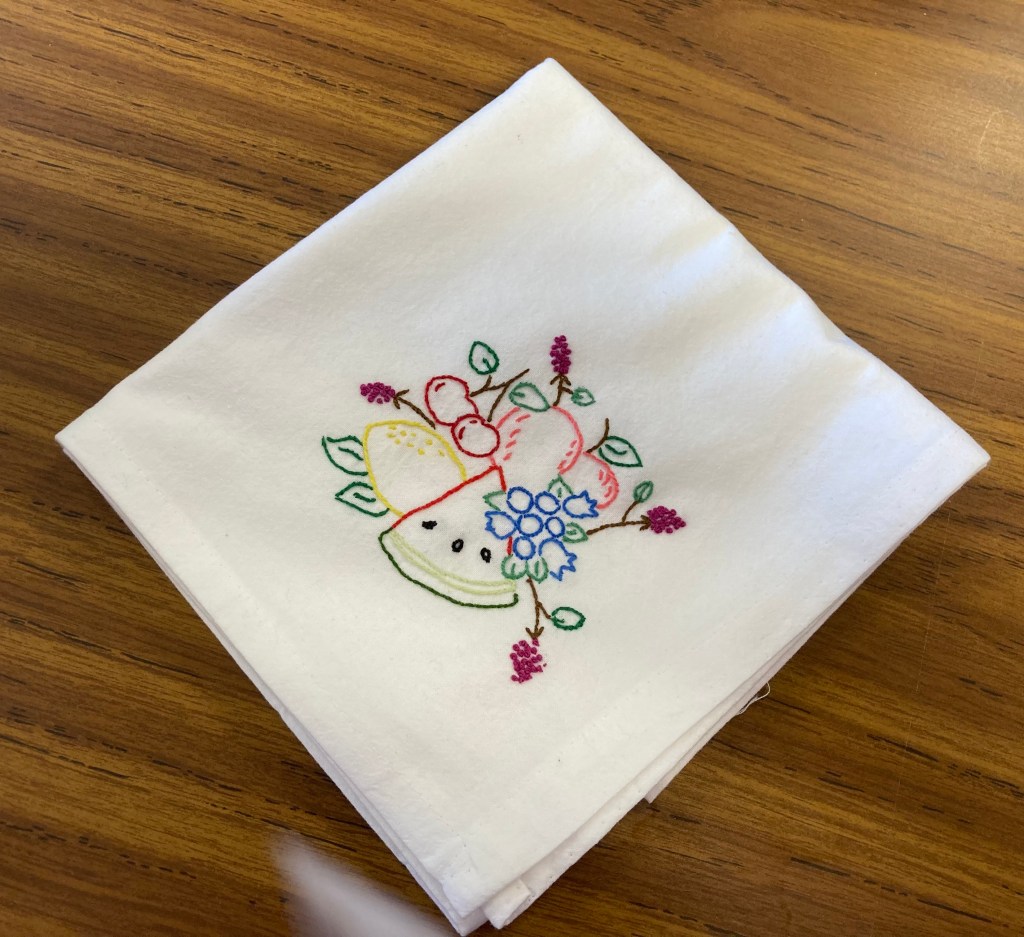
And another hand embroidered all cotton tea towel! $8

In Honor of National Quilting Day

Did you know that tomorrow is National Quilting Day? Like any holiday, it is observed many different ways. Local quilt shops may have special sales. Some well- know bloggers, fabric designers and pattern creators have “give aways” or drawings. Some guilds promote hanging quilts from porches or having quilt shows in public parks or gardens.

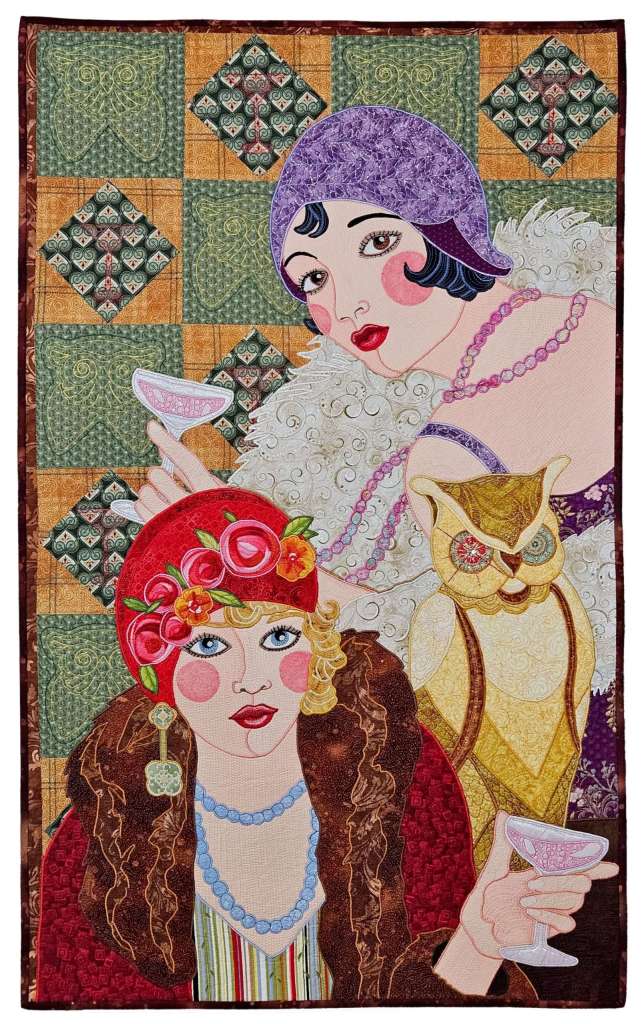
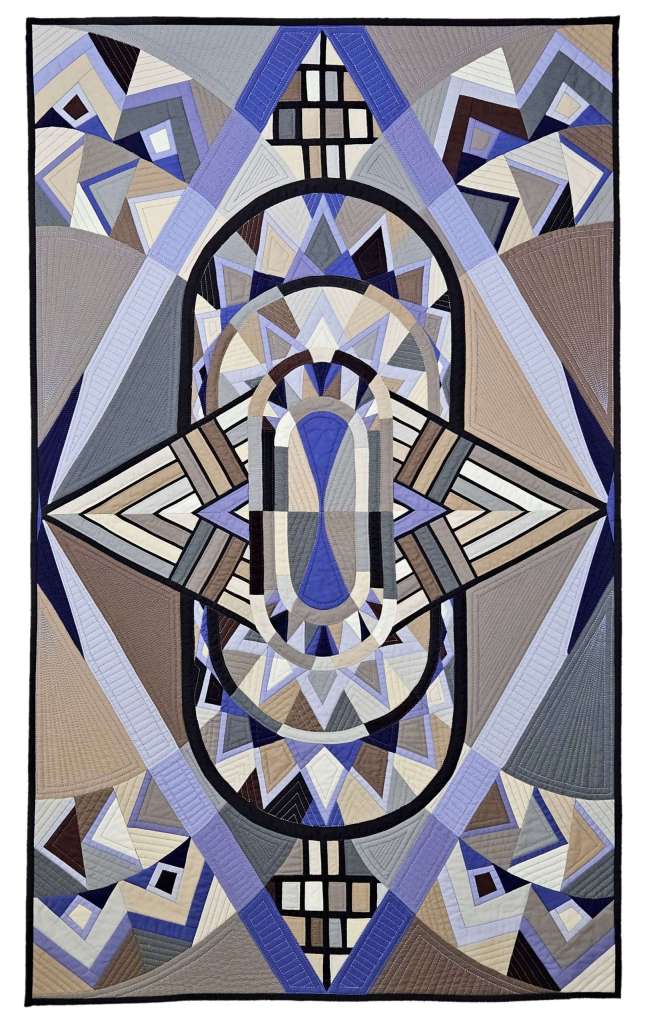
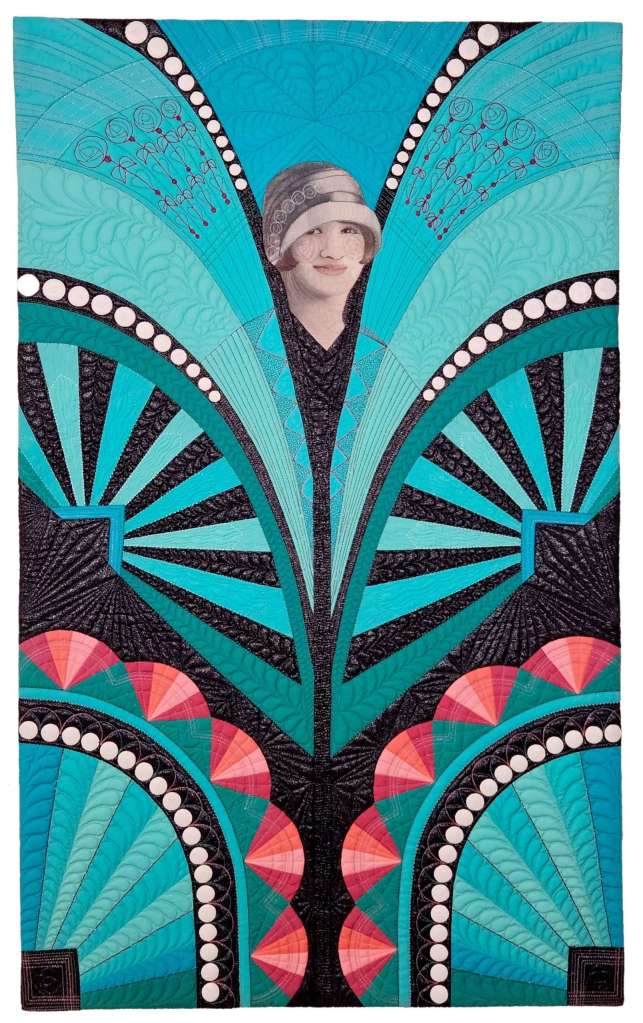
The National Quilt Museum (NQM) organized an international contest of originally designed quilts based on the Roaring Twenties and a traditional block pattern to celebrate National Quilting Day. If you are lucky enough to be in Paducah, Kentucky-home of NQM, anytime before the first of August you can see the winning entries along with other awesome exhibits.

(The winners in the Roaring Twenties 2024 quilt contest)

When I was doing some internet searching about National Quilting Day, I discover a fascinating quilting group—the Quilt Alliance, a non-profit organization “with a mission to document, preserve and share our American quilt heritage by collecting the rich stories that historic and contemporary quilts, and their makers, tell about our nation’s diverse peoples and their communities”. This group recognizes quilt making as an “important American grassroots art form”. This group has over 1,200 recorded quilt interviews and stories and over 60,000 quilts documented! Printed interviews may be found on their web site, quiltalliance.org. But what I found most helpful was the page labeled “Three Key Steps to Documenting a Quilt”.

My husband is a dedicated genealogist for his and my families. He has collected reliable birth and death dates. He has dates of weddings, military service and careers. But I tell him over and over, it is the stories about these people that are important; that will keep our ancestors alive in our memories. We quilters have histories and stories we need to document. Documented quilts will be invaluable to future generations with whom we want to connect and add personal ties to those heirlooms.

Here are the three steps—if you made the quilt, purchased the quilt or was gifted the quilt.

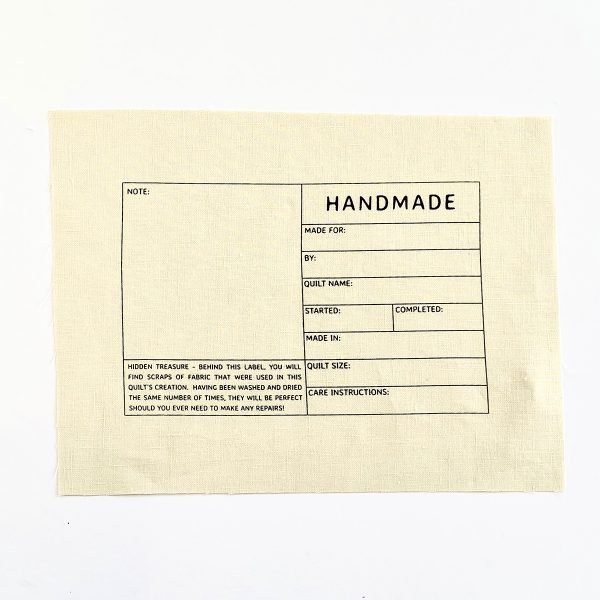
  1. Label the Quilt. At the very least include the maker, the date and the occasion–wedding, birth, graduation. The label in the photo asks for many more details. If it is a gift or made to be sold, care instructions are helpful. Look on Pinterest —there are hundreds of label examples. AND if your gifted or purchased quilt did not come with a label, you can make one or request one made.

2. Take photos of the quilt–front and back and if possible with the maker. I was gifted the Sunbonnet Sue blocks from a member of our extended family. We don’t know who made the blocks but the fabric used dated back to the 30’s. The appliqué was so well done that I felt it had to be hand quilted. This is a photo of the three hand quilters with the finished quilt. Persons who purchase quilts at our Quilts Etc. Sale often want to know who made the quilt..is it one of their church or book club or neighborhood friends? I am going to start offering to take a photo of the maker with the quilt.

Step 3–Write down your quilt’s story. This might take time when you would rather be sewing! But just imagine how excited your great granddaughter would be to read why you chose the pattern and color combination of her inherited quilt.

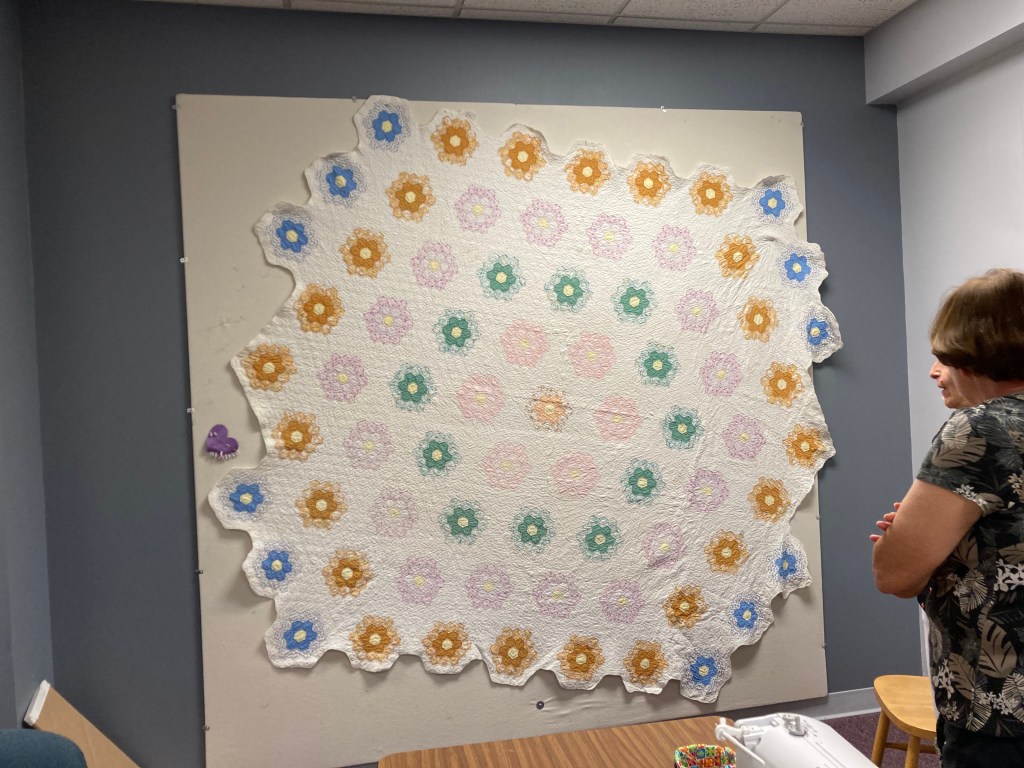
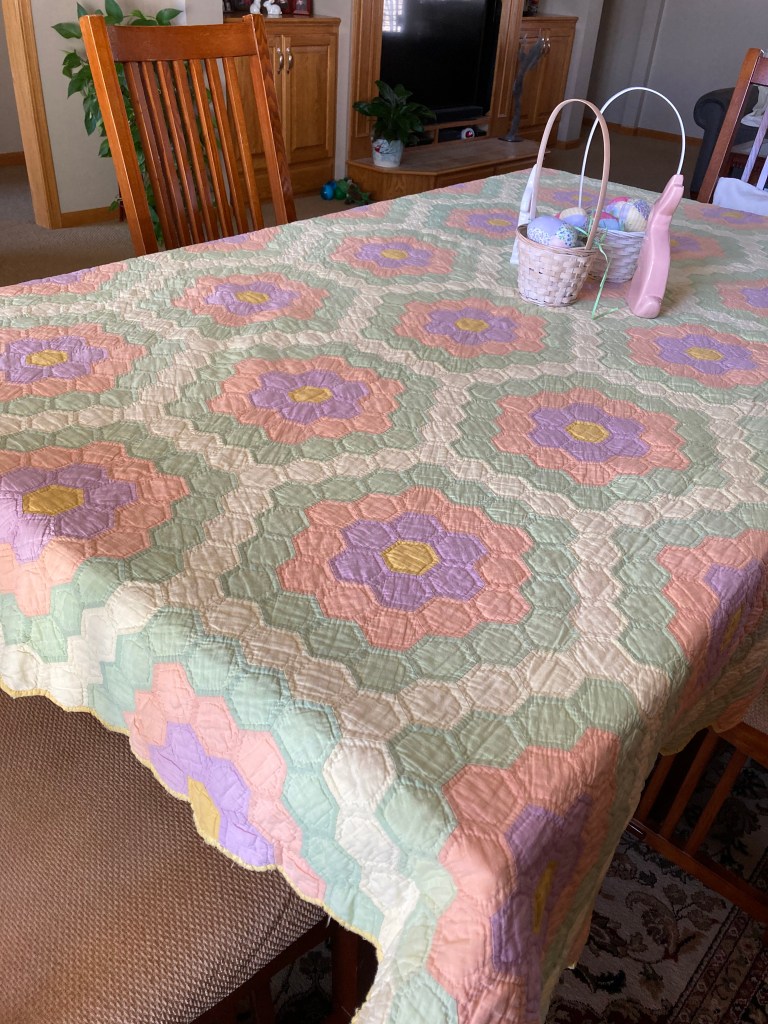
I purchased this quilt at a farm sale. The owner did not know where and when his late wife had purchased the quilt. Every spring when I bring this “flower garden” out, I wonder about the maker. It isn’t a scrappy quilt–the fabric was purchased especially for this quilt. But the fabrics suggest it was between the 1920-1940s, when many experienced financial hardships. What was the occasion? Was it in a “Hope Chest”? Did a group of quilts meet weekly around a frame to hand stitch around each hexagon?

For each quilt, include at least the date, maker, occasion, the pattern’s name, the fabric and batting used, care needed and any special story that goes with it. For example, why is there a National Parks Panel in the back of this quilt?

The quilt was made for my oldest grandson–we spent hours picking out the green fabrics for the pattern he had selected. As we were leaving the quilt shop, he noticed the National Park panels for sale. He had to have it in his quilt. Really? The compromise was to include it on the back. That story needs to be included in the documentation of this quilt, otherwise the nod to National Parks might seem a bit odd.

Confession is good for the soul–right? I haven’t been good about documentation. In fact, I feel very hypocritical writing this post. Maybe I have convinced myself to do some recording of quilt information in honor National Quilting Day..maybe.

************************************************************************

New projects for Sale:

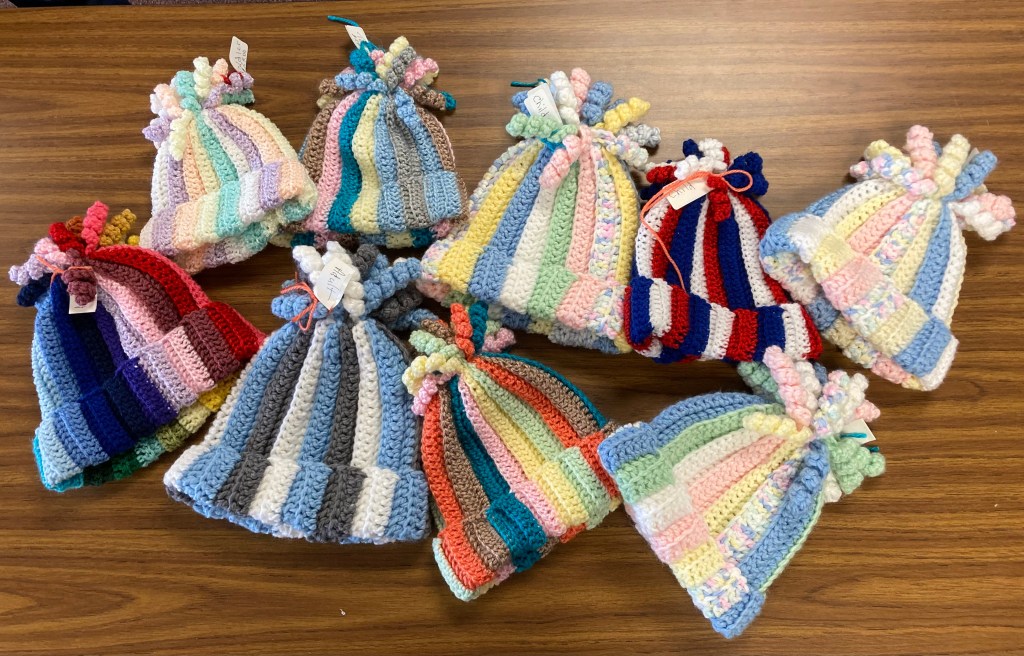
Hand crocheted hats in all sizes–from infant to adult. $25 each. The maker has promised to make more, so keep watching for new color combination.

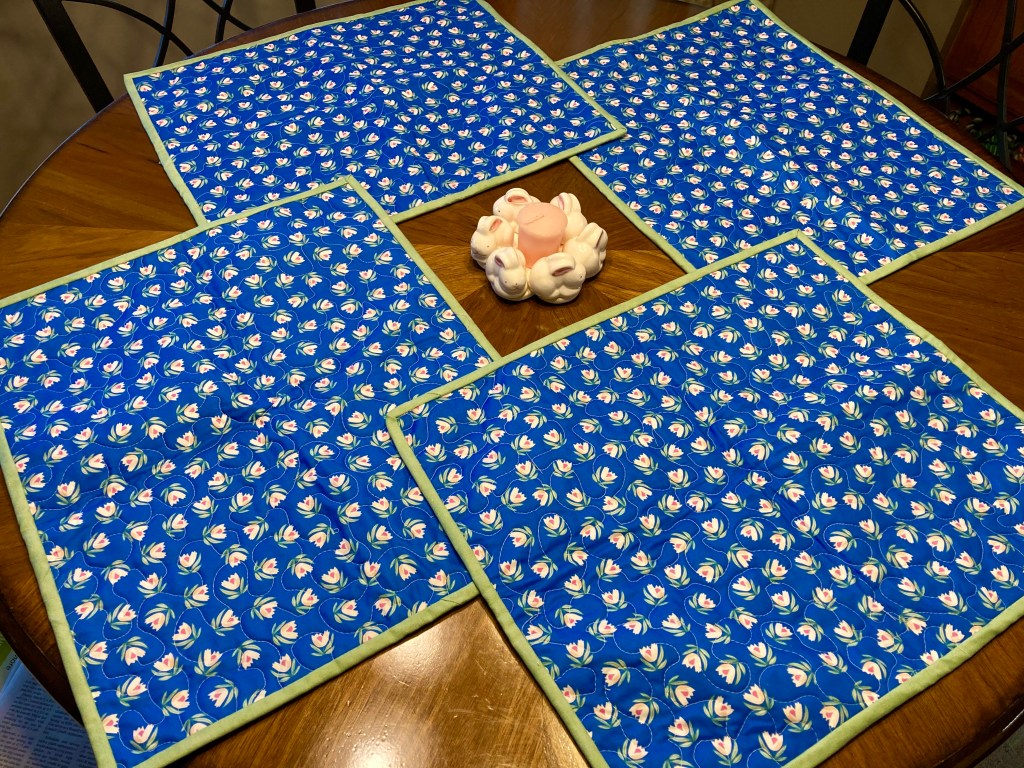
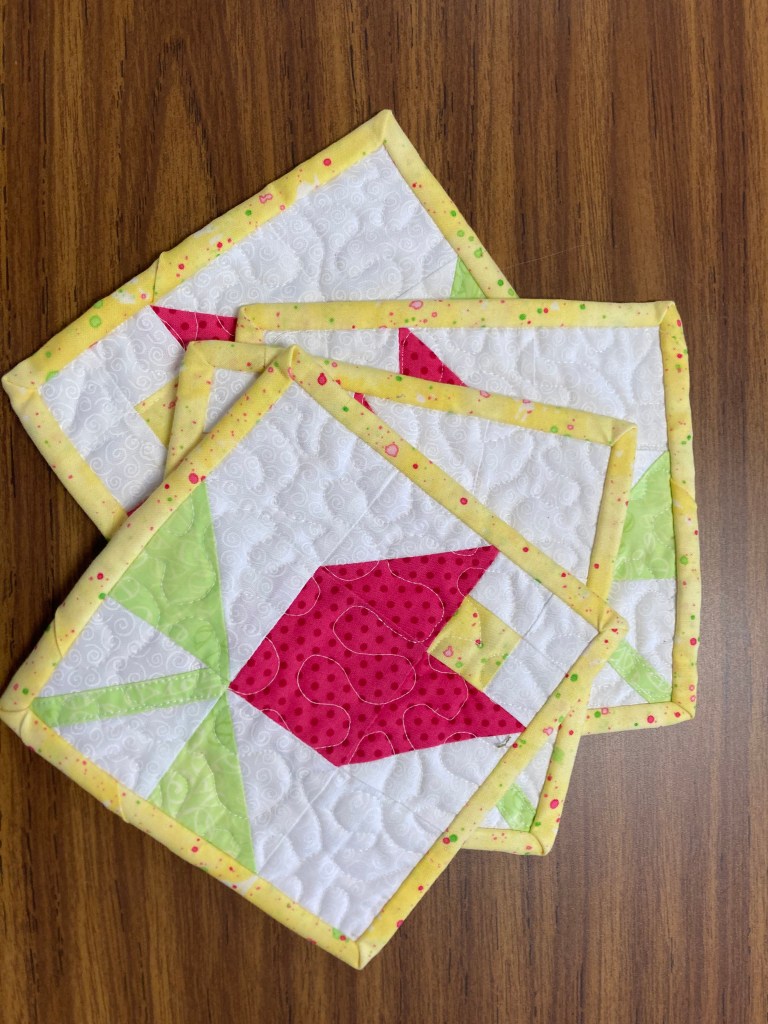
Tulip print placemats. Approximately 15″ x 18″. Back is pink gingham print. Machine quilted and washable. 4 for $40.

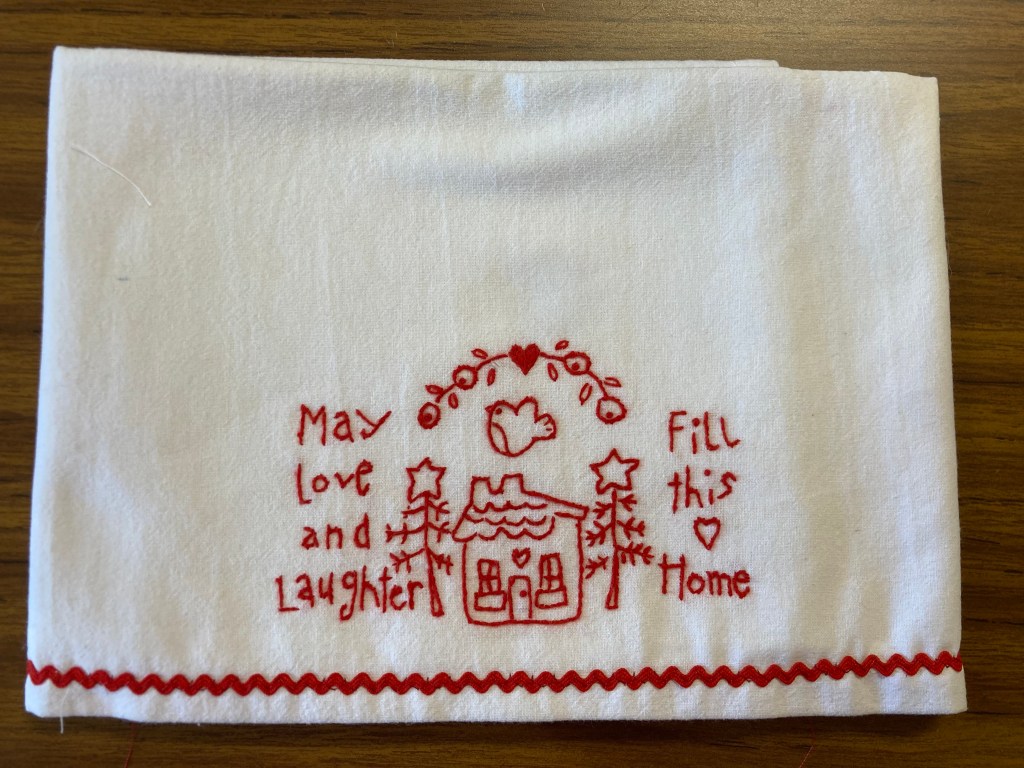
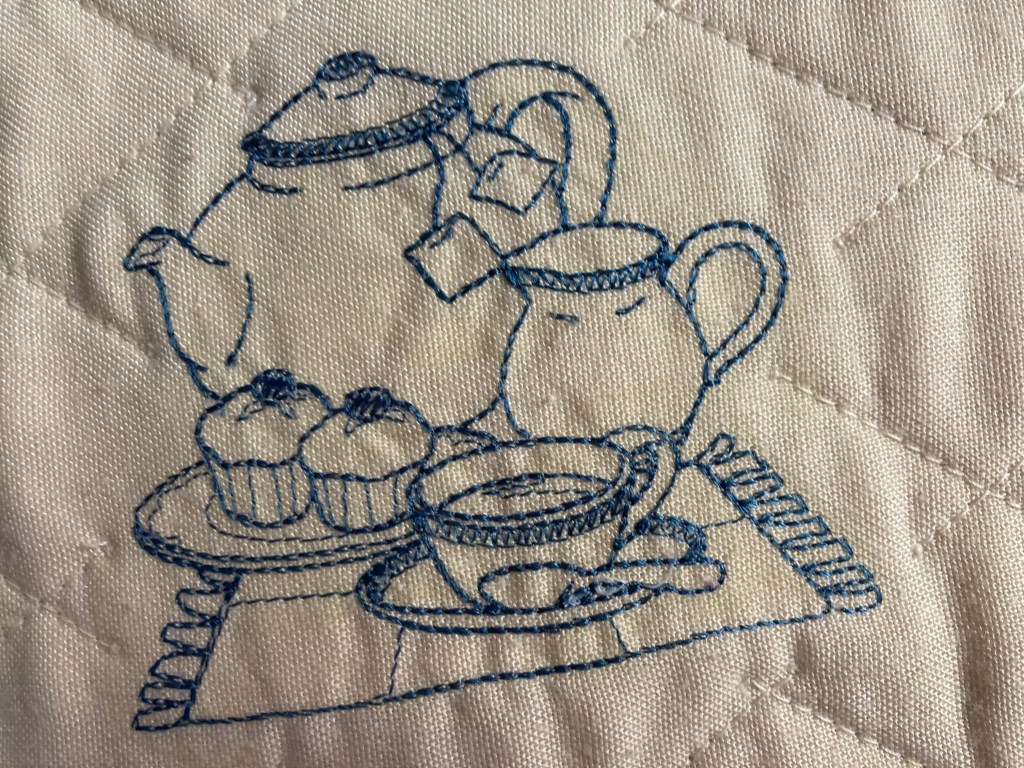
Another muslin –all cotton tea towel with hand embroidered design. $8

Carrot tablerunner—$35.

Baby quilt –40″ x 40″. $55

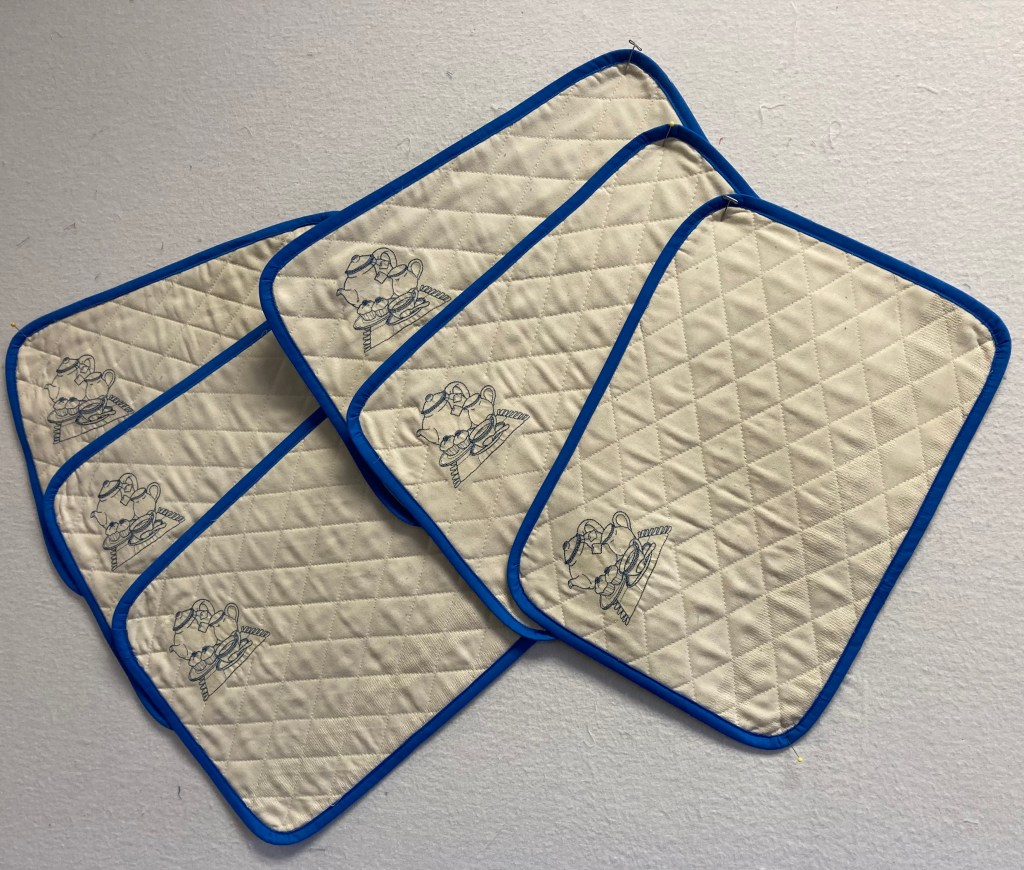
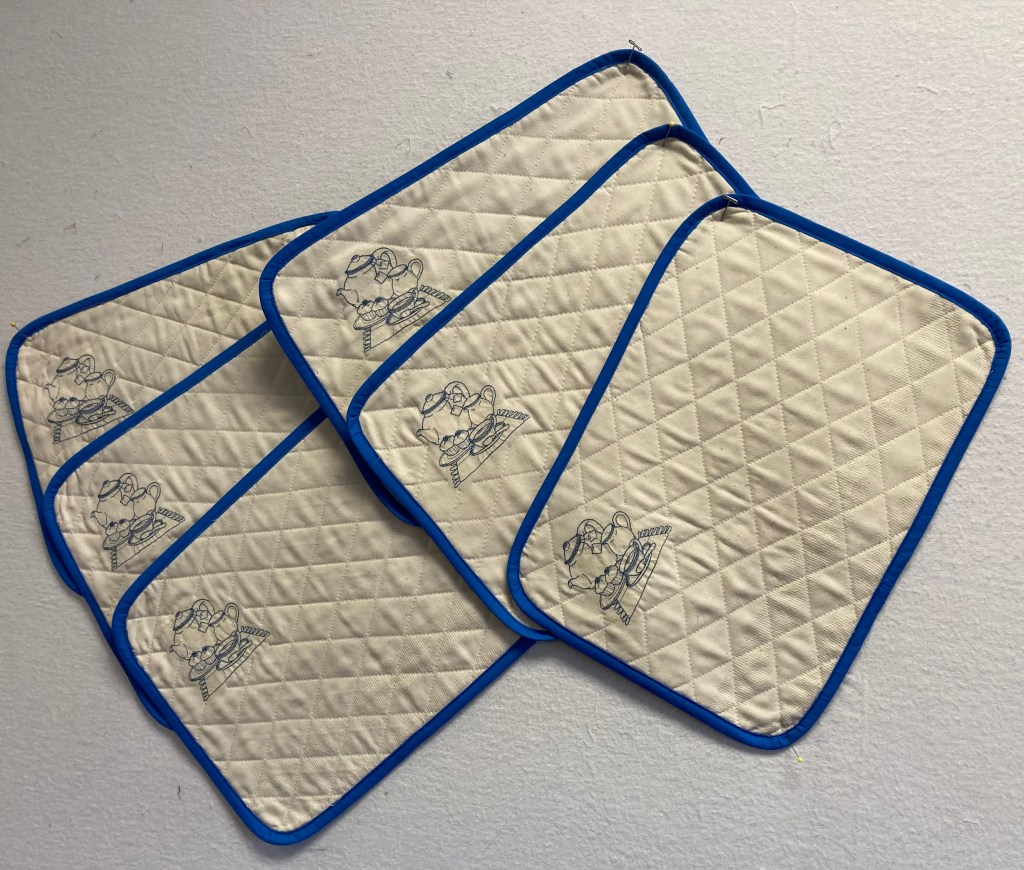
Six placemats with machine embroidered design in upper left corner. From is textured linen look fabric. 6 for $60

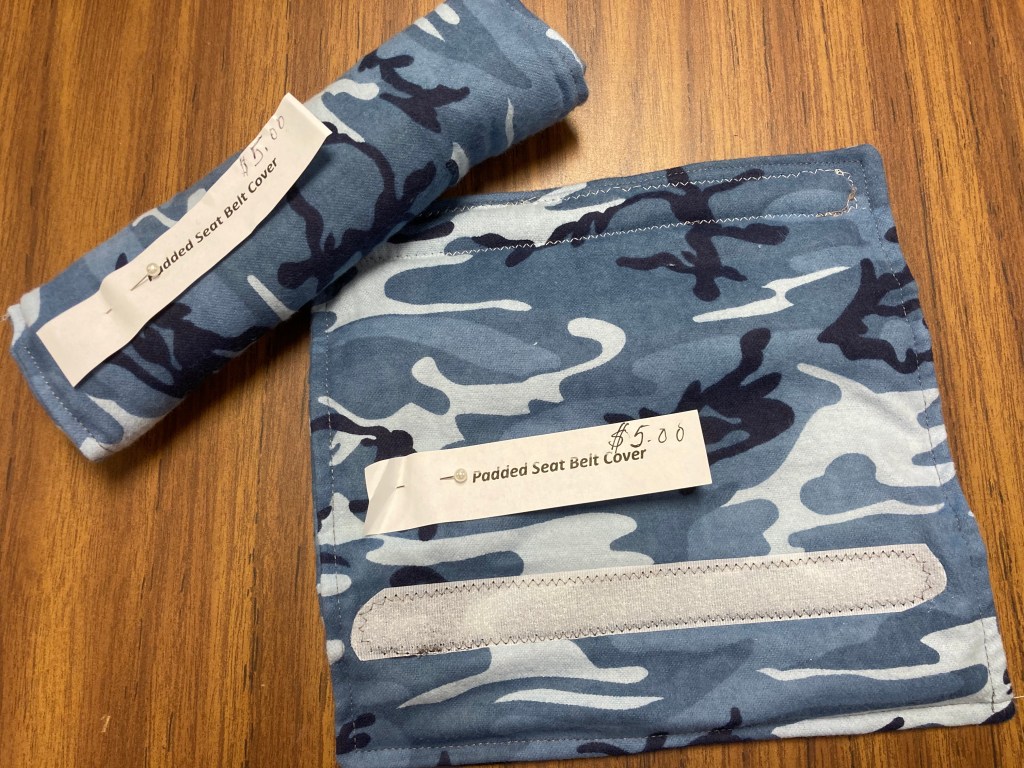
Flannel seat belt covers—recommended by one of quilters for short people. $5 each

Tons of scrubbers–one side is net covered. $2 each

Happy National Quilting Day! Hope you get to sew or at least “pet” your favorite quilt!

Pretty in Pink

Look what the hand quilters displayed in their room this week!

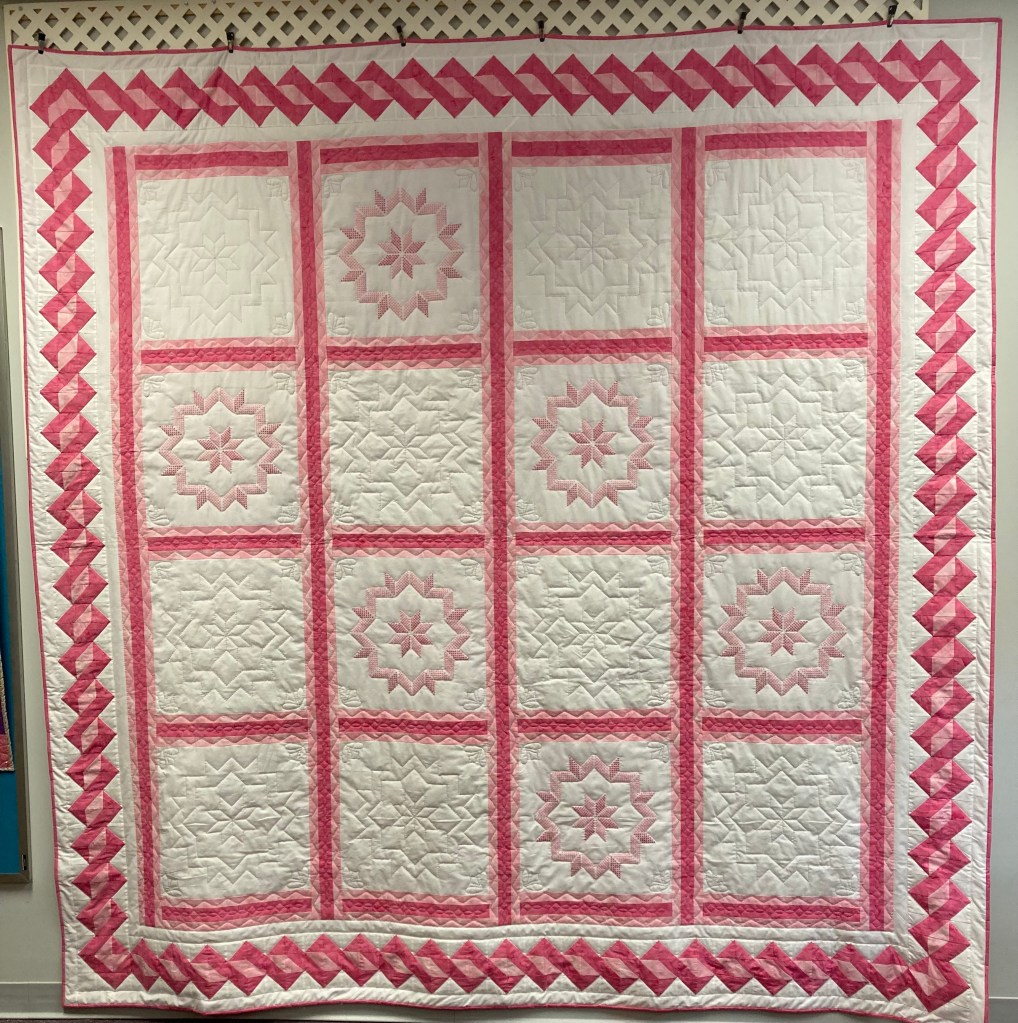
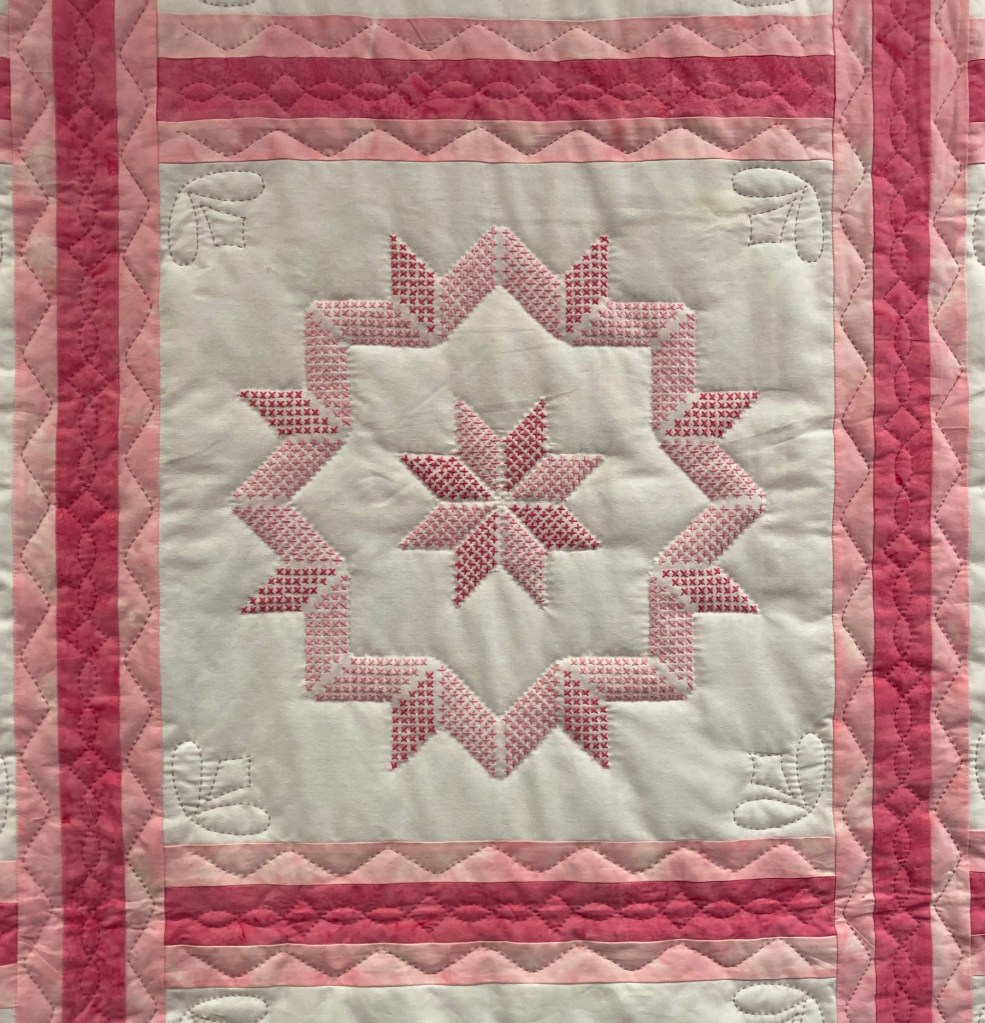
Isn’t she a beauty? Of course the quilt is a “she”–so very feminine in pink and stitching that suggests lace.

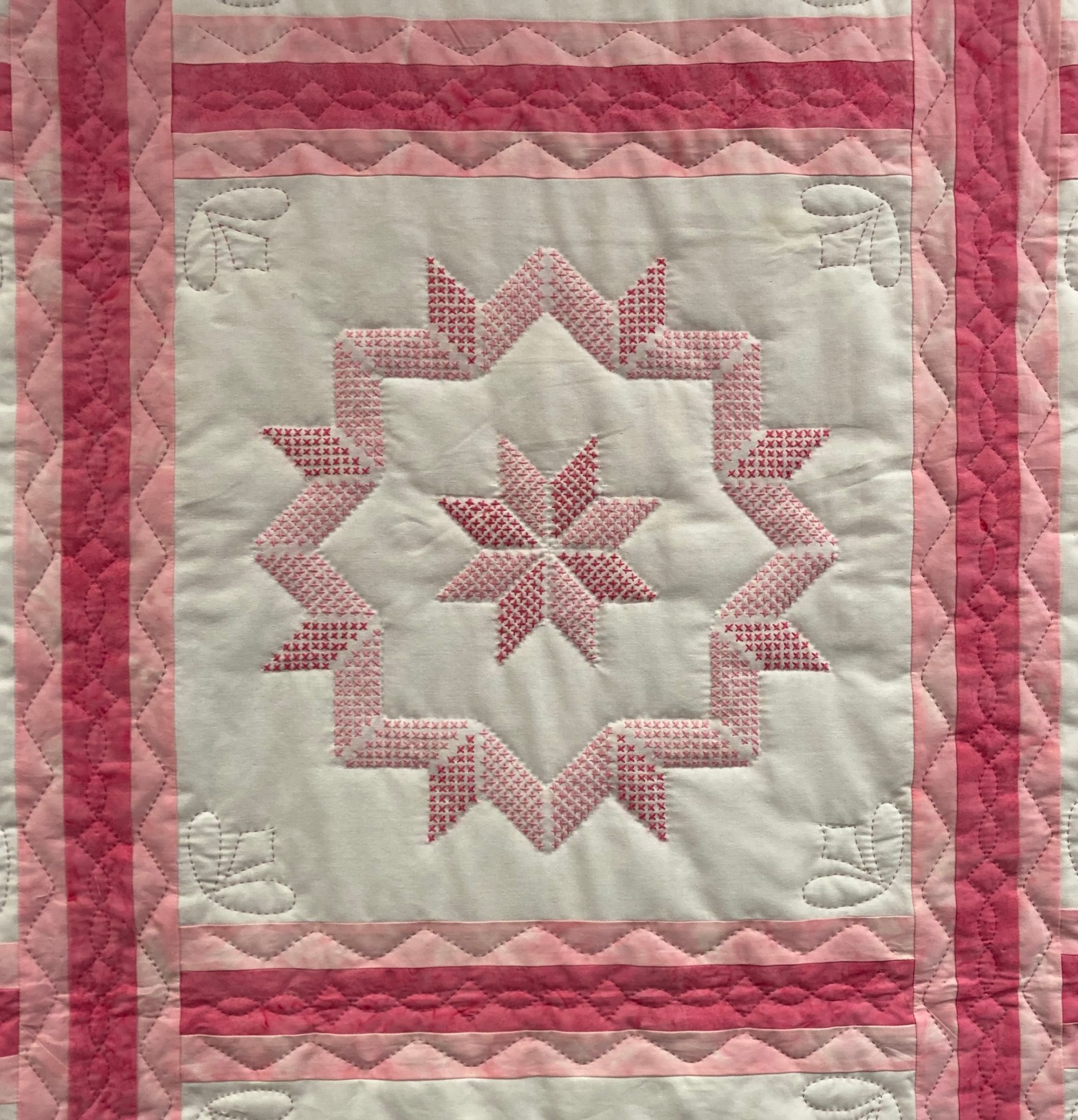
Paulette used the six hand cross stitched squares that Coila Ernest’s daughters gifted us after her passing. It was a puzzle –how to make only six squares into a quilt proportional to the size of the squares. But isn’t the end result creative and perfect!

Using the two shades of pink Coila used in the cross stitching, Paulette copied the colors and the design in the rest of the quilt.

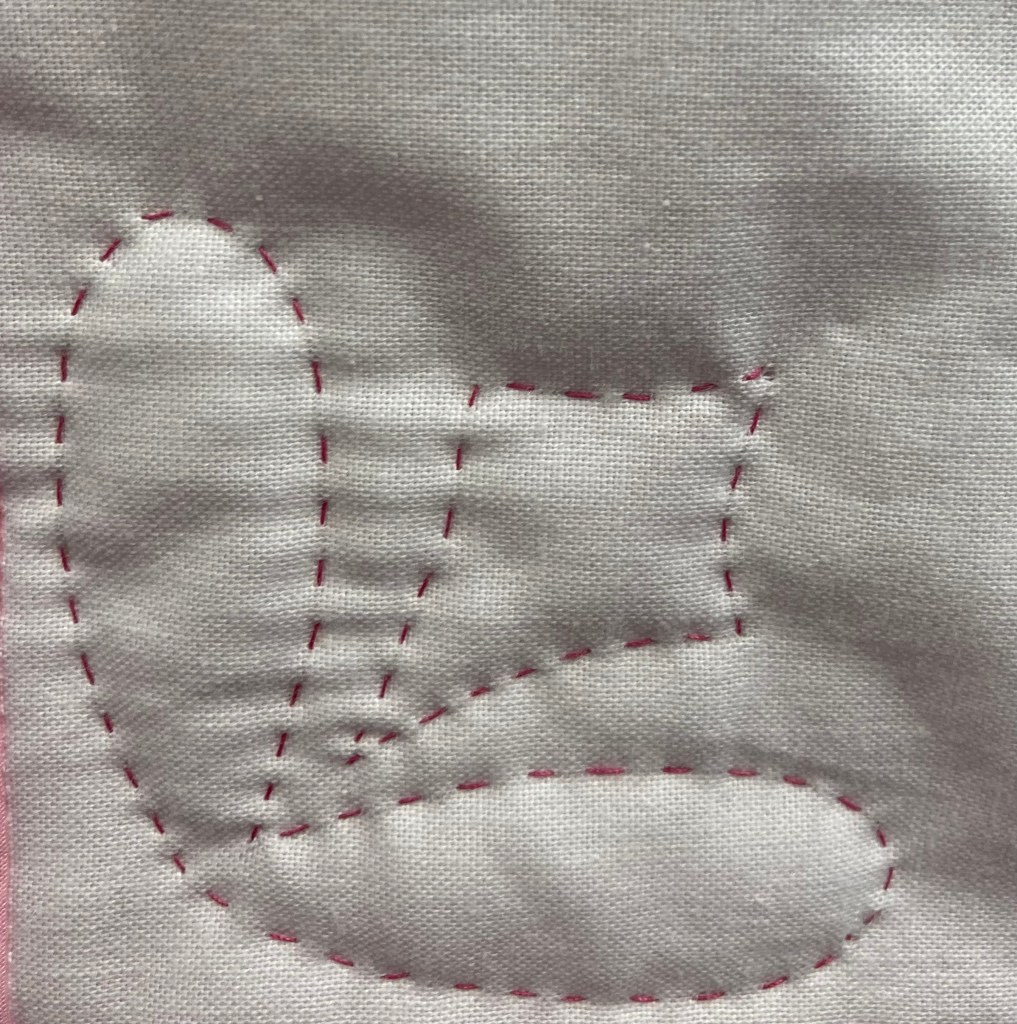
The quilters even used pink thread to hand quilt –a very brave thing to do! So much safer to use white thread on a white background. At a glance one can see how even the stitches are.

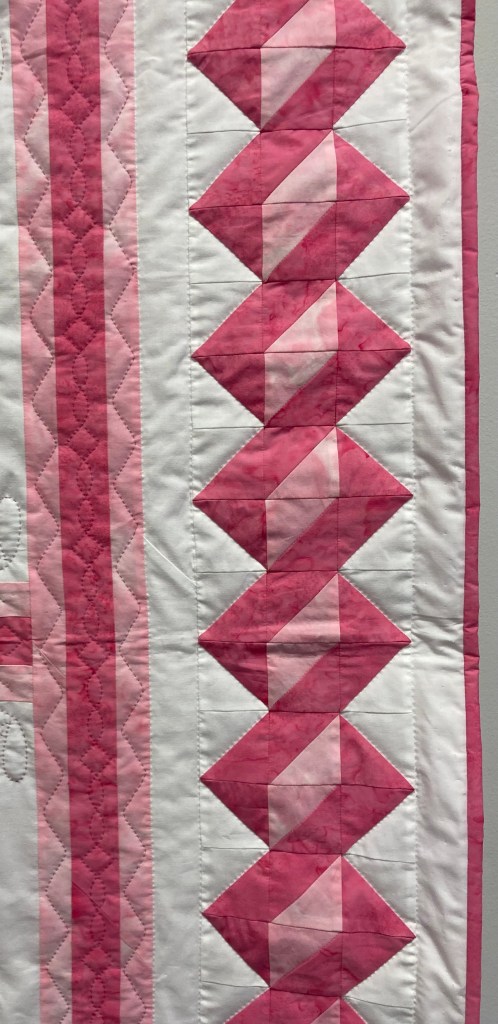
The border resembles curling ribbons, wrapping the entire quilt as if it were a gift package.

The backing is a multi tone pink print. The true test of good hand quilting is seen by looking on the back—these stitches passed with flying colors!

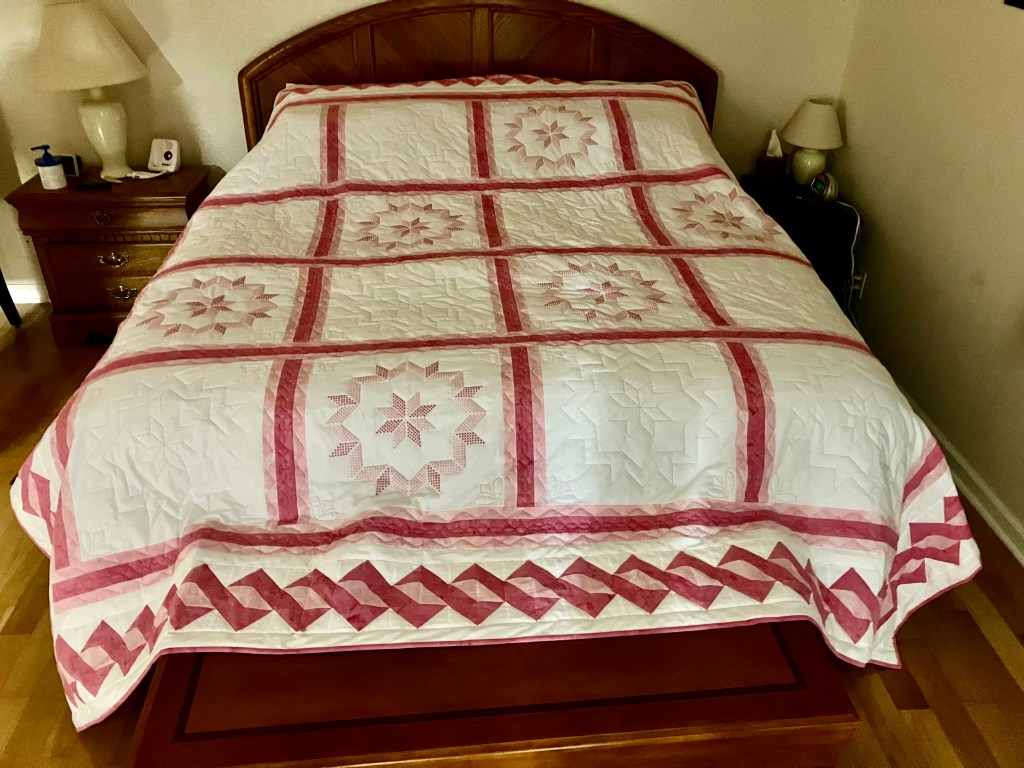
The quilt is 102″ x 102″ shown here on a queen size bed. The quilt would fit nicely on a king size bed also–the minimum size suggested is 96″ x 90″. The batting is polyester which is warm but light weight to handle. The quilt will be entered in the bi-annual Prairie Quilt Guild show in June. But “Pretty in Pink” can be yours now—$600.

What else did the Quilters at First complete this week?

Spring theme mug rugs–6″ square, machine quilted and hand bound. $20 for 4

Halloween table topper—the backing is spooky witches with their bat friends. I love that purple is now a Halloween color. Approx. 21 inches –$40.

More bibs—can you ever have too many? $8 each

Six place mats with a machine embroidery motif in the upper left hand corner. The textures linen like fabric is machine quilted. The mats measure 11″ x 16″. 6 for $60

Our cabinets are filling with all sorts of items for the sale in October–but why wait to get your prize? Contact quiltersatfirst.com if you have questions.

Visiting Places in my Mind

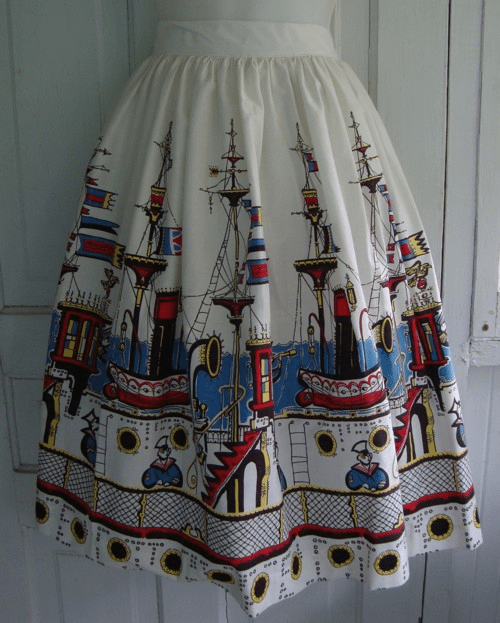
Do you every wish you could whisk yourself off into a pretend place? When I was in the fourth or fifth grade, I had a border print skirt.

My skirt was an ante-bellum southern river port scene; probably it would be considered politically incorrect now. It was a simple gathered cotton skirt much like this but in greens and browns. I was fascinated by this period of American history, just having finished “Gone with the Wind”–for the second time. So, I during long sermons, or boring class periods, I would imagine myself walking the dock, seeing the paddle boats and listening to the sounds of the whistles and shouts.

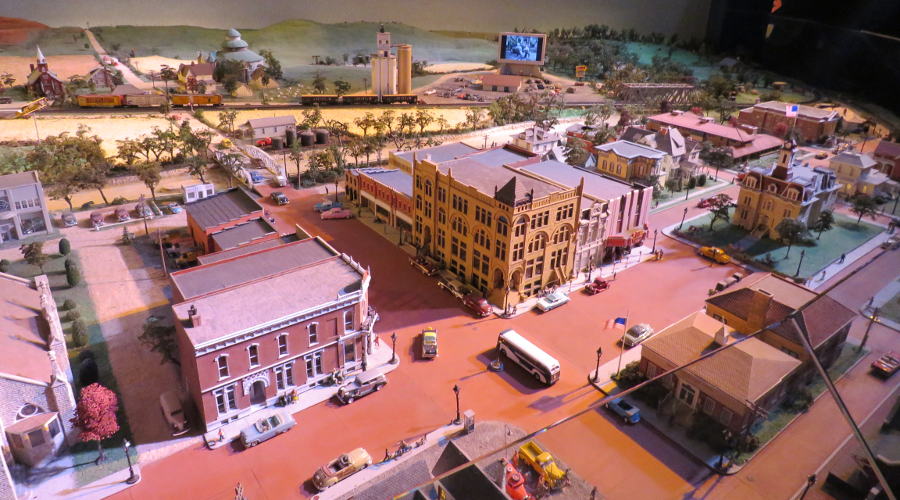
As an adult, I have visited Exploration Place on the Arkansas River in Wichita many times. And every time, my favorite place is Kansas in Miniature created by Thomas Nichols. This a 1500 square foot model of landmarks from all over Kansas. Locomotives pull up to water towers, people in 1950 dress and cars move about city blocks and natural landmarks.

There isn’t a time, I don’t wish I could shrink down to the miniature’s size and walk among this representation of the 1950 Kansas. What would I learn about my state? Who would I meet?

I do the same at the dentist’s office. I am not a good dental patient–I go regularly because I am a rational adult but sincerely dislike it. My former dentist had an inexpensive print of a side walk scene in Paris. I am sure you have seen it. How many times did I visit that cafe–in my mind — to forget where I really was?

Do you ever do seen a scene and “teleport” yourself there? Shirley brought in two “quilty” projects that are perfect for transporting you to another place.

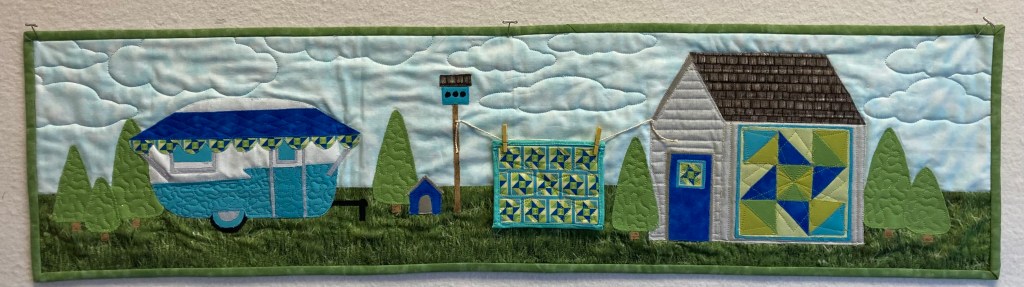
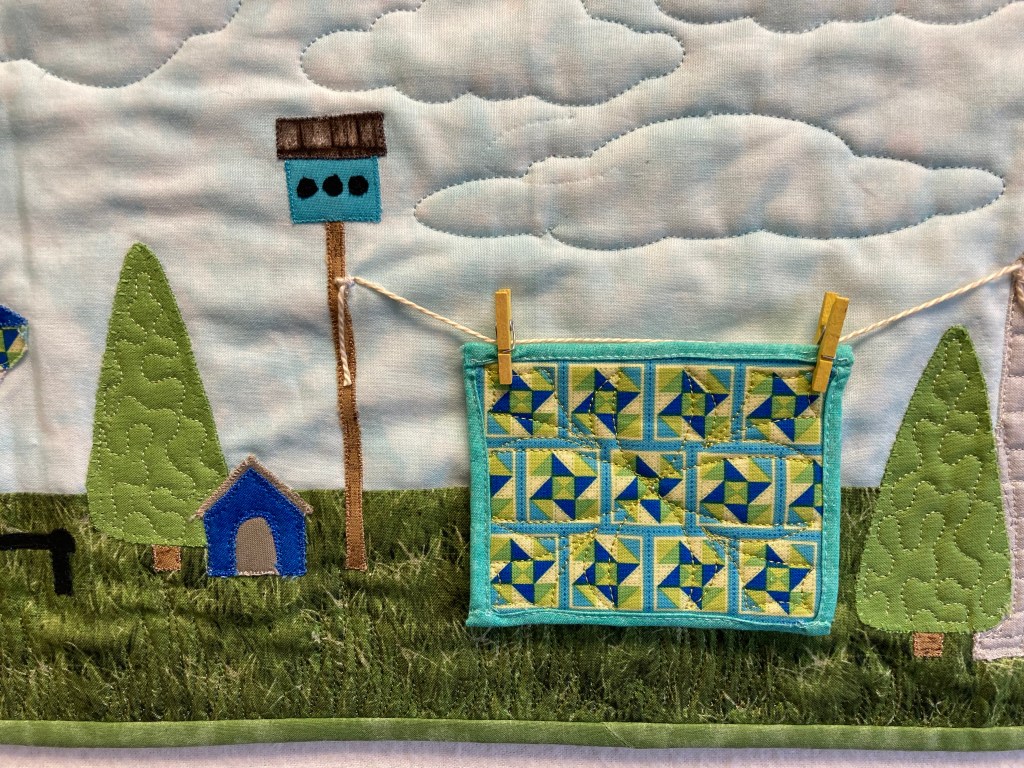
Can you imagine yourself “glamping” in this sweet little vintage fifth wheel camping trailer? Take note of the all the details–the friendship quilt block on the 3-D miniature quilt and the barn quilt, the bird and dog houses, and the bunting used on the trailer.

Fabric choices for the grass and clouds are perfect. The machine quilting creates more realism.

The shingles and clapboard siding—too good! This would be a great gift for camping enthusiasts for their motor home or on a wall in their home above a door. Especially if you are like me and just like to visit places in your mind!

The 9″ x 35″ wall hanging is a steal for $50. SOLD

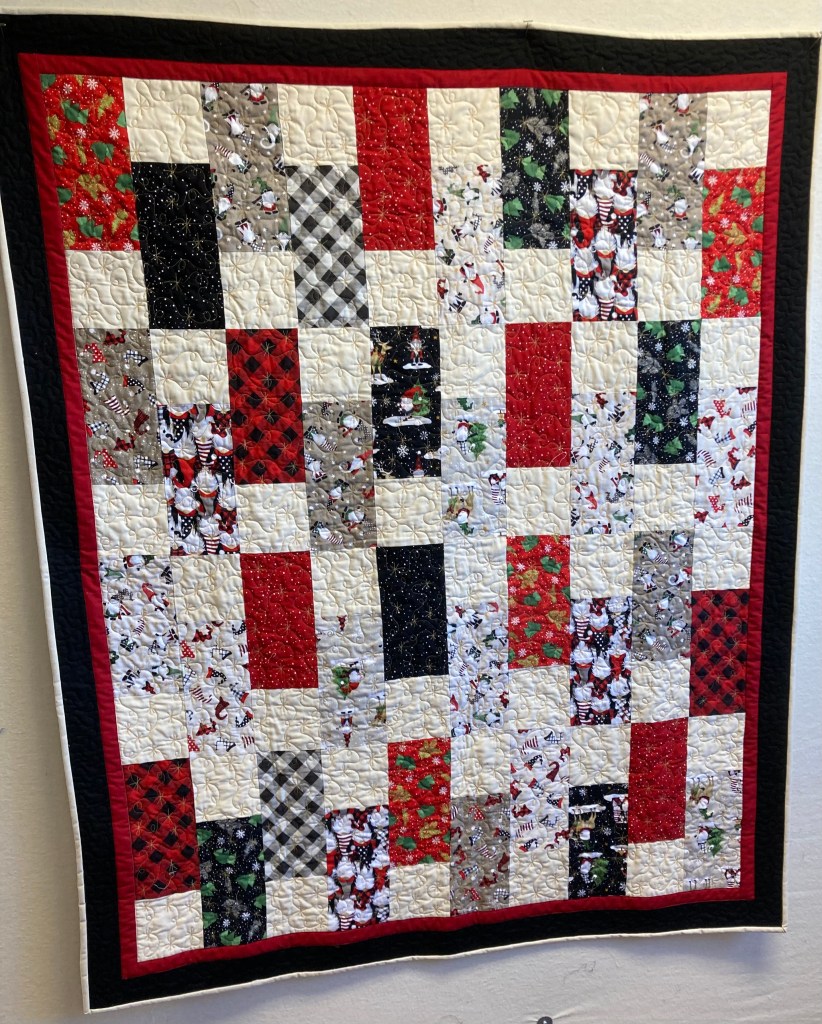
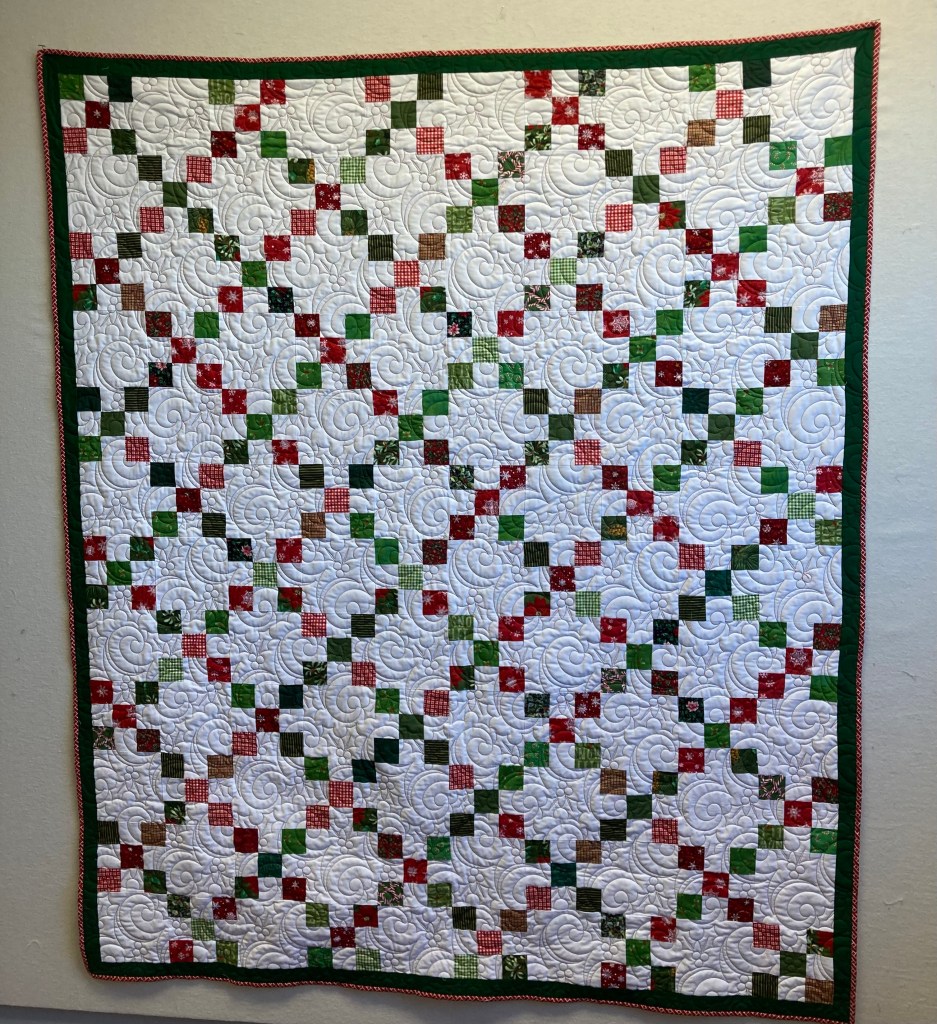
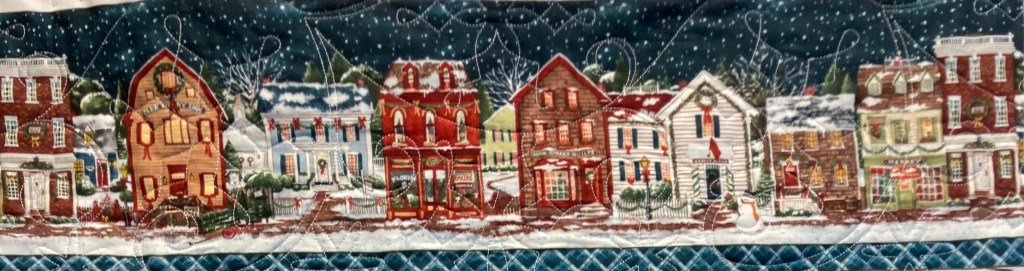
This Christmas theme quilt also has scenes from the past.

The border print is of houses from another century decked out for Christmas.

The print depicts an image we would like to believe existed and that we would enjoy strolling on a winter’s night—This 68″ x 76″ quilt fits quite nicely in a traditionally decorated home. The quilt is machine quilted using a snow pattern-flakes and swirls of blowing snow. $200

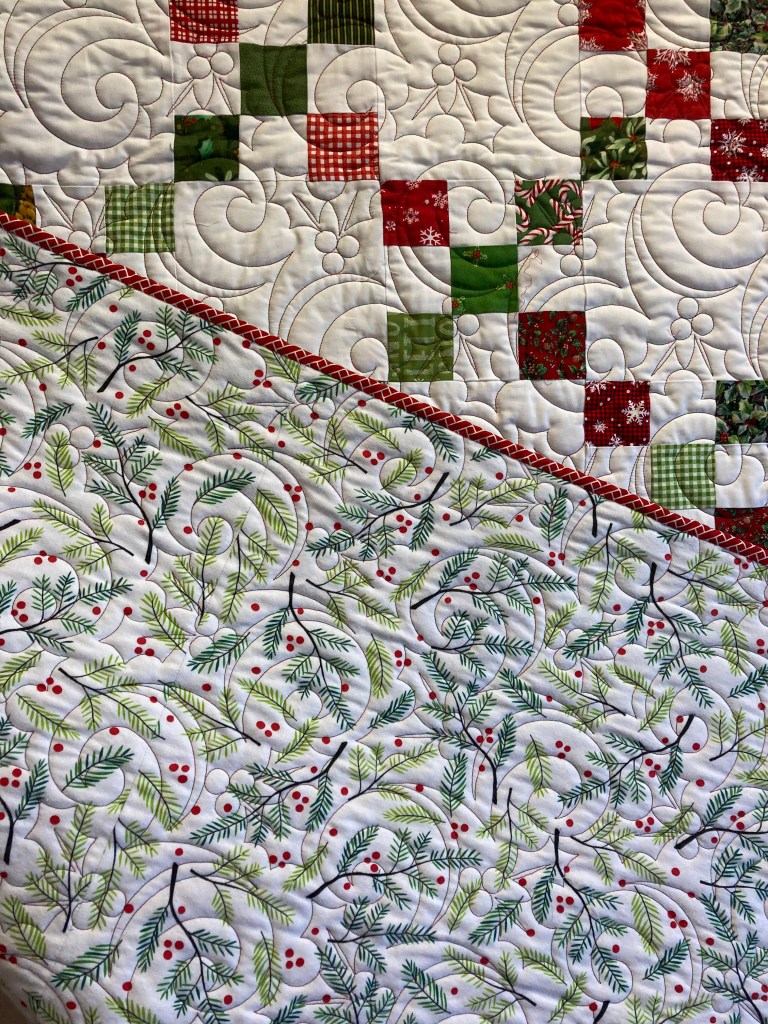
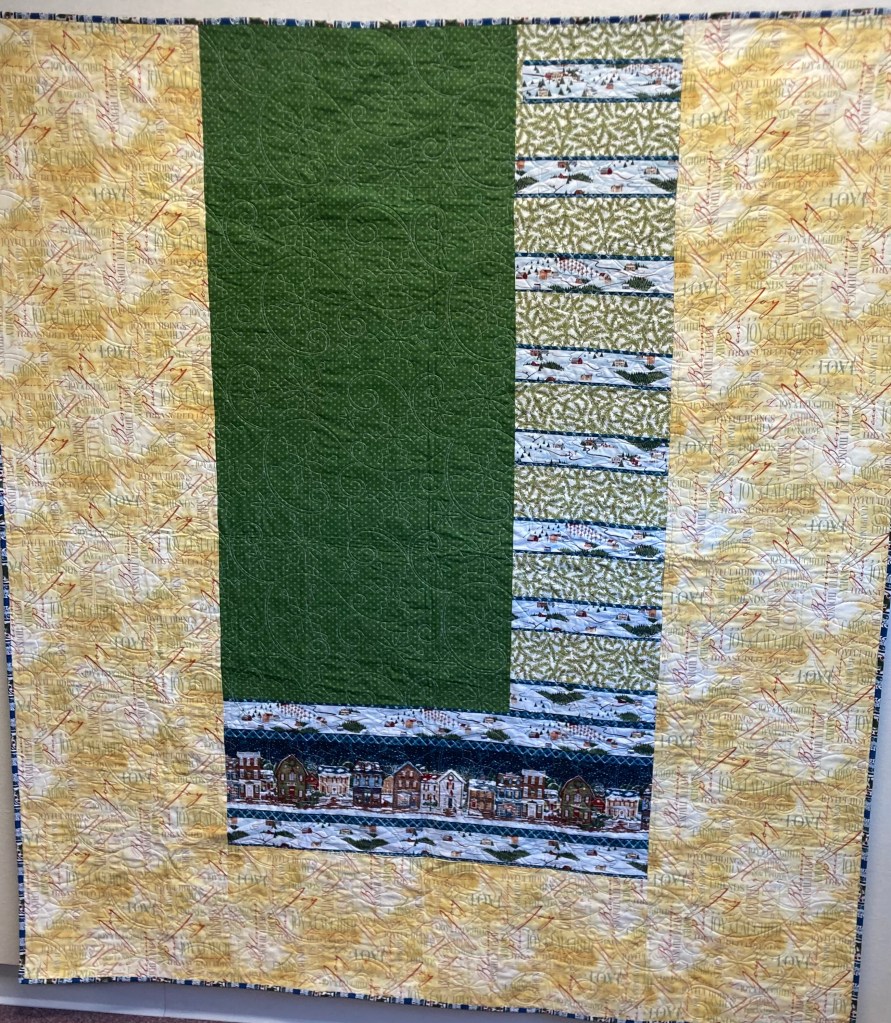
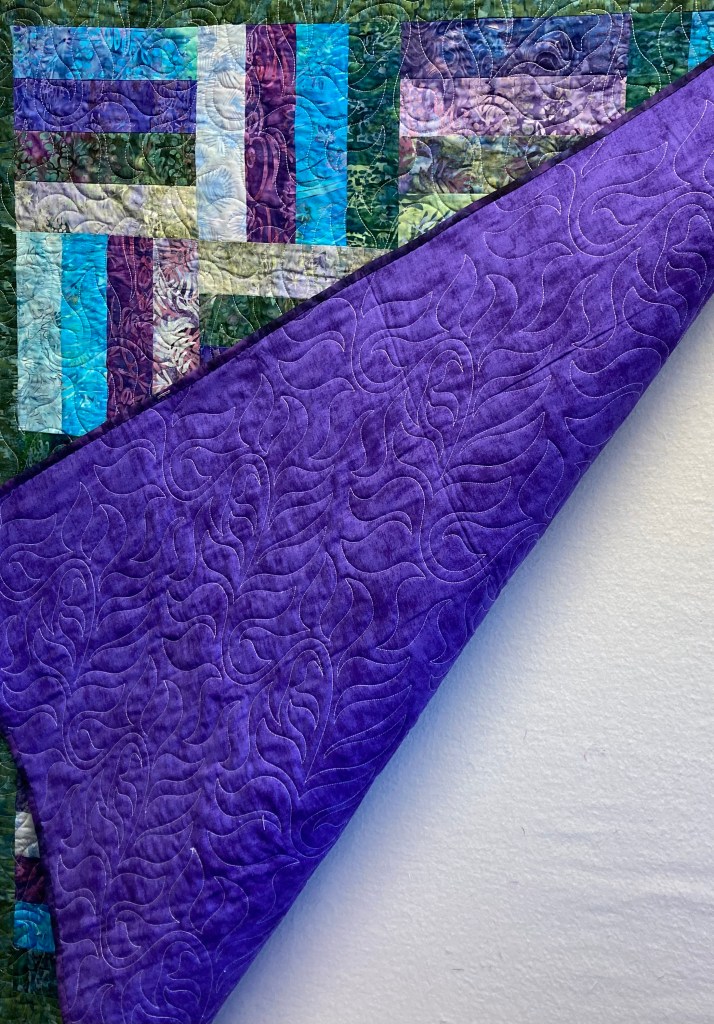
The back of the Christmas theme quilt.

Peggy finished this “jewel”–

Rich colored batiks are used in this 40″ x 49″ throw. The pattern is a variation of the rail fence pattern.

The machine quilting continues the floral impressions found in some of the fabrics. Cotton blend was used for the batting. $125

An imagination is a wonderful thing! Quilters are very imaginative–it helps the creative process. And there is nothing more fun that sharing the results of our imagination with you!

Patterns vs. “Wing it”

Are you a “pattern follower” or a “wing it” type of person? I am a 70/30 blend—with the 70% being “wing it”. And sometimes that gets me in trouble!

Many, many quilt patterns are just variations of the classic quilt blocks that have been used since who knows when. The time tested block patterns become the tools in the creative process.

40″ x 50″. $125

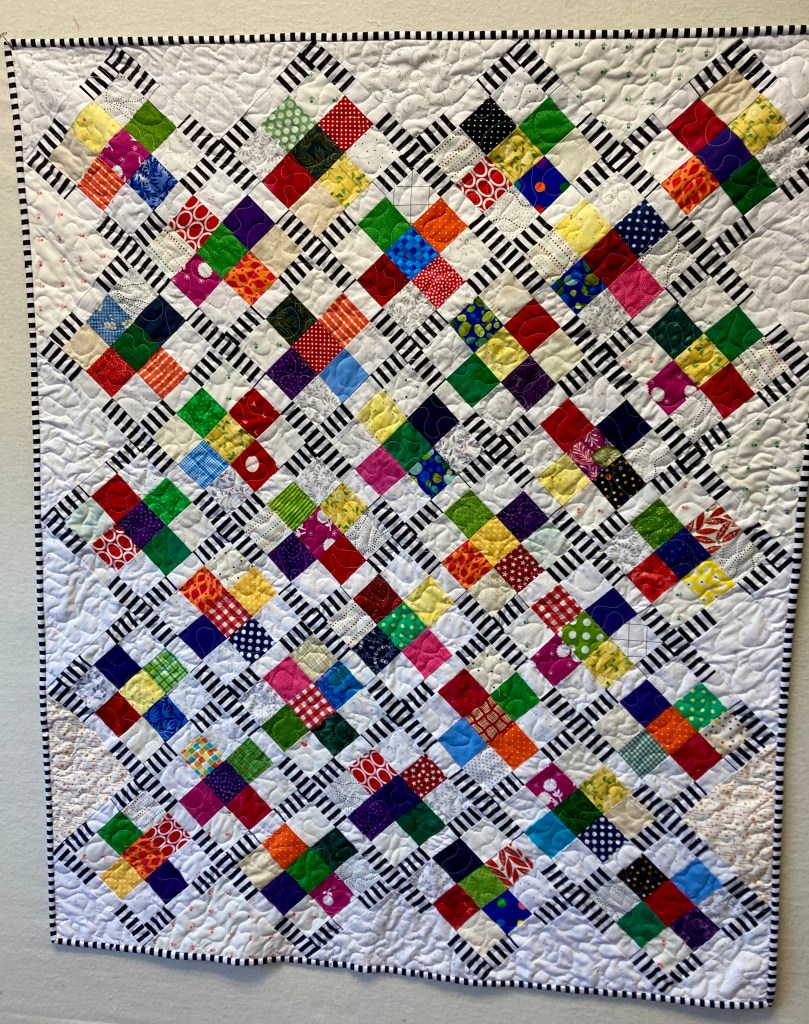
This quilt is simply a nine patch–the most simple of blocks–on point with the addition of striped sashing. This is based on a published pattern by Eric Jackson named The Ruth Quilt but I winged it.

This quilt top—it is at the long arm quilter now–is the “disappearing four patch”. Videos and tutorials are easy to find. Pattern for a quilt? Made as big as the number of charm squares I had–with the rule of thumb I usually follow that is to make it longer than it is wide.

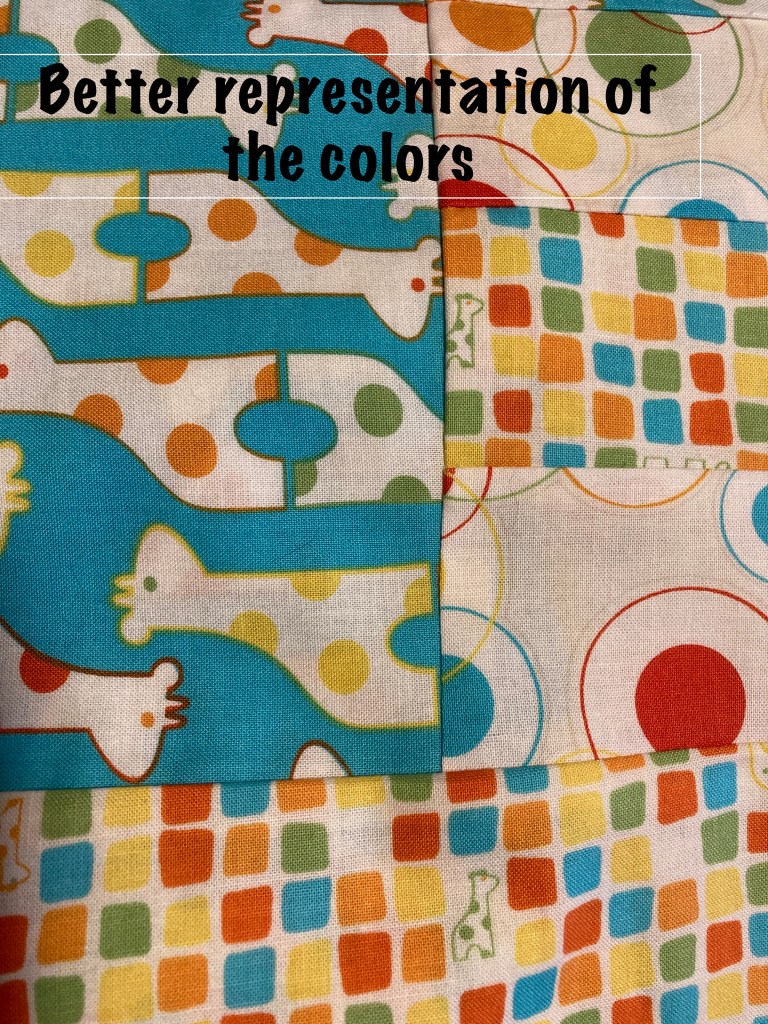
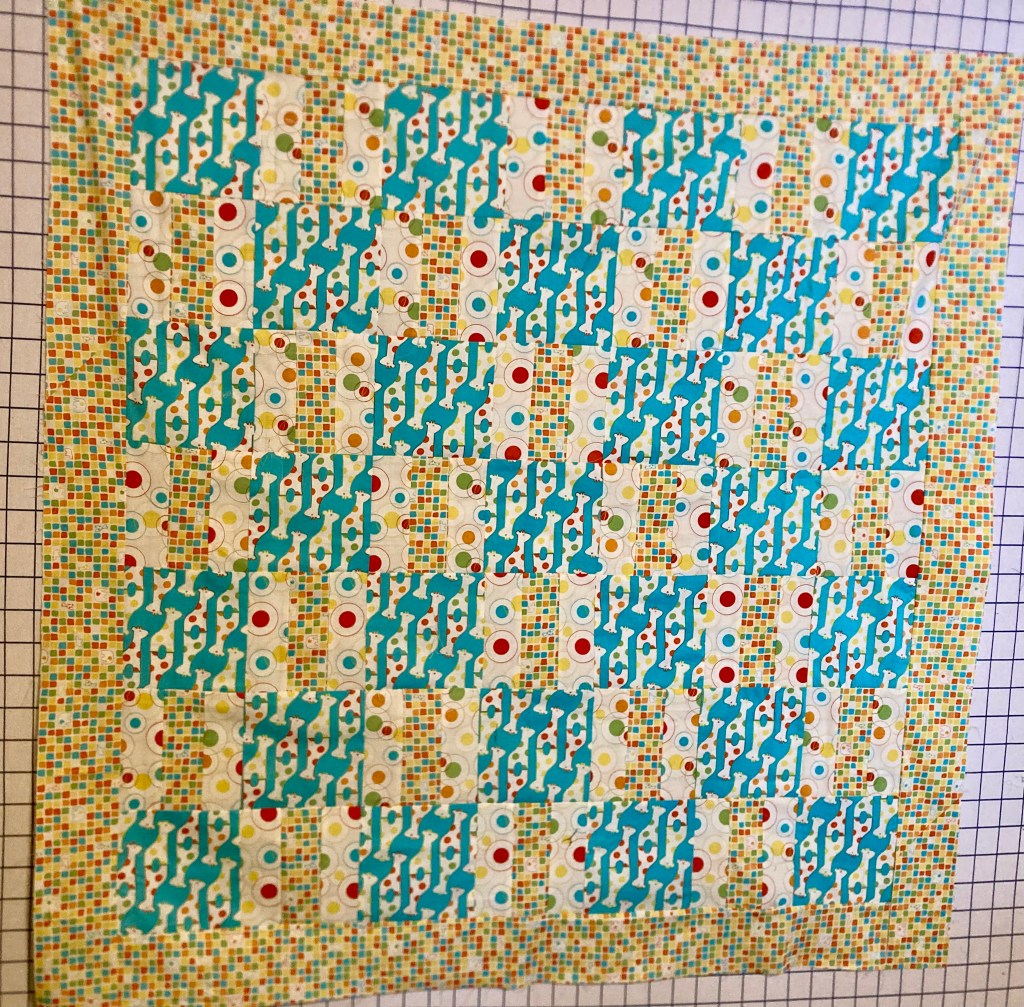
This baby quilt—folded up in my sewing room waiting for me to quilt it–is from fabric my daughter gifted me. No pattern, but I wanted to leave the giraffe print as big as possible to avoid losing the fun design. I also wanted to use just the coordinated prints, which was rare for me to have. I chose to copy a “rail fence” block for the spacer between the giraffe print. I did not alternate the fabrics in the three fabric block because I wanted to save most of the mosaic print for the border. How big to make the border? That depended upon the amount of remaining fabric. Another “winged it” pattern.

Some quilts are the same block over and over.

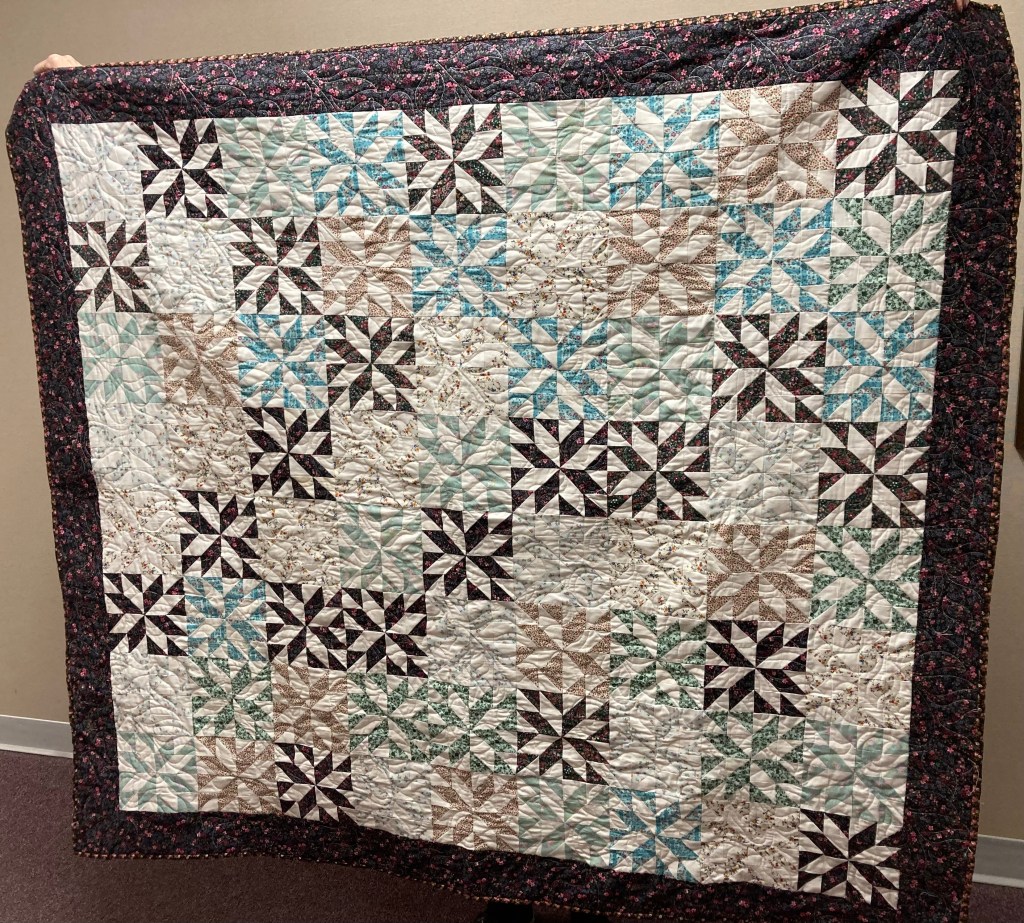
This beautiful quilt is a variation of the Lemoyne Star block being repeated. No quilt pattern is needed. The block pattern is in books and on tutorials videos.

Baby quilts are often a “no pattern” quilts. The focus is on the color or texture.

But sometimes I do use patterns.

…and I usually love the results!

My fellow members of Quilters at First, also like to “wing it”–

But my co-quilters have created some great quilts following a pattern.

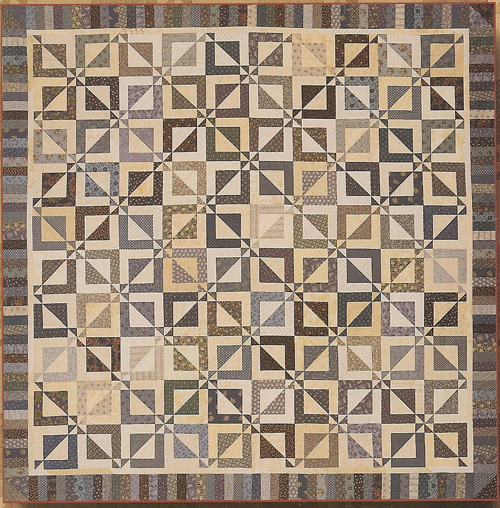
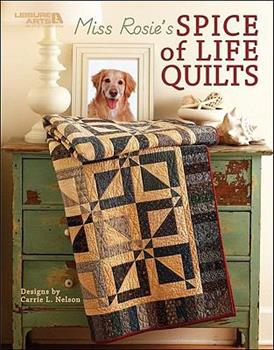
Remember the huge box of quilt fabric and unfinished tops my daughter sent me? We made a quick trip to Virginia over Presidents Holiday and she had found more to send home with me. She gifted me 25 finished blocks of the 100 blocks need for the quilt, True Blue by Carrie Nelson. She also sent all the blues and low volume neutrals she had purchased for the quilt.

She had the pattern’s front cover but had lost the instructions with the measurements. Not a problem, I can just accurately measure one of the finished blocks. The key word being “accurately”. I am blaming the head cold and cough I also brought back from VA; I mis-measured the rectangle pieces. And then I cut forty sets of block pieces. Yesterday when I started sewing the blocks together, I discovered my boo-boo! Really wished I had had a pattern to follow.

Sometimes it is a great feeling to go off on your own creative path, and sometimes a interesting pattern is just the thing. Like a lot of life, it just depends!

*********************************************************

Not many new completed projects by Quilters at First in February but check these out..

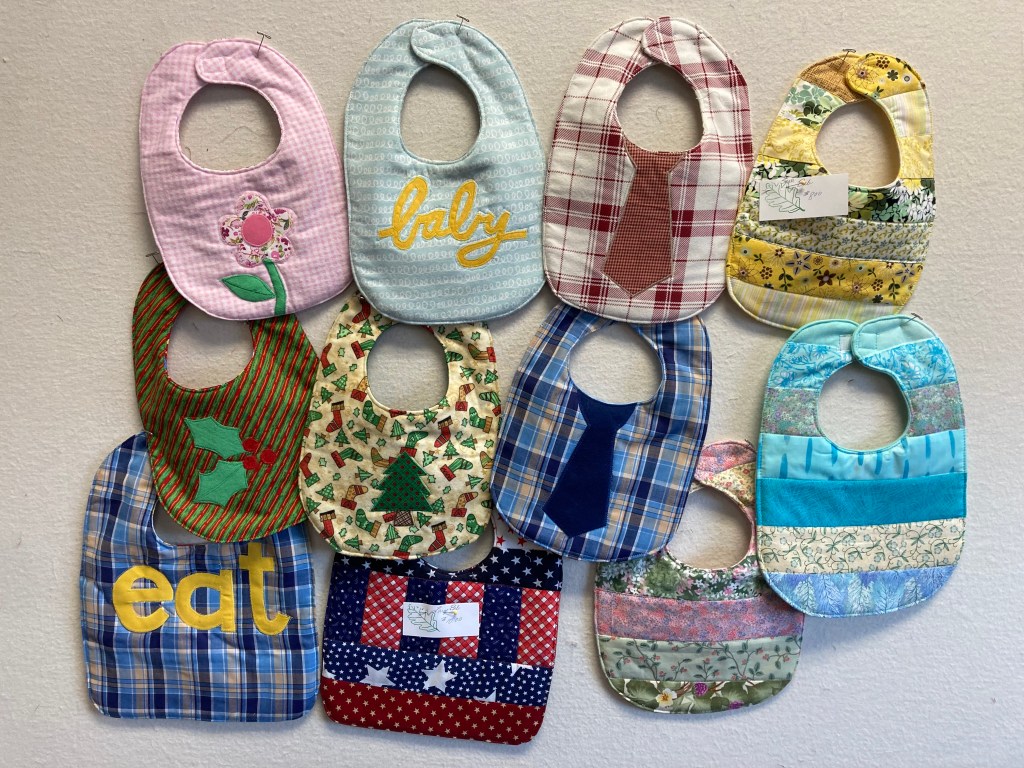
More baby bibs…Diane is very creative with her baby bibs, no pattern. They are all quilted with batting to make them extra absorbent. They have Velco fasteners for easy use. The smaller ones are $8 and the larger ones are $10.

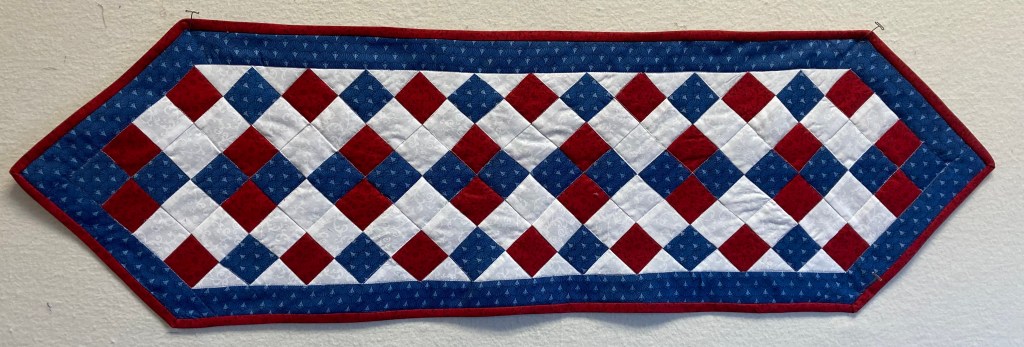
She also finished a ” 4th of July- Flag Day- Memorial weekend” table runner. Really red, white and blue is great anytime!

The runner is 13″ x 45″ and machine quilted. The binding is hand sewn. $40 (She used a pattern–she is more of a 95/5 person–95 being “wing it”.)

The best part of Quilting

Do you know what I like best about this quilting experience? It isn’t the finished project– sometimes a bit of a let down, or fabric purchasing–I have almost broken myself of that habit, or having an outlet for creativity that is practical….it is being with my quilting friends on Wednesday! Wednesday from 11 am to 4 pm I am part of a group that still likes and cares for me ..the authentic me. 

We are fairly homogenous; same age group, same ethnicity, same religious backgrounds, all mothers and most grandmothers, but when there are twelve women together there will be big and little differences. We don’t all agree politically. Each of the twelve have different strengths and weaknesses. The role quilting plays in our everyday life varies. Roles shift within the group. But we joke we want to be on the same floor, in the same assisted living complex when we are older so we can take care of each other.

You would be surprised at all the topics we cover in a short five hours! Yesterday we  * shared latest streamed series we had watched and gave a quick review of each.   * discussed current books we are reading or listening to –audio books are preferred by quilters so one can quilt while”reading”.                     * results of latest medical appointments, up coming doctor visits and questions about health–our children don’t want to hear about this and our husbands are tired of hearing about it.                                   * Taylor Swift’s chances of making it to the Super Bowl this Sunday and her re-recorded songs.                                    * the British Royal Family’s medical crisis and the retired nurses diagnosed the type of cancer King Charles most likely has                       * the challenge of wearing flannel pjs bottom when sleeping on flannel sheets in the winter.                                   * funny self deprecating storied about losing things–keys, glasses, phones.      * and some topics and discussions that will not be shared outside the four walls of our locked quilting room.

BUT, quilting does happen! Sometimes it takes another quilter’s brain to solve a frustrating road block.  Yesterday, I could not figure out the repetitive pattern needed to put quilt blocks into rows. Diane and Shirley saw the solution immediately.  Another quilter finally realized the small detail in a printed pattern that made all the difference in the construction of a block that a quilter was trying to make to no avail. A few weeks ago, we all pitched in and curated blues for a quilt to be gifted. Many sets of eyes could see which blues were too green or grey, which prints were too big, or if there was a balance between darks, lights and medium. Not sure about adding a border to your quilt–take it in Wednesday and ask. We will have an opinion which we all know doesn’t need to be followed.

The second best part about my quilting buddies? The affirmation they give. When I show my husband (who is a wonderful, loving, generous man) my quilts, I usually get one of three comments. 1. That is interesting. (he sort of likes it). 2. That is a bit busy. (he doesn’t like it) or 3. That should bring a lot of money at your sale. (High praise). But he never says ”ohh, I love the color combination” or “the stripes made that so fun”. or “Wow, that was complicated but you did a great job”. My quilting pals do. We love “show and tell”. No matter the project, there will be praise. Even if most of think the colors clash, we will compliment the quilting or the pattern. If the binding is a bit wavy, we assure each other it won’t be noticed. Praise is important no matter your age or ability.

But the very best part about my quilting group. We care. We share the heartaches of losing persons, we share the joy of milestones reached by grandchildren, we share the uncomfortableness of change, we share frustrations of relationships, we share the excitement of trips and vacations and we “check-in” with each other. 

Of course we have our moments–eye rolls, lips pressed together so we won’t say anything, and hurt feelings. We have passed the stage of superficial interaction. We are a quilting family. No matter your passions, I hope you find your tribe.

*************************************************************************************

New projects just finished!


A Christmas wall hanging—28″ x 46″. It has a hanging sleeve attached which makes super easy to use. Look at the machine quilting.

The Christmas theme was continued with tree and snowflakes. $75


Three different sets of six placemats. Each set is reversible. They are machine quilted and hand bound. Speaking from experience, these placemats will last through many, many washings. Approx. 14″ x 18″. Each set is $60. 

Soft unique baby bibs. They are extra thick and have a Velcro closing at the neck. Watch for more in the coming weeks. I already have dibs on an aqua pieced one for a great niece or nephew arriving this summer. The smaller ones, all the yellow ones and the top red, white and blue one are $8 each and the larger one is $10.

Nothing like an “feed sack” tea towel –the embroidery makes them gift worthy. $8 each

A scrappy lap quilt or throw–40″ x 50″. Machine quilted with a cotton/poly blend. 

The pieced backing is all black and white prints.  $125

Thanking you for checking in and reading this post. My sincere hope is that you have a supportive, up-lifting ”village” in your life.

Thinking Outside the Box

Have you ever been advised “to think outside the box”? If I had a dollar for every time that phrase was used at in-services during my teaching career, I would be booking that river cruise! But it is great advice. I am more of a rule follower–a think “inside the box” person but I admire persons who can look at a situation and see a nonconventional solution. 

My nephew and his wife needed another bedroom when child #3 arrived. They reconfigured their small home and the former dining room became a bedroom for the little one–babies don’t need closets. A friend creates outfits from pieces out of her closet that I would have never put together, but she always looks great. 

Both my friend and her daughter are very musical. As a birthday gift, the daughter made this “out of the flower box” .

Quilters at First are a wonderful mixture of “inside” and “outside” the box thinkers. Shirley finished two great examples of “Wow! I would have never thought of that” quilted projects. 

Shirley had pieces from a king size quilt made into a full size quilt. What to do with the already made quilt blocks? Make a table runner! 

13″ x 36″. $40

Pre-printed panels are difficult for me to re-invent. Sometimes I give up and just quilt the panel as purchased. But Shirley thought “outside the box” and came up with is delightfully soft baby quilt.

The front, the panels and the backing are all yummy soft Minky. 

Cute little baby animals–rabbit, deer, giraffe, duck and a penguin.  The backing is white polka dots on grey. 39″ x 40″. $100

Vicki used “found” navy and white polka dot bow tie blocks to make this red, white and blue table runner. The result is a completely different look than most bow tie block quilts. 16″ x 34″ $40

Sometimes, we use “the box” or pattern to get us started, but then add a bit to make it more interesting. 

Shirley followed a pattern and the suggested color scheme for this 62″ x 63″ quilt but then added the whimsical flower and butterfly appliqué. Now it is unique! Did you notice the butterfly quilting motif?

The backing is a perfect match in style. $200

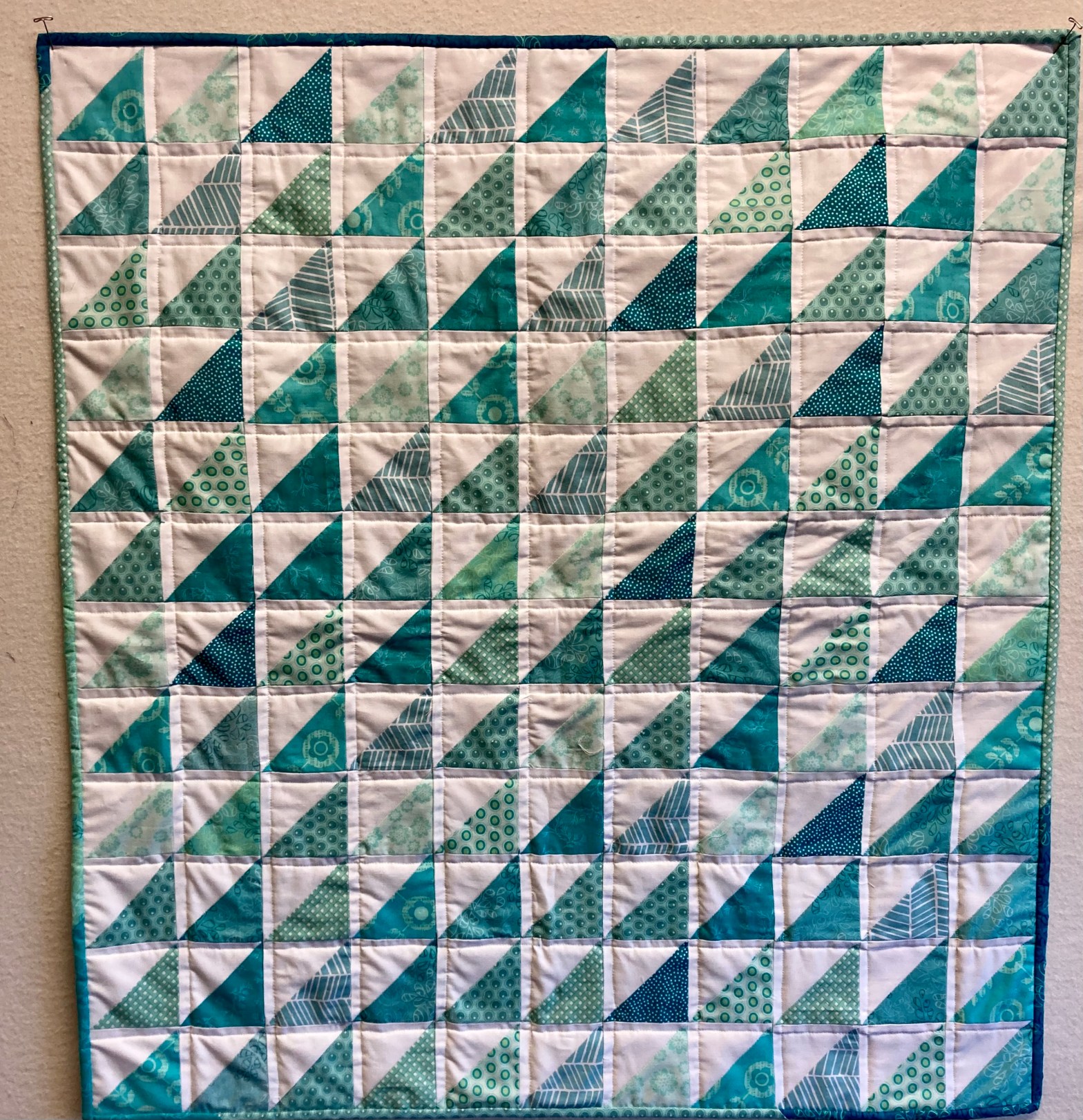
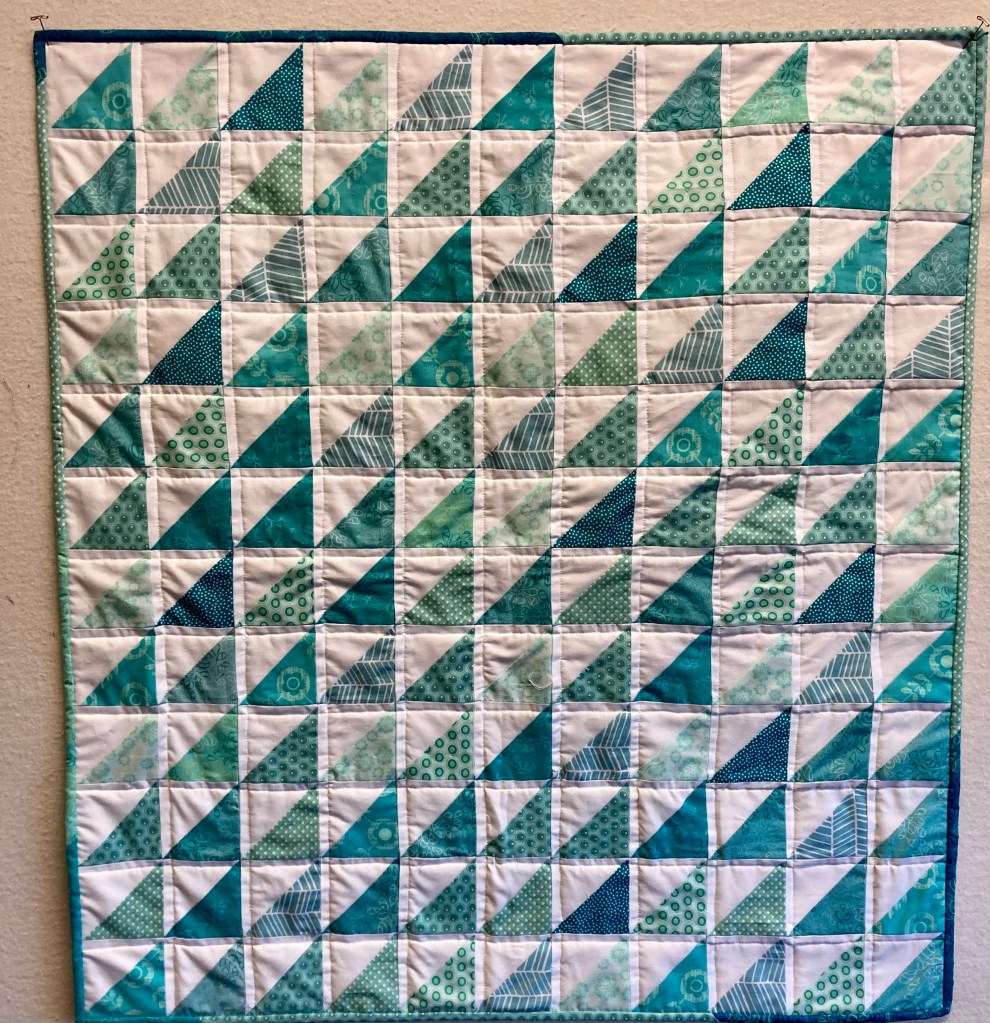
But some times it is very satisfying to follow a plan. I like to make half-square triangles. I loved this collection of aqua fabrics my daughter sent me. 

Non-gender neutral, with a flannel backing–a great baby gift for a tiny one. Machine quilted and hand bound with a cotton batting giving it great drape. 32″ x 35″. $50

This block of the month quilt included some embroidered blocks–but not the style of the maker. So additional pieced blocks were included. 

Did you see the print? It is all to do about sewing–thread, shears, pin cushions, buttons. Do you know someone who like to create with fabric?

Sewing machines were quilted into the all over design. 

50″ x 52″. $175

An orphan block becomes a small table topper.

Nine patch, half square triangles, rail fence patterns were all used to create this block that sort of resembles a shoo fly block. 21″ x 22″. $30

Not a four or nine or sixteen patch—but a 25 patch was used with these batiks to create a quilt for the nature lover. 

The colors suggest leaves and grass, wood and stones. 

The backing is a batik in a leaf pattern. 42″ x 62″. $125

And you realize that in ten months you will be decorating for Christmas. And of course, some of you organized souls are already purchasing gifts for next year. Well, we are making potential gifts for you!

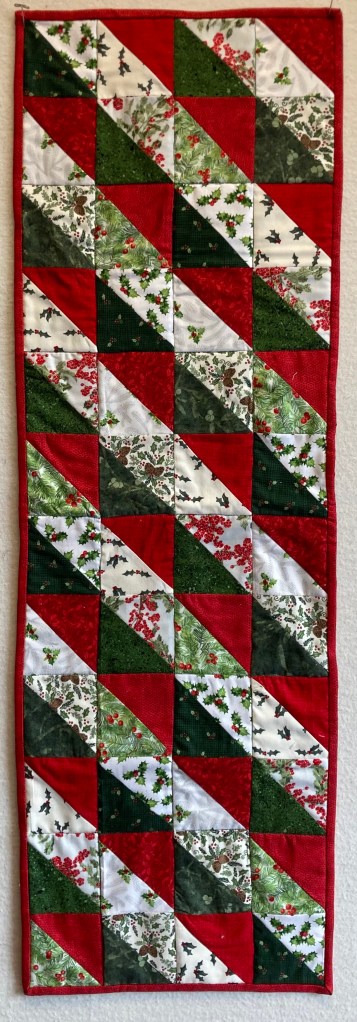
A table runner with many different holiday prints! It is backed with the same beautiful print that frames the front. 12.5″ x 45″. $40

For the holidays or all year a-round, this suggests view in the Rockies. It is machine quilted and hand bound. 16″ x 36″ $40. (I really should start pinning all around the pieces to have a better representative of the actual item!)

I found this on the internet a couple of weeks ago. Probably describes me best.

But a friend posted this on Facebook this morning and it is a bit more positive.

There is always “outside” the box.  Have a good week.

The “Filling” in the Sandwich

Quilts are sandwiches–the pieced top which is usually the star of the show, the backing which is often an afterthought and the batting which is not seen or given much thought by non-quilters but which adds warmth and drape. Thus the batting used can greatly affect the look and durability of a quilt and can add to the cost of the quilt’s construction. (photo by T-Shirts of Texas)

Quilt historians have found many different battings. A quilt that is registered with the Kansas Historical Society and was donated to the Quilters at First, used raw cotton as the batting. Cotton was cleaned of seeds and stems and stuffed between the top and backing and tied. This method would not allow hand quilting. 

Early housewives used worn out sheets, blankets and quilts to add warmth to the new quilt. Women in colonial and western expansion times used what was available. Many of the quilts of the Depression were made to keep families warm thus a torn or tattered quilt’s life could be extended by becoming the “batting” of a new quilt.

We have lots of batting choices in 2024. Cotton, polyester, wool, bamboo, silk and blends are all available. 

Cotton is the most common. It is breathable, easy to work with and affordable. Cotton batting will shrink when washed which gives it a well used appearance or added texture. 

Cotton batting is packaged by quilt size–baby quilt (45″ x 60″)to king size (122″ x 124″) or by the roll. Most of the “cotton” batting” is really a blend with 10% more or less of polyester fiber. The blends are usually less expensive and combine the best features of both cotton and polyester. It is important that 100% cotton be used in anything that would be used in a microwave. Polyester blends can cause fires! 

Polyester is fluffier and according to the hand quilters at Quilters at First, much easier to slip the needle through. It won’t shrink–no crinkly vintage look and won’t show fold creases. But it is not as warm and doesn’t drape as well. It is slightly less expensive. 

Wool batting is warm, breathable, super-soft, very strong and is a sustainable fiber. Wool batting shows off hand and machine quilting and resists fold creases and shrinking. Persons with animal hair or fur allergies may have problems though.

Wool batting is a bit more expensive and not as available.

Bamboo batting is the “summer” batting. It is light weight, thin, strong and won’t mildew (in case you forget to take it out of the washing machine for a couple of days). It is more expensive of the common battings. 

Siłk is the luxury batting with a lovely drape and feel.  It is very breathable. In cold climates it keeps the body warm and in warmer climates it cools, remarkable! It is hypoallergenic, very durable, and resists mold. But silk is the most expensive, almost double the cost of cotton batting. 

Lots of fiber choices! But wait, there are also color choices. Most cotton batting comes in a cream or natural but white and black are for sale. White batting beneath a mostly pastel or white top adds to the sparkle.

 Black should be used if most of the background of the pieced top is black or navy. Often a needle will bring up tufts of batting, especially when machine quilting. White batting on a black background top is not pretty.

Batting adds to the cost of making a quilt! If a twin quilt top is completely made from scraps (which were purchased at one time), the batting will add $20 to $30 dollars depending on the type. The batting for quilt offered on our web site for $125 probably cost $20+. I save every scrape of batting to “Frankenstein” batting for table runners, baby quilts, placemats etc. I puzzle piece the scraps together and zig zag the straight edges. 

If you are careful, no one knows that the batting has lots of scar tissue! Most of the small items I offer for sale use pieced batting. Tape that is light weight and heat bondable is available, but that is just another cost.

Batting has been on my mind lately. I have six finished tops stacked in my sewing room needing to be quilted and to be quilted– batting is needed. 

I “bit the bullet” and ordered a roll–90″ wide by 40 yards of cotton poly blend. Buying in “bulk” was the less expensive route.  I wanted to show you a photo of me standing the roll on end in my messy sewing room but FedEx just informed me that it is still on the way. Even on sale it is about $100 more than I paid in 2020! My hobby/passion is not cheap!

All this was probably more than you cared to know about batting but it is the “filling” in quilt sandwiches and you are a bit more knowledgeable about the information provided in the description of a quilt for sale. Happy shopping!

Enjoy the Journey

Do you multi task? Do you several things at the same time? Some would argue that a person isn’t really doing several things at same time, rather individual actions very close together. I have also heard it argued that multi tasking slows the process down; a person would accomplish more if only one chore was undertaken at a time. Others champion women as the ultimate multi-taskers—that genetically men are not able to several things at a time.

Many years ago I read Cokie Roberts’ We Are Our Mothers Daughters after hearing her speak. I don’t remember any thing about her lecture but the following from her book has stayed with me for decades. She observed that women have always performed many tasks at the same time out of necessity, citing her mother’s simultaneous dictation of a speech(her mother was a member of Congress), while making pickles and cradling a baby. “Multitasking is just a made-up guy word to describe what women have done all along,” 

Keeping house and raising a family is a series of tasks done at the same time or at least a series of starting one job while finishing another. When I taught Family and Consumer Classes and especially clothing, I would be frustrated with students who had not learned the fine balancing trick of doing at least two things at the same time—waiting for an iron to heat up and filling your bobbin. Don’t just stand there and watch the iron preheat, set up your machine! Ahh, the difference between a 16 year old and a 50 year old. It is evident I valued using every minute productively…not sure that is good or bad. 

I always have two or more things going on at the same time.  Most of the time this method works for me. But I will admit to over baking brownies because I was focusing on getting all my emails answered or flooding the flower bed while ran in side to unload and load the dryer. But I have many interests and lots on my “to-do” list for a retired person! I love to sew and I have a long list of books I want to explore. Can’t read and sew at the same time, but I can sew and listen to books. Great example of multi-tasking. My husband and I enjoy an hour in the evening of watching Prime, Netflix, or Apple TV streamed series. Many an embroidered tea towel has been completed during these hours. Bluetooth technology allows me to visit with far a way family and cut out hundreds of 2.5″ fabric blocks for the next quilt at the same time. I am always in a hurry to finish one project and move on to the next, often starting one before finishing one.   

This week the Quilters at First received two beautiful quilts, a baby quilt and a wall hanging, that were hand quilted, They are exquisite. While looking and handling these pieces of vintage art, I estimated the hours spent creating them. I marveled at how the makers were willing to devote so much time on one project. Give the age of the projects, I assume there was no blue tooth technology calls while quilting. The quilter may have been listening to the radio while stitching those tiny stitches, but no audio books. These women, and I assume they were women, were willing to focus on one project for a very long time. This took patience and perseverance. Probably their goal wasn’t “how many” but “how well”.

I am guessing the baby quilt was for a very special child and the quilter was not trying to overwhelm the recipient with many gifts but to create one special quilt.

The quilt is probably post WWII —made for a baby boomer. It is 33″ x 46″–made for a crib. 

Miss Rabbit’s balloons are appliquéd..

…and she is hand embroidered with the finest stitches. The quilting is parallel diagonal rows. The quilt edge is finished with a buttonhole stitch instead of a binding. The fabric is so soft. We found only one stain after a careful search. I have so much admiration for the grandmother or new mother-to-be who welcomed the child with this quilt. $50

The wall hanging is made from whole cloth, meaning it isn’t a pieced top. The classic, detailed design is created by the hand quilting. 

Zillons and zillions of tiny stitches created this treasure. The maker had to enjoy the actual sewing more than the finished quilt. Perhaps as she sewed, she envisioned where it would hang in her home and hoped for many compliments on her mastery of needlework. Perhaps she was making it for her daughter’s wedding or for a much loved sister. But no matter what would become of it, she had to have looked forward to her time creating this art with her needle.

It seems she did not “save” time or “hurry up” the completion by skipping elements of the design. 

It is 38″ x 38″ and has a hanging sleeve. It is bound with a double stitch. I did not find any flaws–my phone camera did not do it justice as to color. $100

These two pieces are lovely reminders that the journey should be enjoyed just as much as the destination. Their creators had no idea where their quilts would be in 2024, but I trust they would have hoped someone would enjoy the finished project as much as they did making it.

******************************************************************************************

Projects completed by Quilters at First this past week

“Tree of Life” laser cut wall hanging/table topper 23″ x 23″. $50 SOLD

Fall Batik table runner 11.5″ x 35″. $30

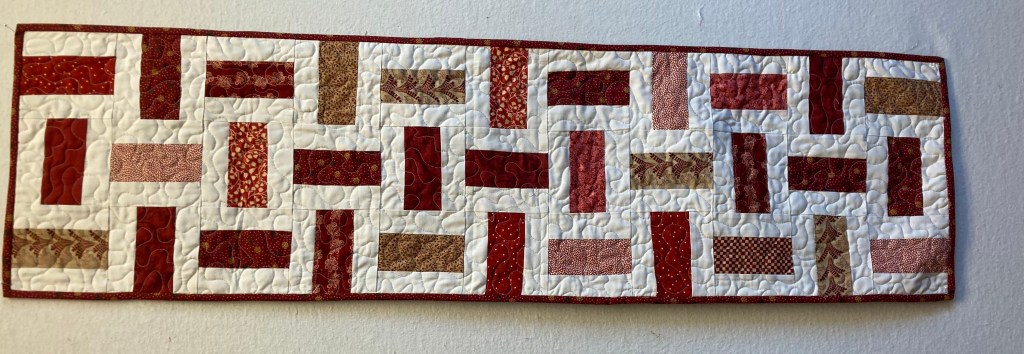
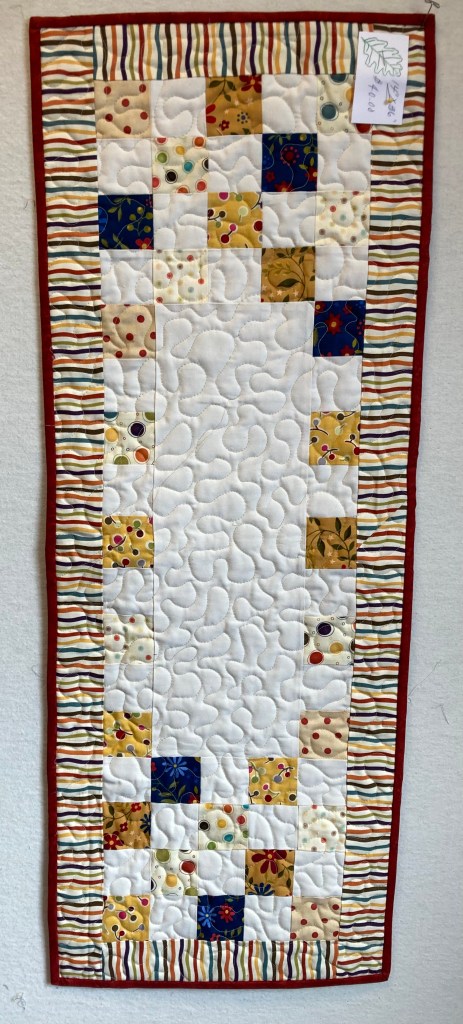
Ribbons–table runner. 18.5″ x 42″. $40

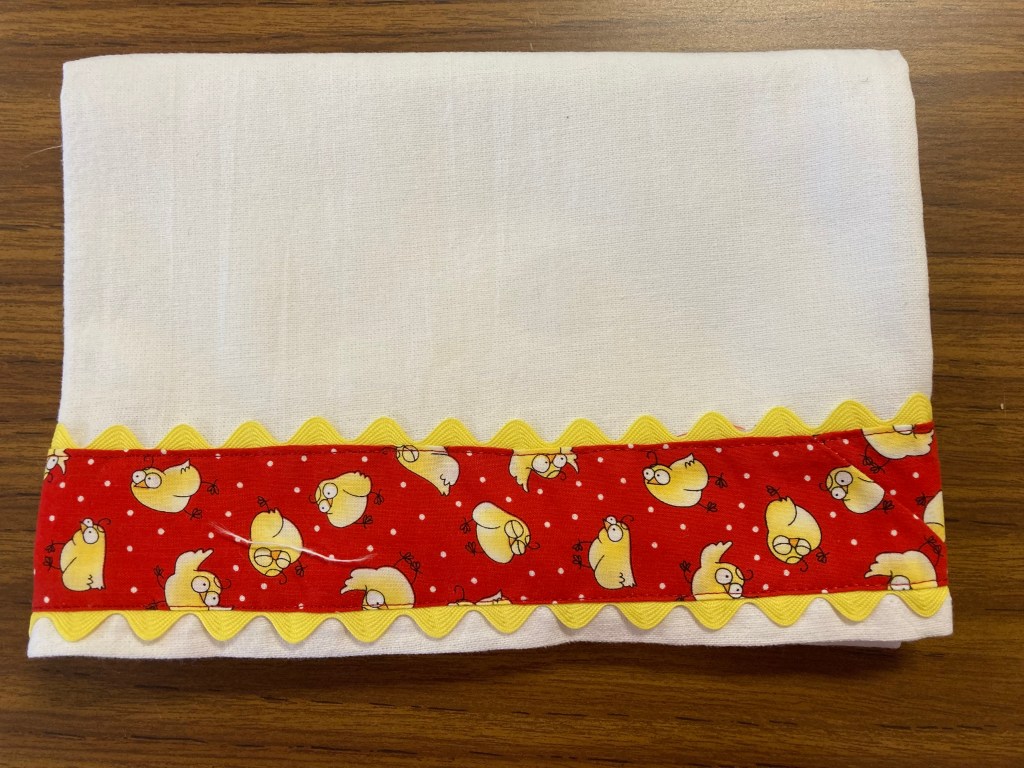
$8.00