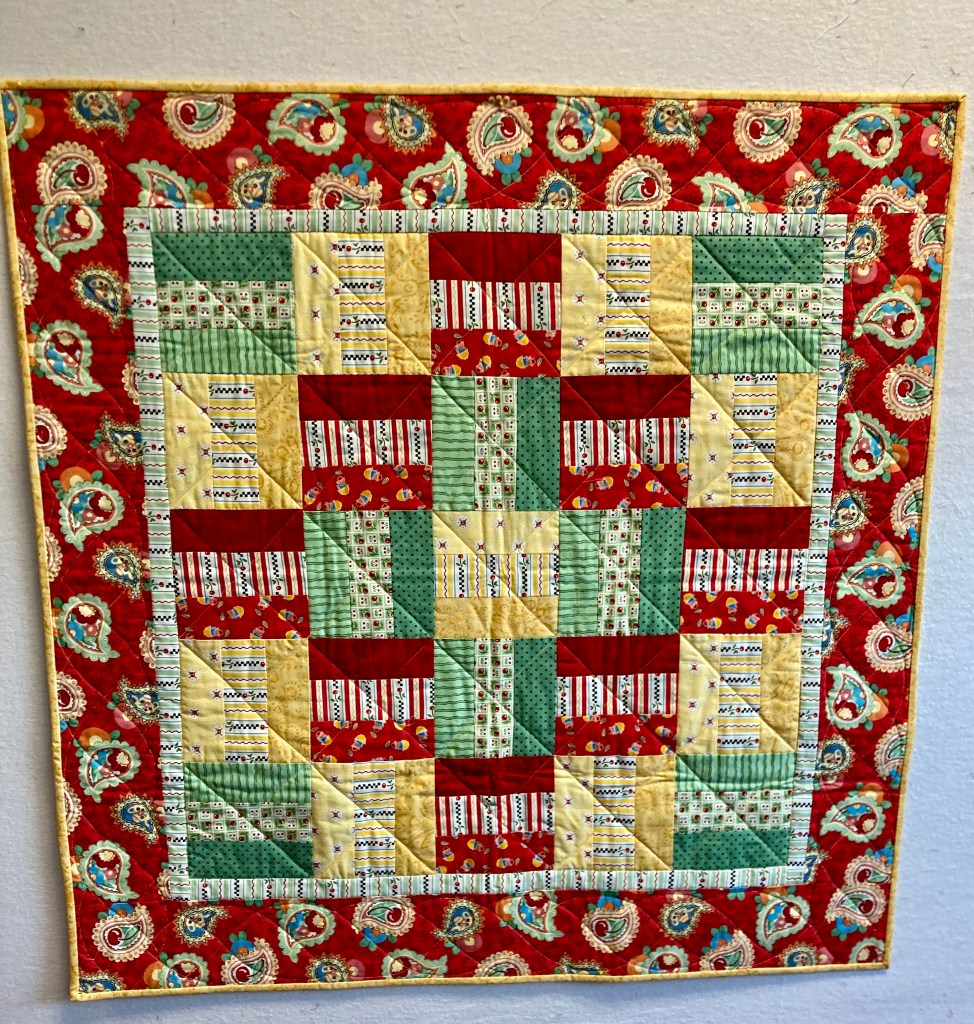
Ric Rac

When I suggested adding “ric rac” to the apron a student was making in class, I was met with the most incredulous look only a teenager can give. Ric Rac? Surely I was making that word up! None of the students recognized the name of a trim they might have seen once. Gleefully, I introduced the class to one of my favorite trims. In fact, I created an entire bulletin board to show off the versatility of ric rac. I am not sure I made any converts, but I still a fan of this trim with the funny name.

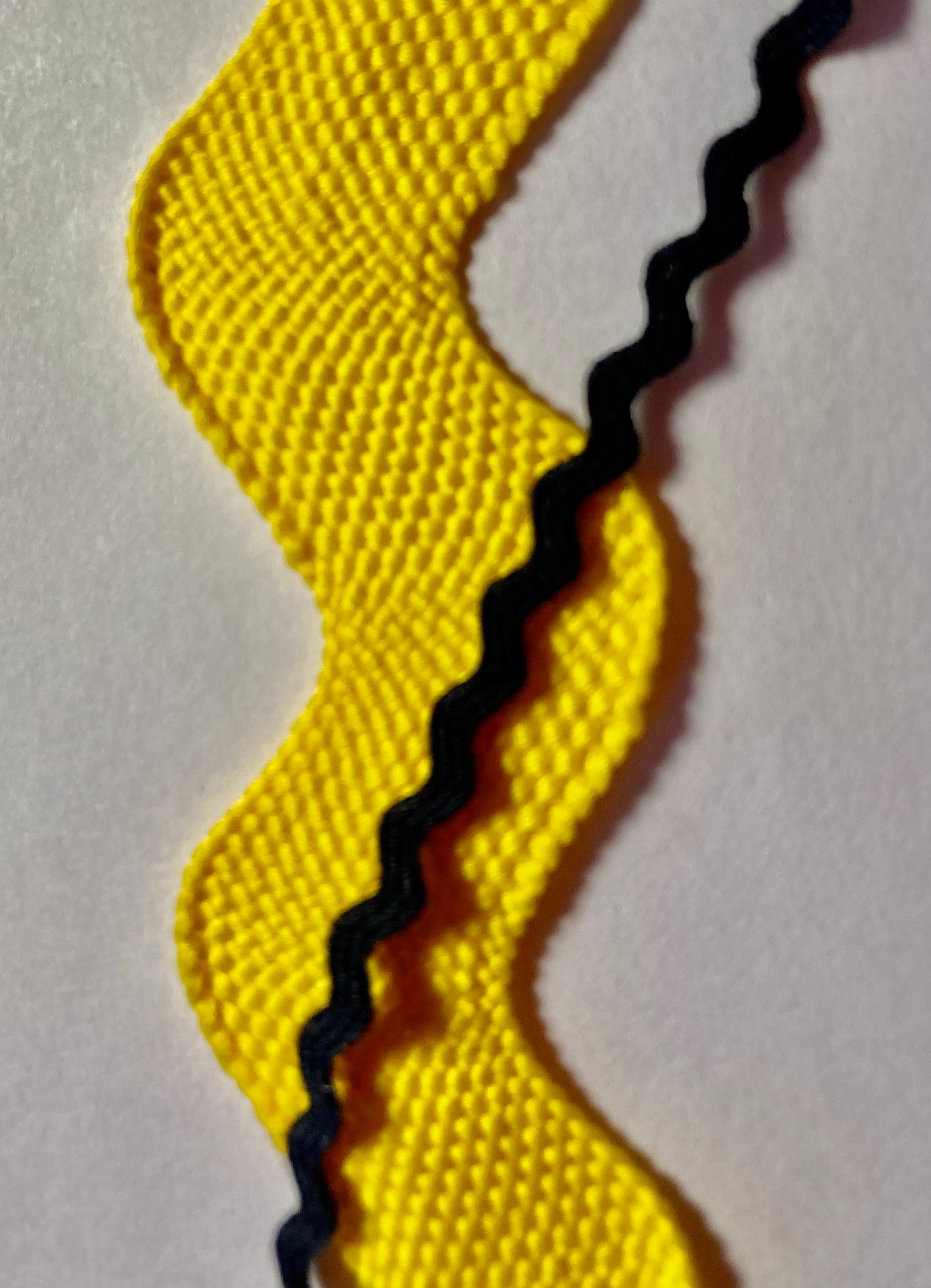
According to the internet and Google, ric rac was originally called “flat woven braid”–very descriptive! Ric rac is a flat woven braid in a zigzag shape and used as a decorative trim on clothing and household items. Originally made of cotton, most is made from polyester fiber now. It came about in the 1860’s and was used to finish hems due to its stability and durability but became popular as a decorative trim. In the depression era, ric rac dressed up garments made from feed sacks. But it’s heyday was the 1970’s.

Today we can purchase several different widths from tiny to jumbo.

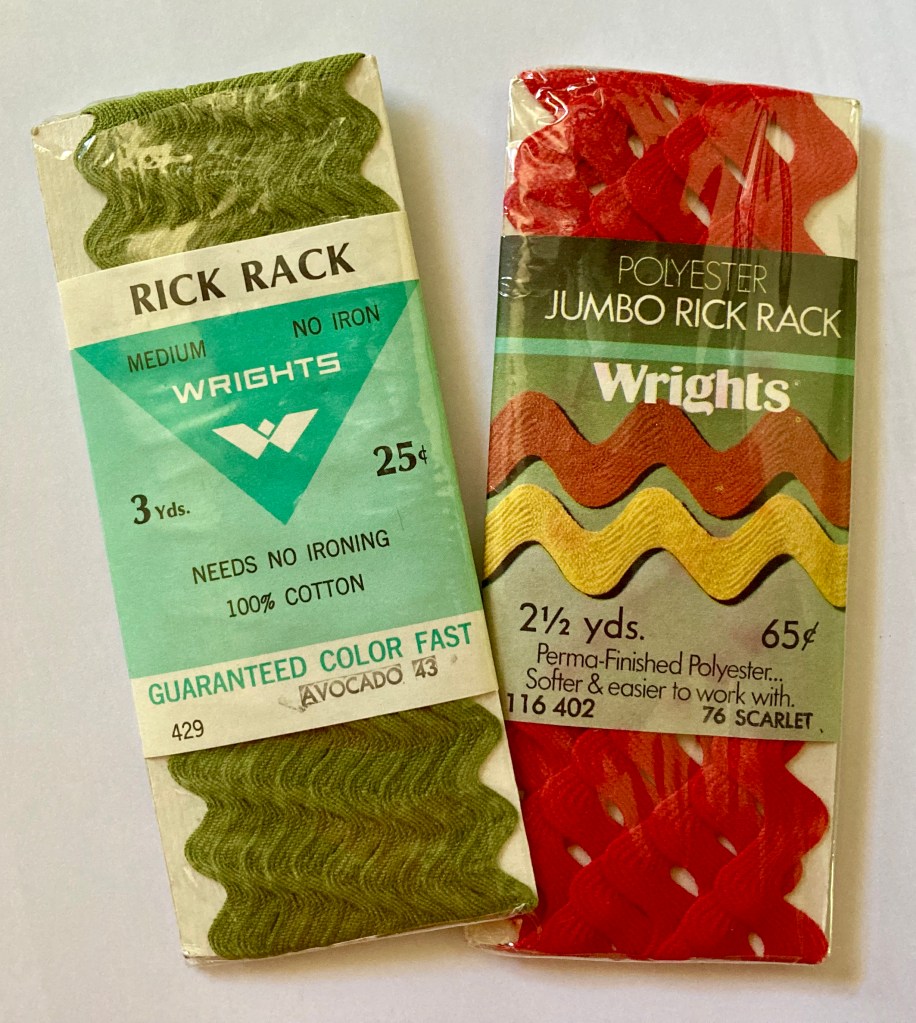
Wrights and Offray are the most common brand names and usually comes in packages containing 2.5 to 4 yards depending on the width. These two packages were rescued from my mother in laws sewing basket. Notice the prices! Today at a nation wide chain, a package is $2.99. The package in avocado gives you a hint of its age. Also notice that switch has been made from 100% cotton to polyester.
Where do I get my ric rac? Since I sew for charity-all my sewing/quilting friends that no longer do much sewing besides piecing or quilting have given me their stash. Friends are on the look out at garage sales, estate sales and in thrift shops for ric rac. Without their generosity, I couldn’t be able to add that final touch!
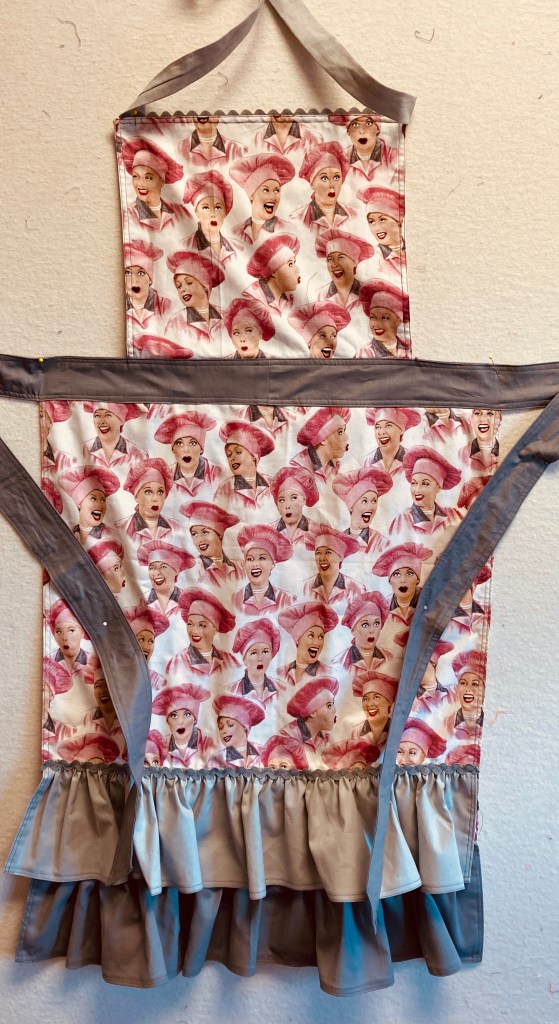
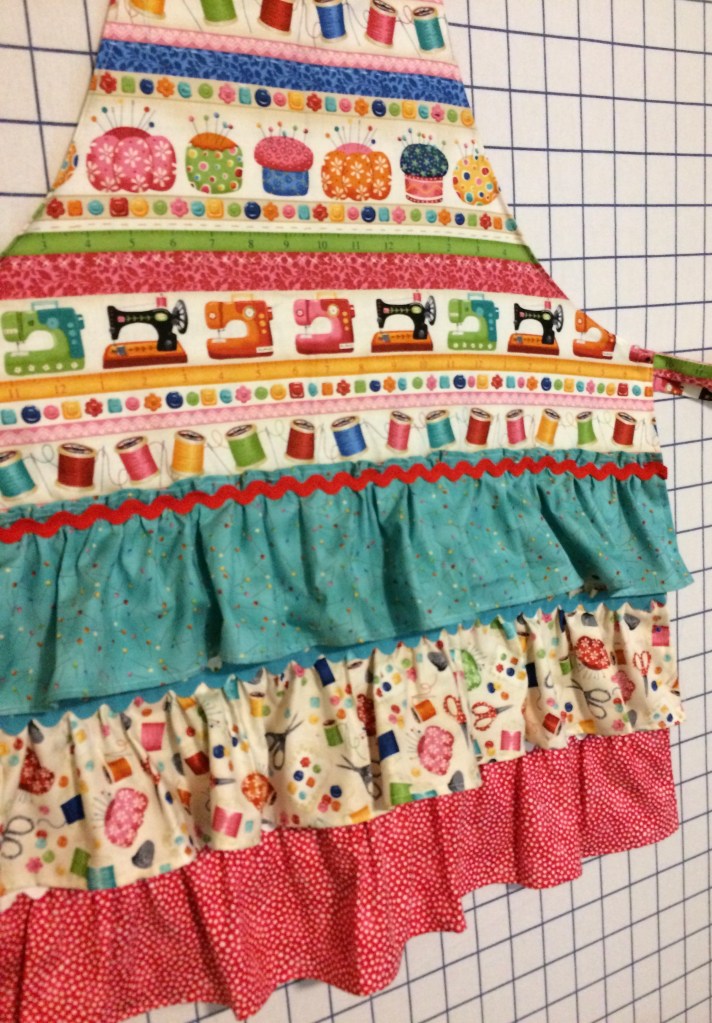
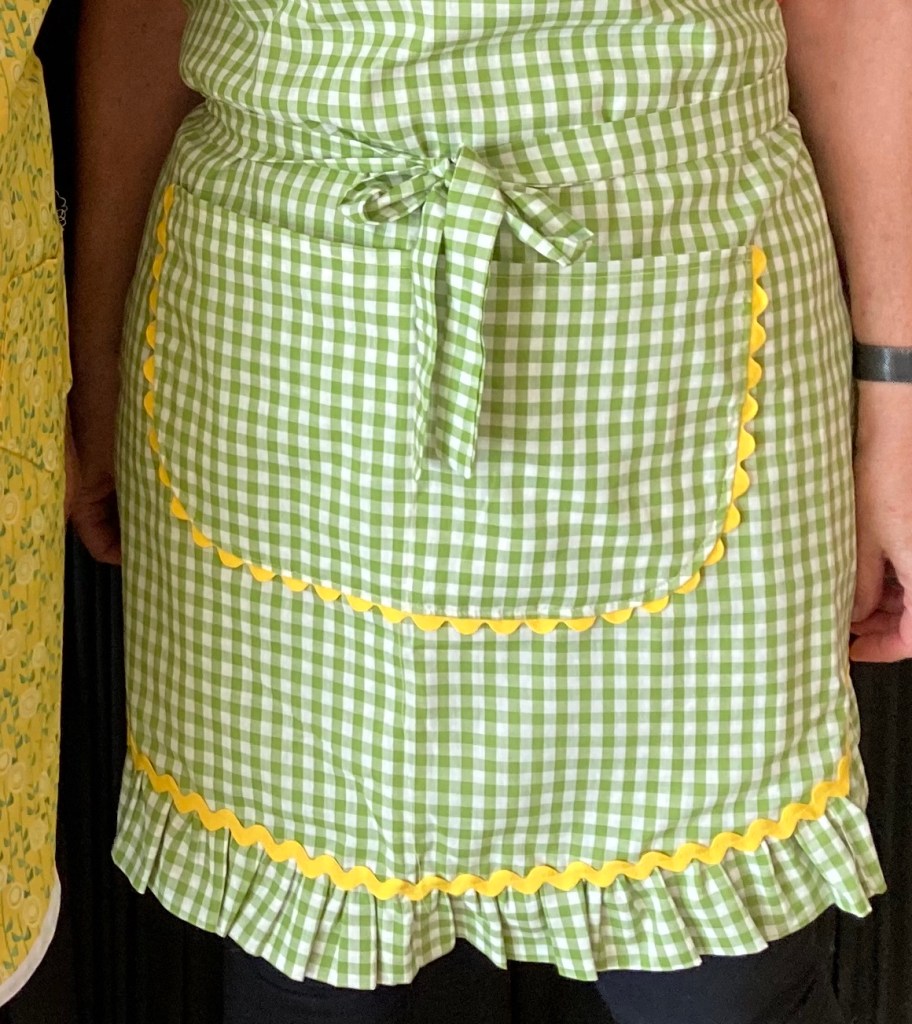
Presently ric rac is not used on clothing for anyone over the age of 6 years! But it is used on aprons….

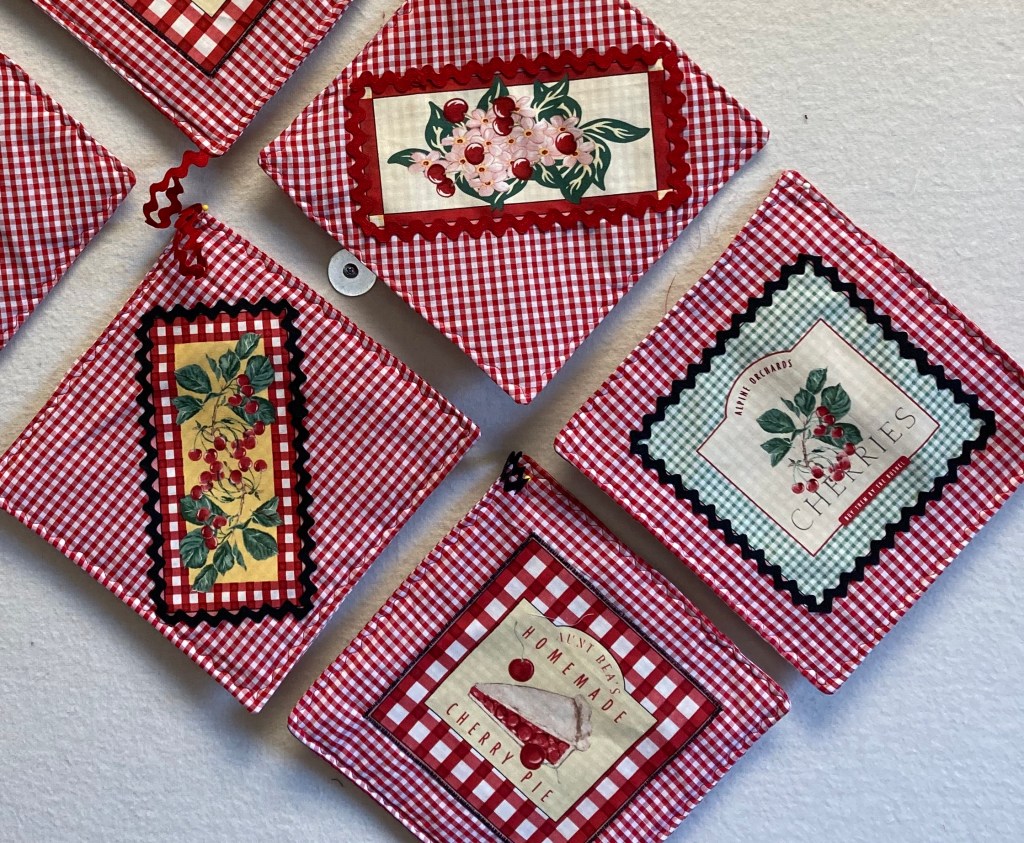
Ric rac is a fun trim to add to hot pads…

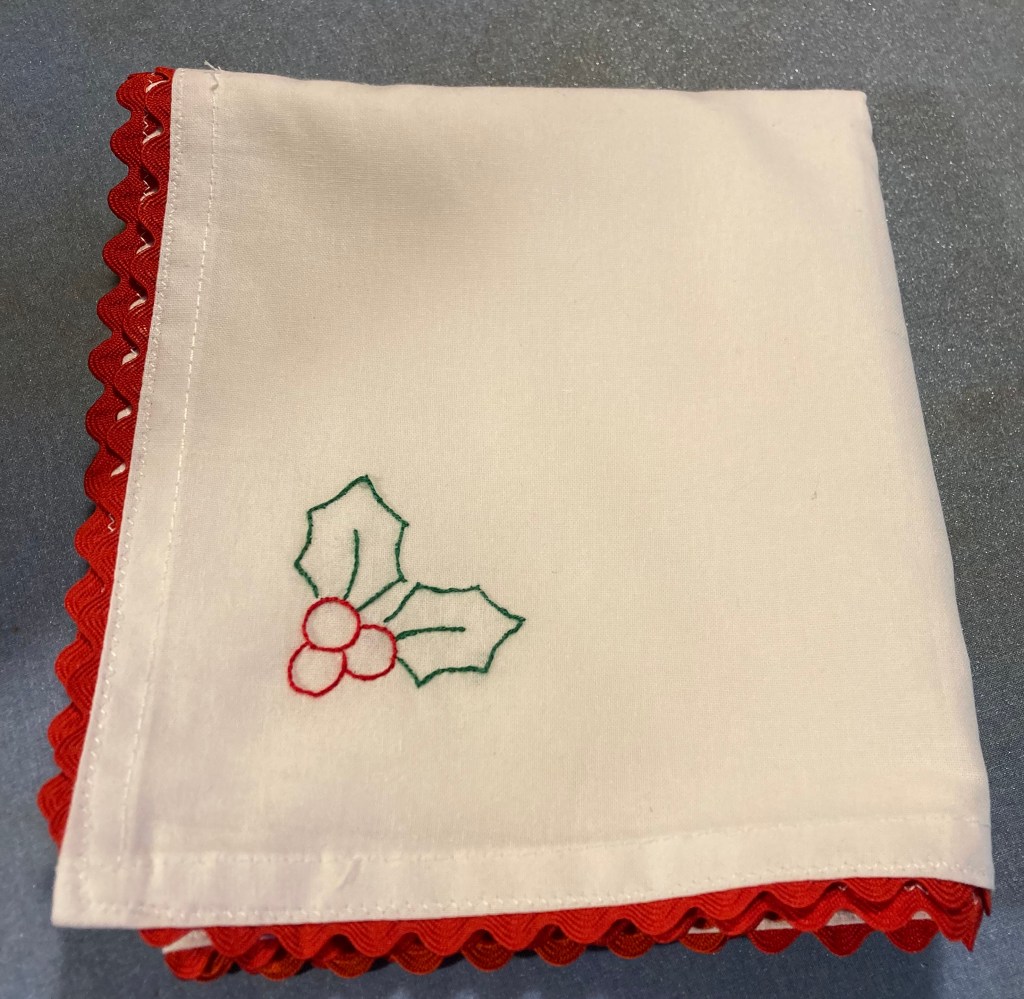
Even a utilitarian towel for the kitchen looks better with ric rac…..

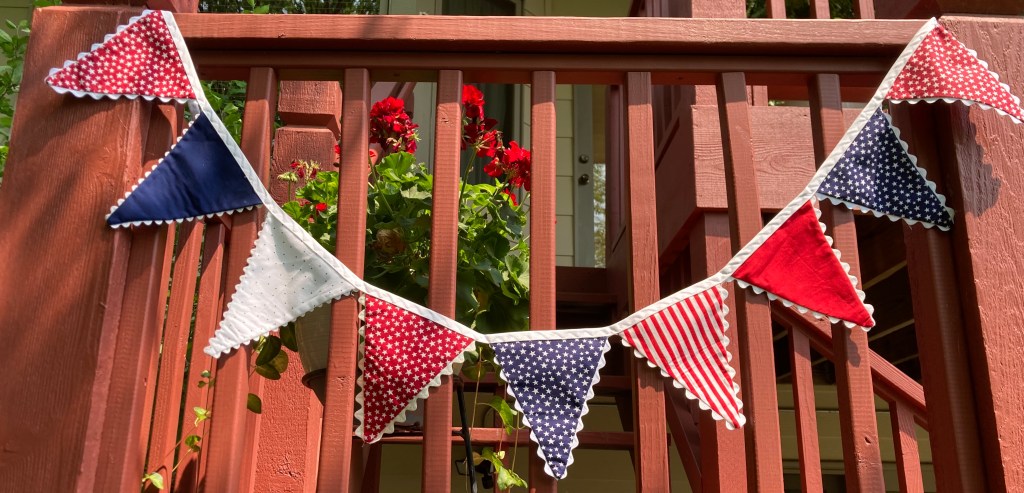
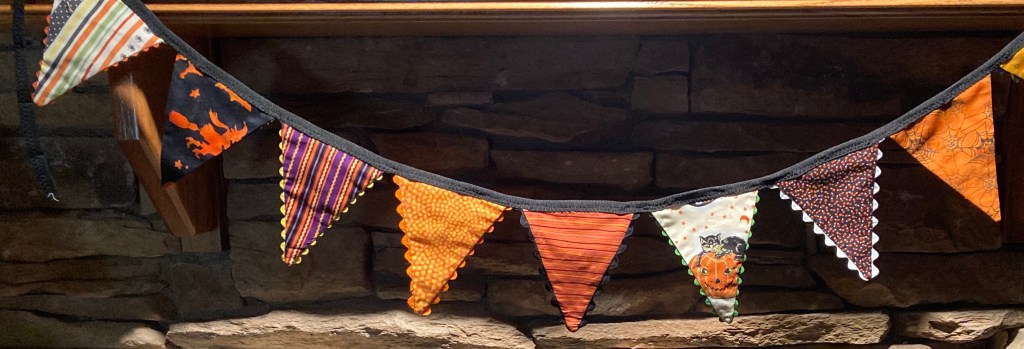
When I make pennants or banners for a holiday or season, ric rac just adds something….

When you are typing ric rac, be prepared— your computer will change the words over and over. Nevertheless, I liked using ric rac so much that I made the words into part of an account password once!

Come to the Quilts Etc. Sale in October and see how many items you can find with ric rac trim! The sale is October 21 and 22 at First United Methodist Church, Wichita, KS, and for all of you that are not ric rac enthusiasts, the vast majority of items won’t have any ric rac!

Playing with Blocks

Quilters love to play with blocks! Not the wooden cubes of our childhood– but those squares of fabric cut and combined with other squares to create a quilt top or the square made up of little cut shapes that create a pattern that will be repeated over and over to create a quilt top.

The most basic quilt block is a simple square–and it is a very good place to start your creative endeavor.

Any number of “looks” may be made using different color and prints depending on the arrangement of the blocks

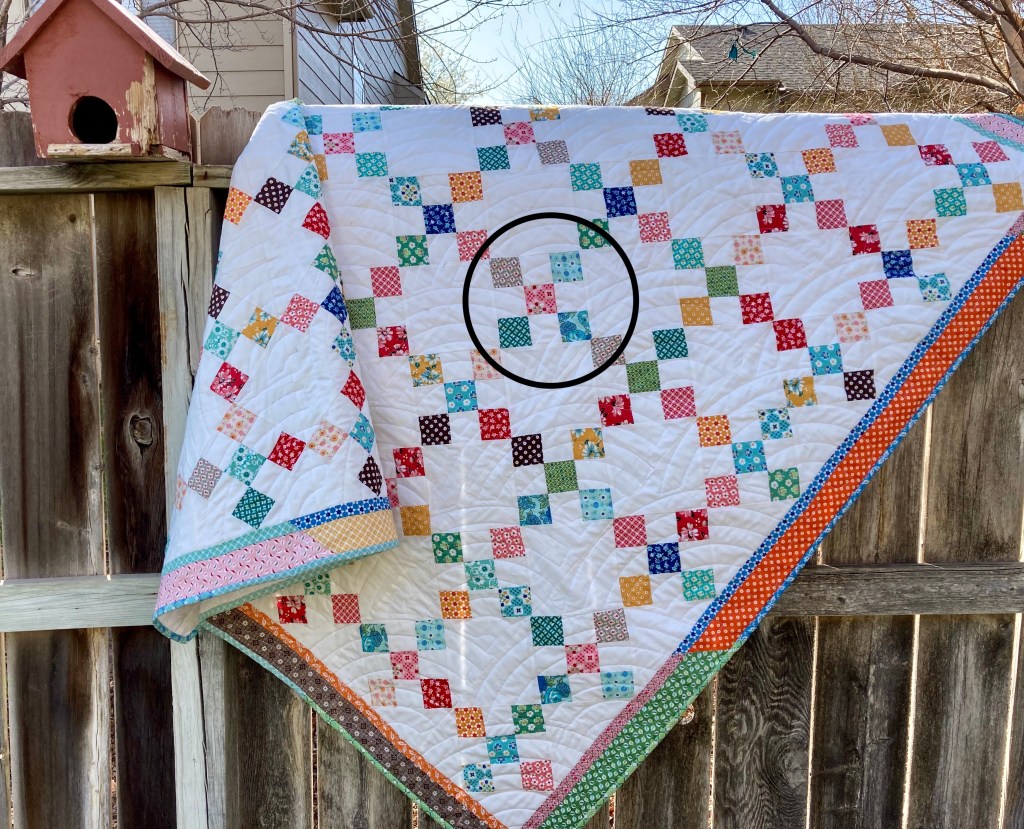
Nine-patch, cousin to the Four-patch, is made by alternating squares. This Nine-patch is set “on point”, another trick to add interest.

The quilt measures 65″ x 73″. $250

But why do something simple? Quilters like to manipulate small squares, rectangles, triangles, wedges and even circles into designs more complicated and perhaps more interesting. Quilters identified the different patterns with a name that was easy to remember and descriptive of the design.

Many factors went into these names. Block names may reflect where the quilter is physically located. Kansas pioneers quilted to keep their families warm and as an outlet for their creativity. The names of three blocks tell a story of life on the frontier.

Rocky Road to Kansas uses every tiny piece of fabric left over from clothing construction, illustrating the hardships and frugality of the pioneers.

Kansas Troubles is prickly and has two sides–reflective of the period in the states history known as “bloody Kansas” .

Kansas Dugout is simple with a small center, appealing to quilters who lived in or remember living in cramped sod homes. This block is also known as Grandmother’s Dream, Church Windows, Going Home etc.

The Kansas City Star was famous for hundreds of quilt block patterns printed with instructions and templates for free during the depression and WWII ! To read more about the paper’s pattern go to https://quiltmuseum.org/kcstar/. I have an envelope of fragile, yellow patterns my grandmothers cut from the paper–I inherited my tendency to collect more patterns than I will ever possibly make!

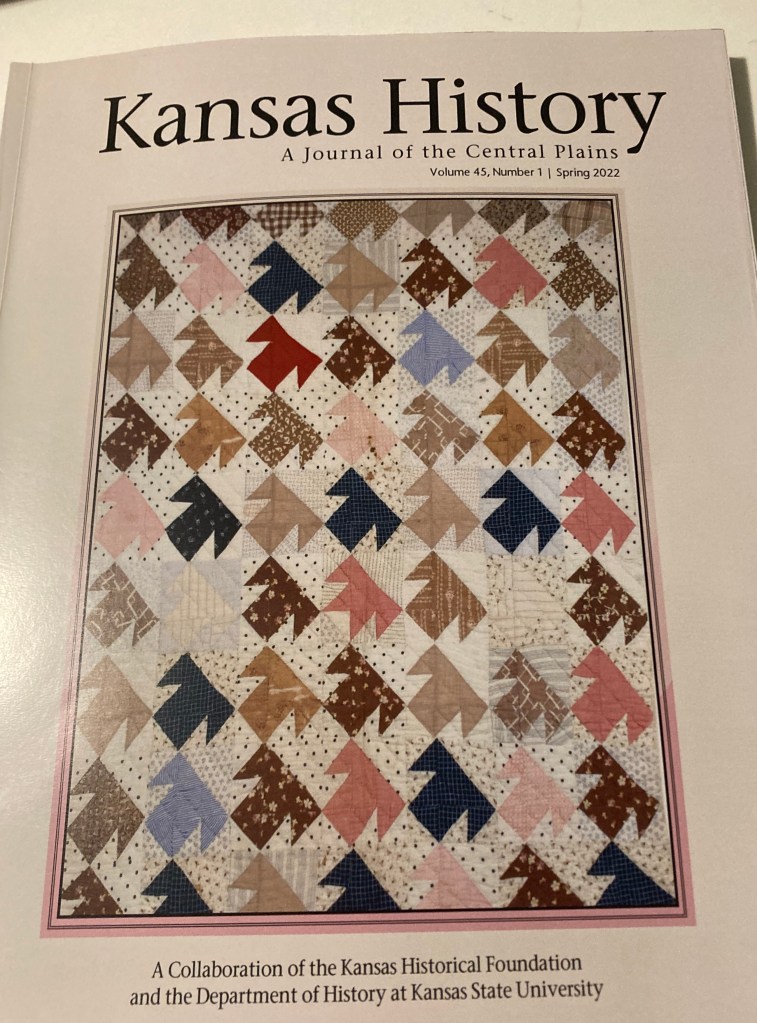
The current issue of KANSAS HISTORY featured the Temperance Quilt block. Women fighting the sale and manufacture of beer and spirits created a block to promote their cause. Often the women paid a nickel or dime to have their name embroidered on the block as a fund raiser.

Currently, quilters are creating quilts featuring sunflowers, the national flower of Ukraine, to show support and/or to raise funds for different refugee charities.

We have many quilted projects using the “tried and true” blocks—-

The Log Cabin is one of the oldest and there are many variations of the block.

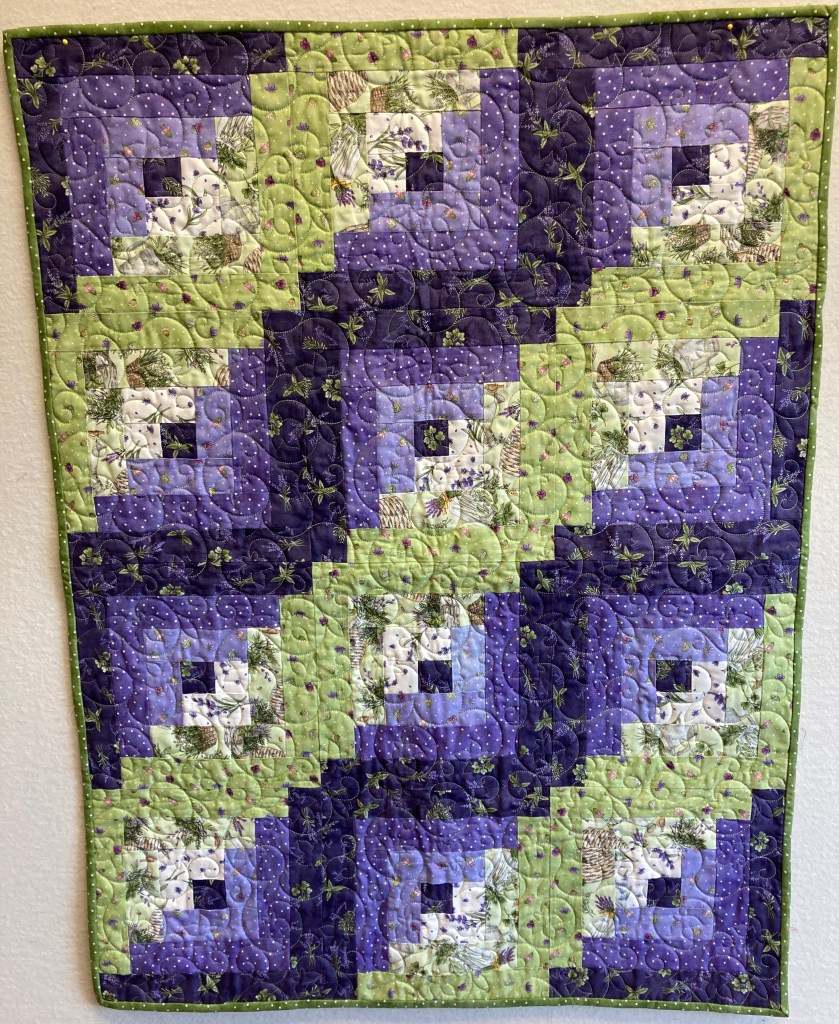
A traditional Log Cabin in rich greens and purples was made by Vicki. It is 28″ x 38″ and is $50.

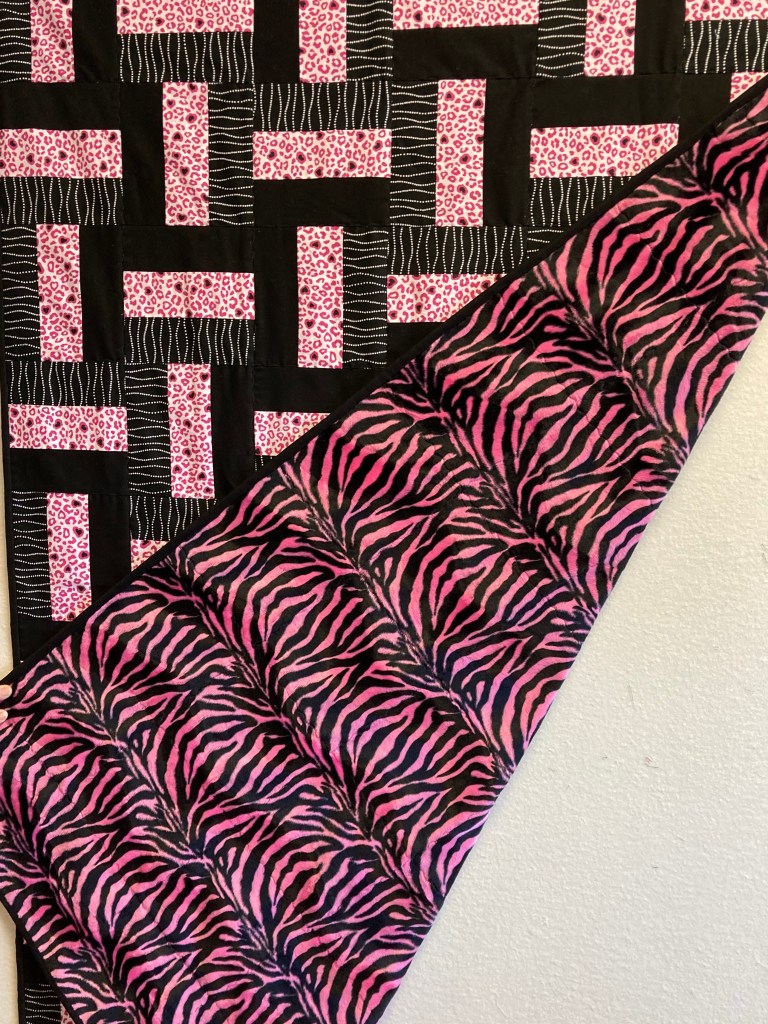
Rail Fence is very popular; the three rectangles reminded pioneers of enclosures using three split logs interlaced with three other logs. This pattern also has many variations.

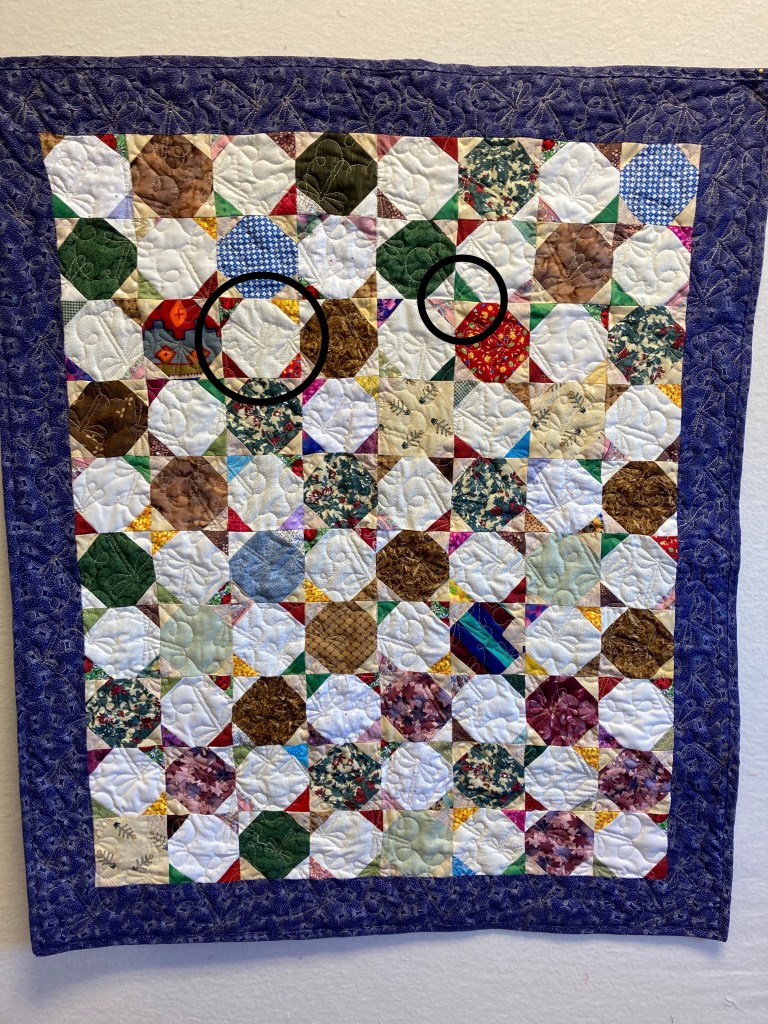
This scrappy quilt used the Snowball block–a simple block but the use of color and prints make it appear more complicated. The corners of the snowballs form a secondary pattern–an Hourglass. The quilt measures 37″ x 42″ and is for sale for $50.

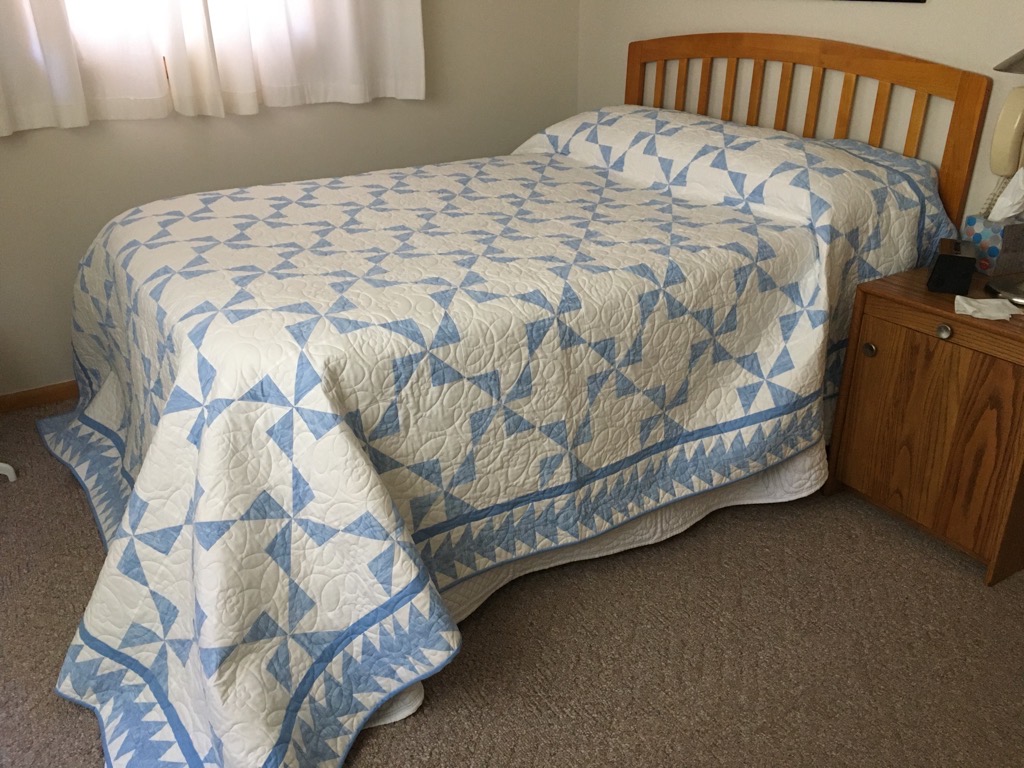
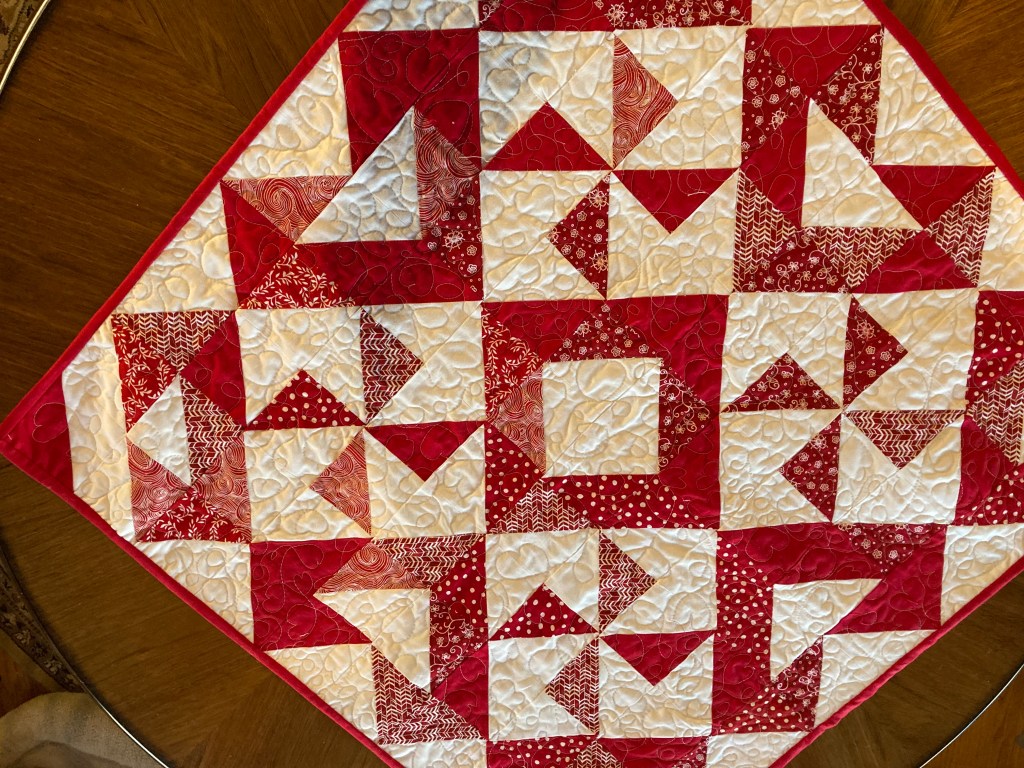
Pinwheels are basically half-square triangles set to create a sense of motion.

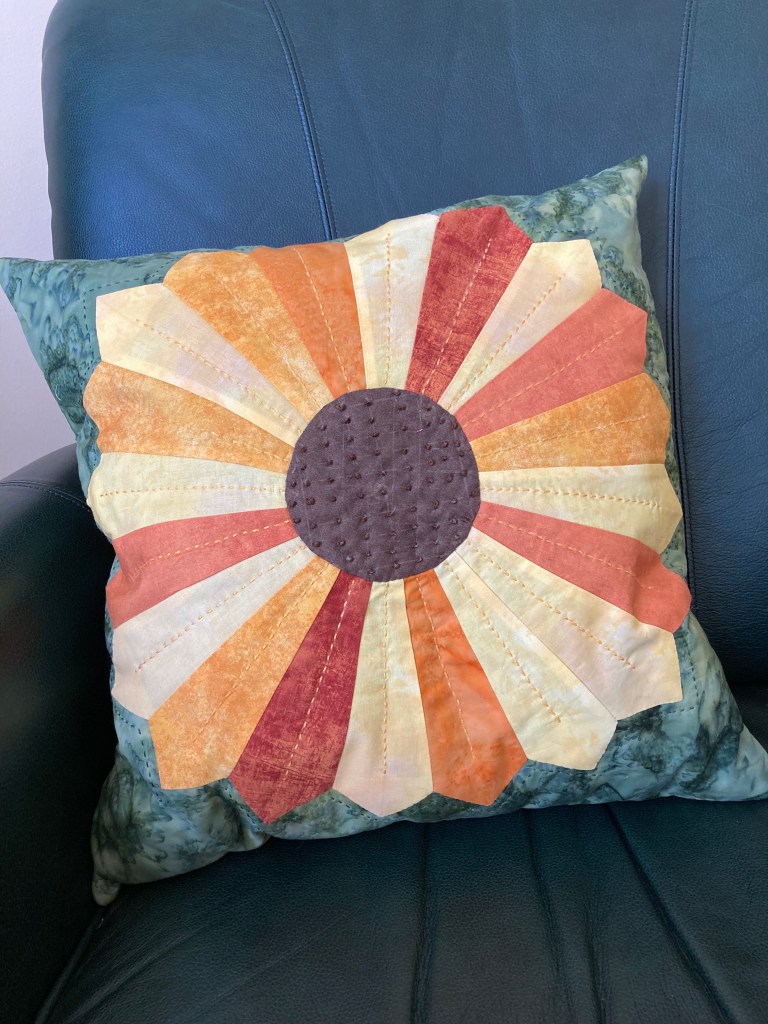
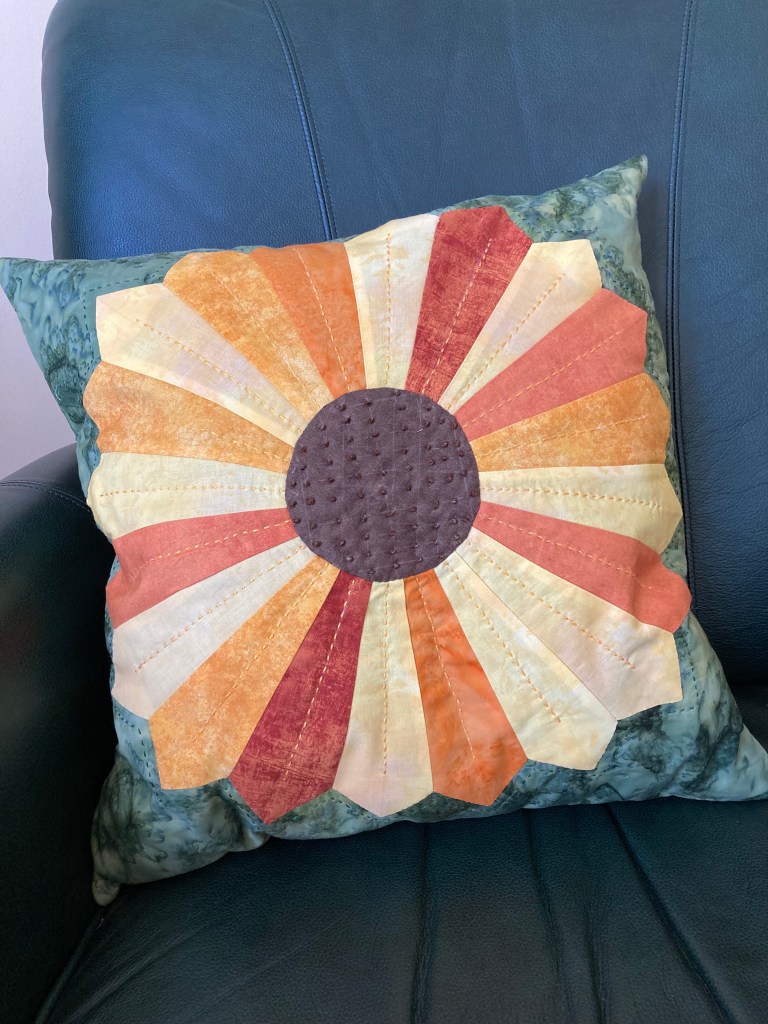
This pillow top is an adaptation of the Dresden Block and uses wedges. It was The number of wedges is dependent upon the width or angle. Originally this block was named after ornate china from Dresden, Germany. It became popular in the late 1800’s.

This pillow measures 18.5″ x 18.5″ and is $30.

This is just the “tip of the iceberg”. Amazon has hundreds of quilt block reference books. Flowers, stars, animals, places, people, Bible stories, food, transportation–all are the source of names for quilt blocks. Just add your twist and you can name it!

Shoppers do not need to wait until October and the Quilt Sale. All items are for purchase now. Please contact me via the comments section of this post.

Life Happens!

Well, life happens! This is not news, but this past week or so, “stuff” seemed to change plans and interrupt daily schedules. My brother and my husband had routine surgeries. My husband’s was be minor and he would be back on his feet in a long weekend. Oops, now he is completely off his foot and no driving for four weeks! My brother was having a procedure that he had had five or six times before and out of the blue he had a reaction to some of the medicines and that changed everything! I know all of you have had similar situations. Remember the old Yiddish saying “Man plans, God laughs”?

Thus, this week I am just going to show off some recent finishes by the Quilters at First. There is no theme- we have a habit of telling ourselves and each other that we will make thus and thus to insure there will be a balance of items at our Quilt Etc sale in October, but we are so easily distracted by new patterns or pretty fabric! So these are our newest additions!

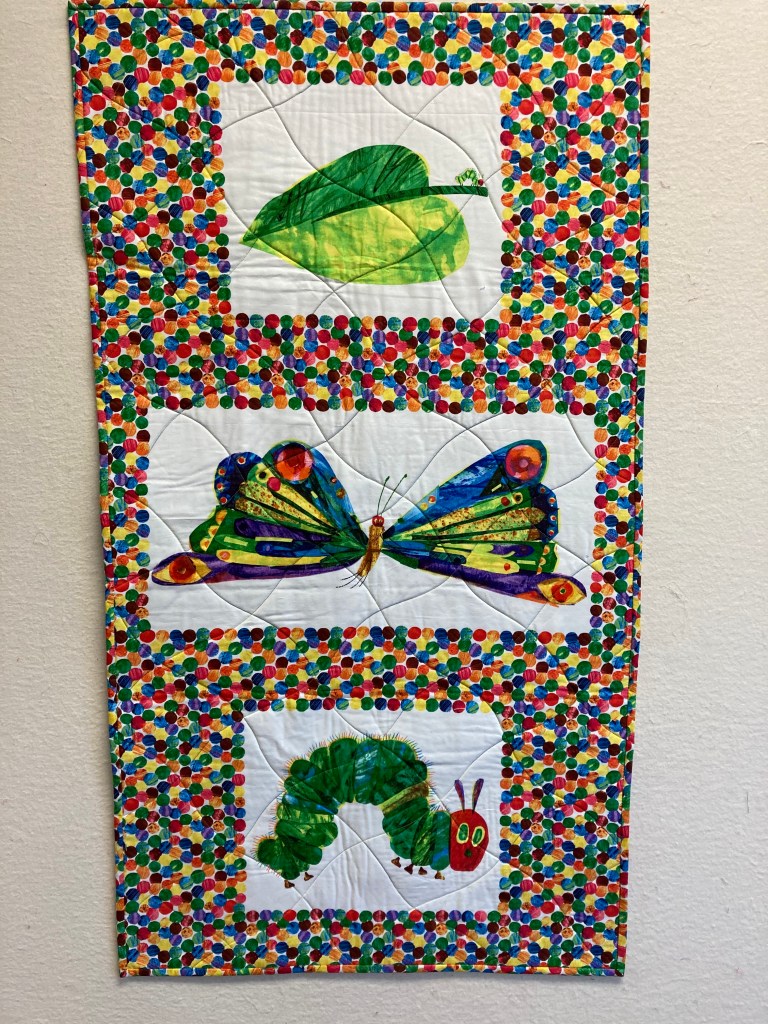
The Very Hunger Caterpillar would brighten any child’s room as either a wall hanging or runner on top of a chest of drawers. Janis added a new copy of the Very Hunger Caterpillar board book. This is $50. I didn’t get the exact size but it is approx. 20″ wide and 45″.

Can’t be too early for the holidays! This wall hanging is 31″ x 36″. There are hanging ears on the back so a dowel rod could be used to hang this with the aide of Command hooks. The back is a bright holly with berries print. It is $50

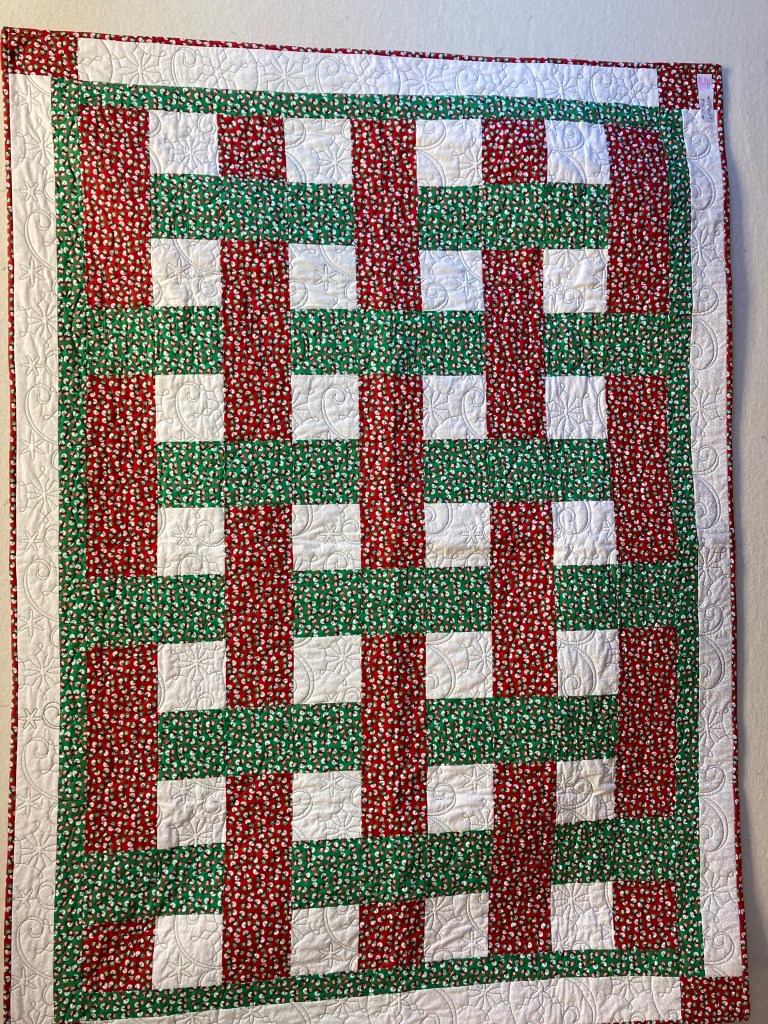
Shirley was also thinking of the winter holidays when she created the scrappy Christmas print quilt using the Chinese Coin pattern. It is 70″ x 74″ and is $200. It is a large twin or would work on a double.

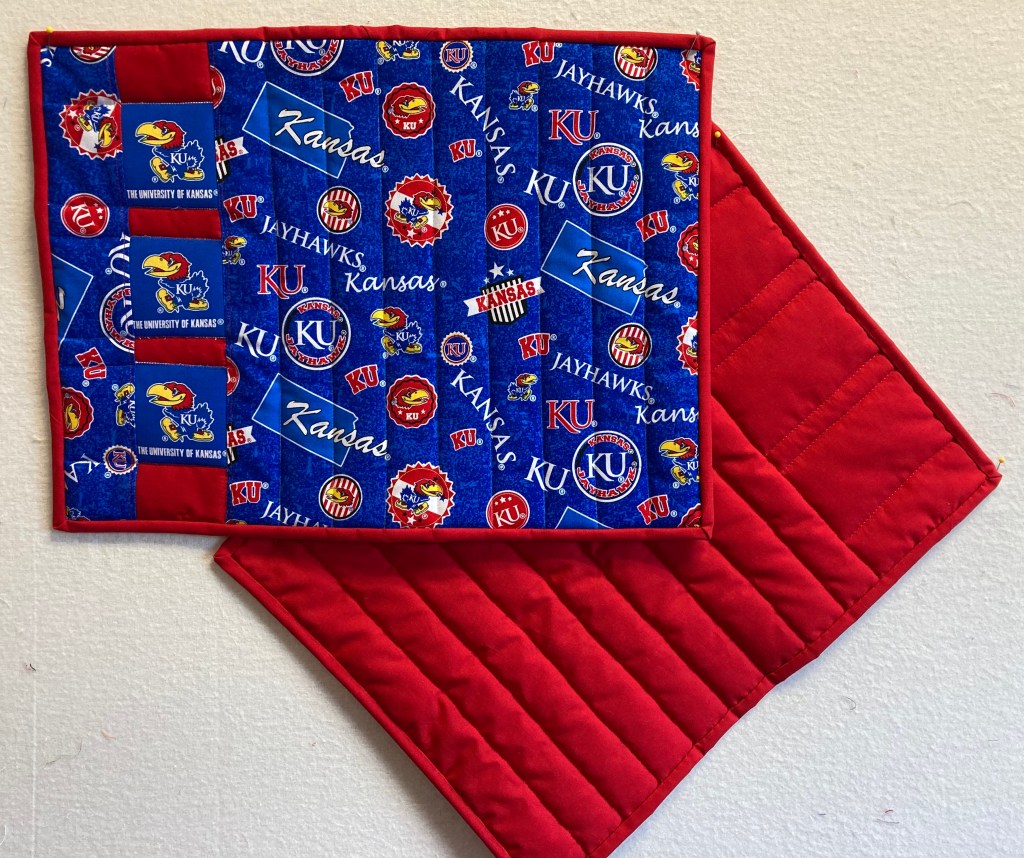
Do you know someone whose child or grandchild is off to KU next fall? These placemats would be a perfect gift for parents of a future KU students. The placemats measure 14″ x 18″ and the four are $40. (All our placemats are machine washable.)

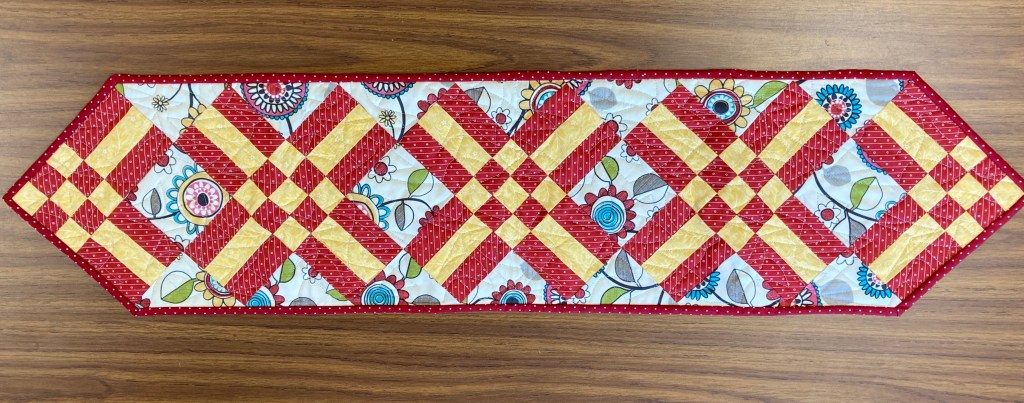
This cool rainy May weather will quickly become hot and sunny. This bright 10″ x 40″ table runner is great for a casual warm weather table. It is $40. SOLD

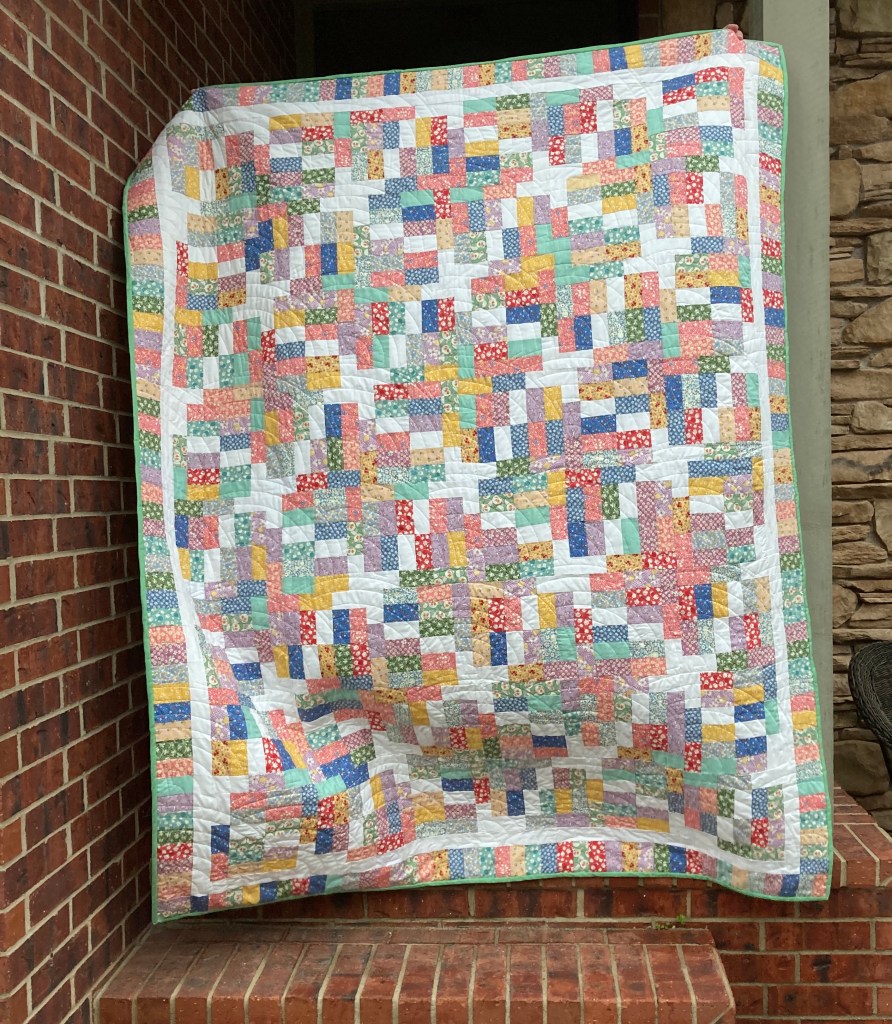
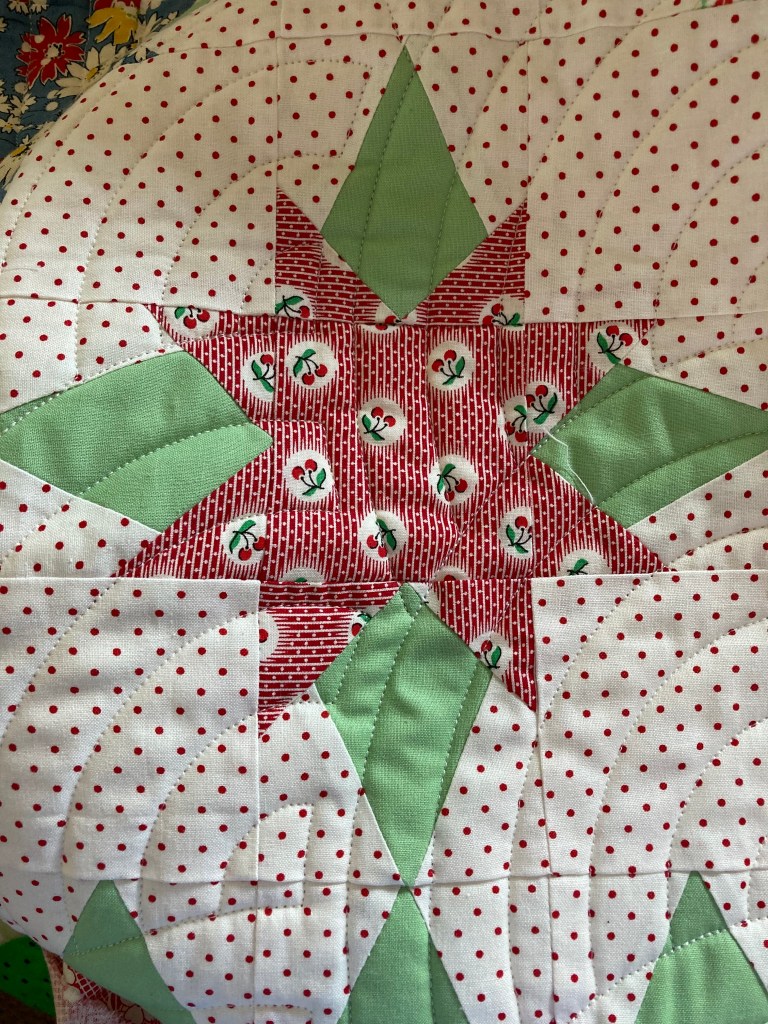
The fabrics are 30 and 40’s reproduction prints. The long arm quilting is Baptist Fan. It is bound in “that green” –very popular in the 1930’s. It measures 62″ x 72″ (would fit a twin bed) and is for sale for $250. This was interesting to make for every piece in this quilt is the same size!

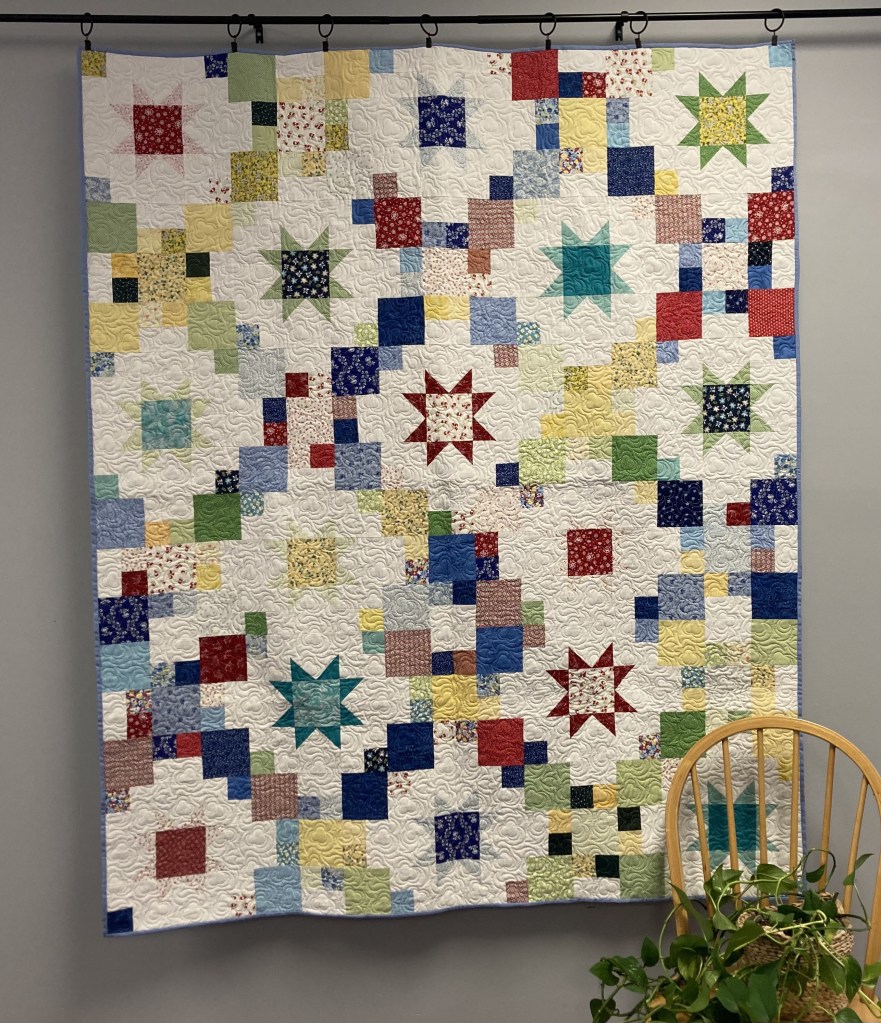
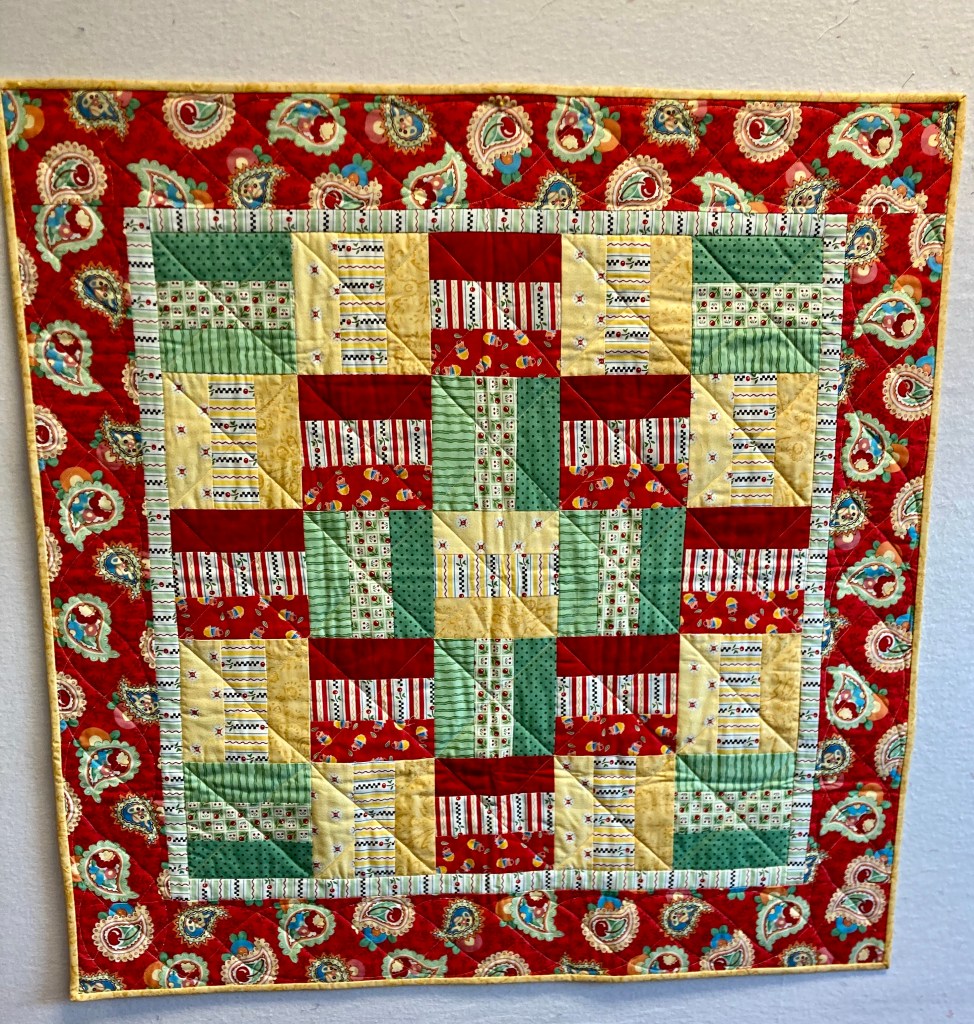
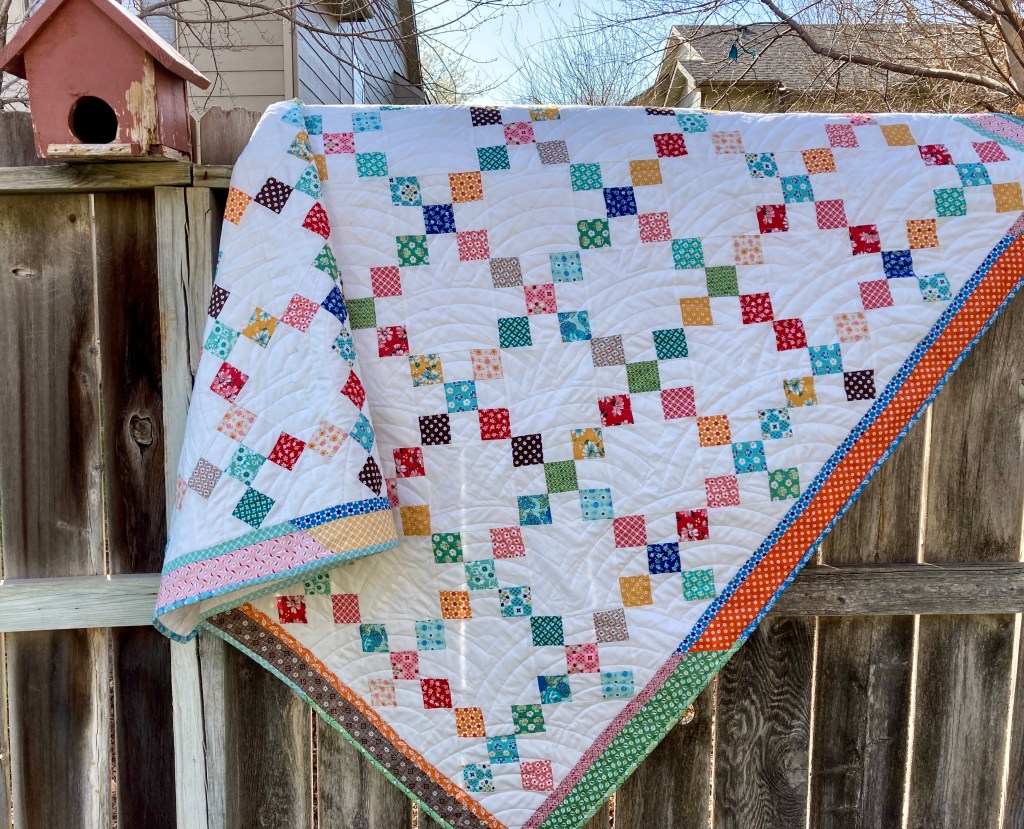
It is a “sort of” scrappy nine patch. The borders and binding are from the same jelly roll collection. The quilting is “Baptist Fan” –Measuring 65″ x 73″ and for sale for $250

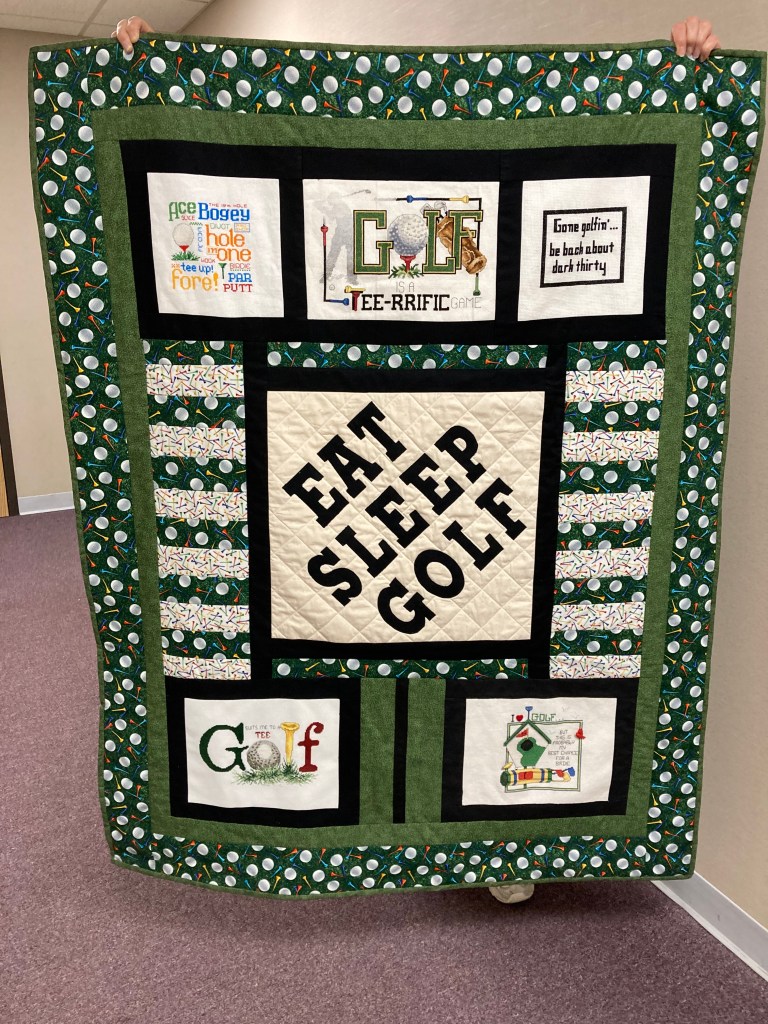
The next photo is a quilt that has probably already sold but just wanted you all to see it! Sharon has lots of friends and “friends of friends” that love to golf and she has specialized in some great golf theme quilts.

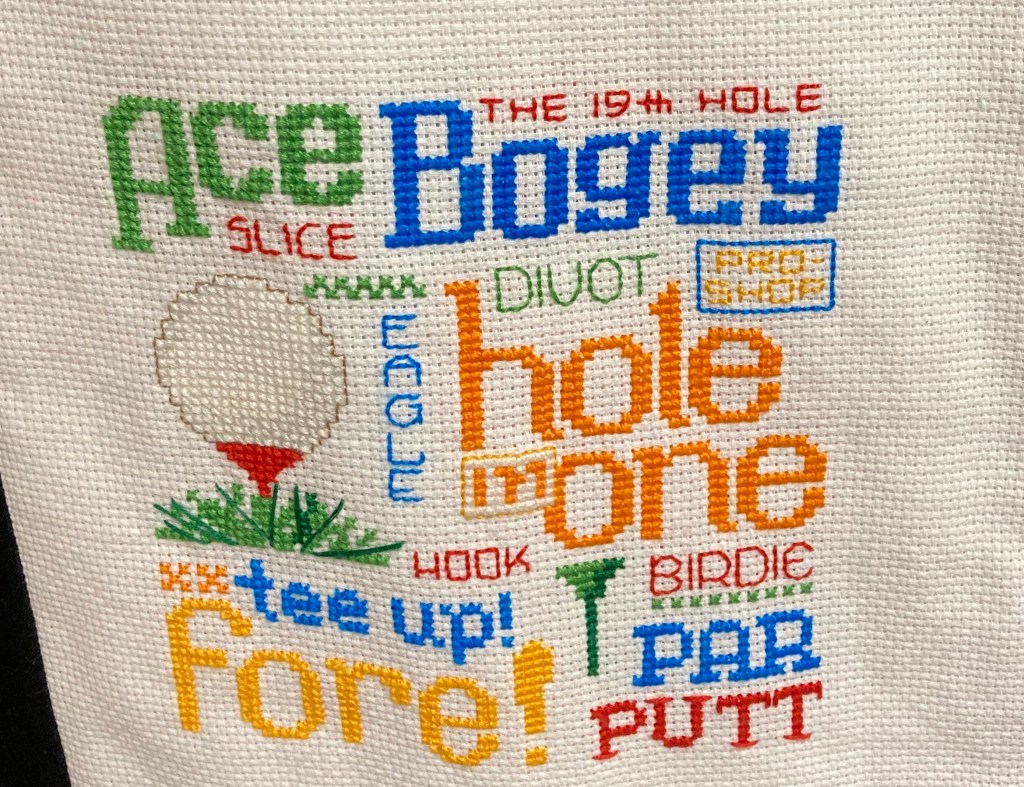
Each of the print blocks are cross-stitched!! She appliqued the words in the center block.

Yup, life happens and sometimes the best therapy is needle, thread and fabric!

If you are interested in any of these pieces, please leave a comment or contact a Quilter at First.

.

Stars in the Quilting World

Quilters love stars in their quilts. Is it because we “wish upon a star”? Or like the Kansas state motto, quilters believe “Ad astra per aspera“— “to the stars through difficulties.” Stars may symbolize our “light at the end of the tunnel”. Whatever, they are fun to make–depending on the pattern!

If you “googled” star quilt blocks, you would find hundreds of star variations. Often the same pattern will have several different names. Twek a pattern, voila–a new star. But some star patterns have been around for years!

Over 120 years, my grandmother made this Lone Star variation for her hope chest. This quilt top has nine stars–the Texas Lone Star is larger making up the entire quilt top. This pattern is still popular but has been adapted for rotary cutting and strip machine piecing, speeding up the production immensely.

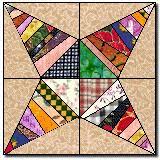
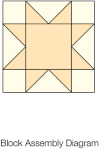
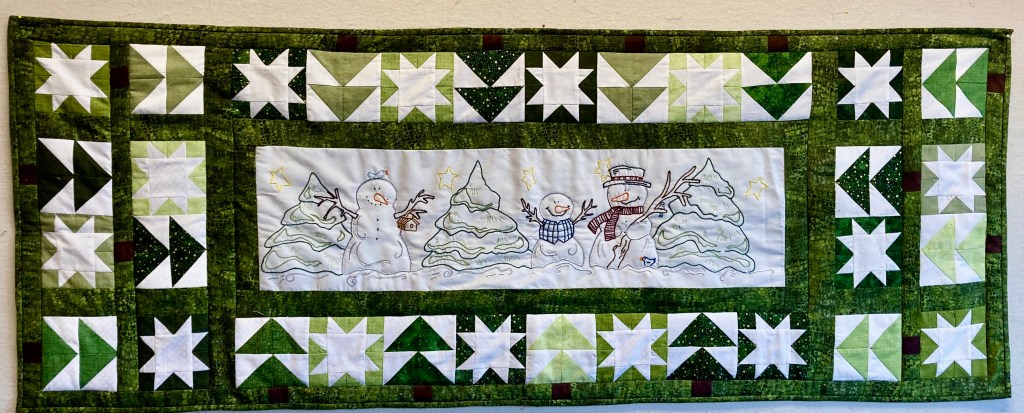
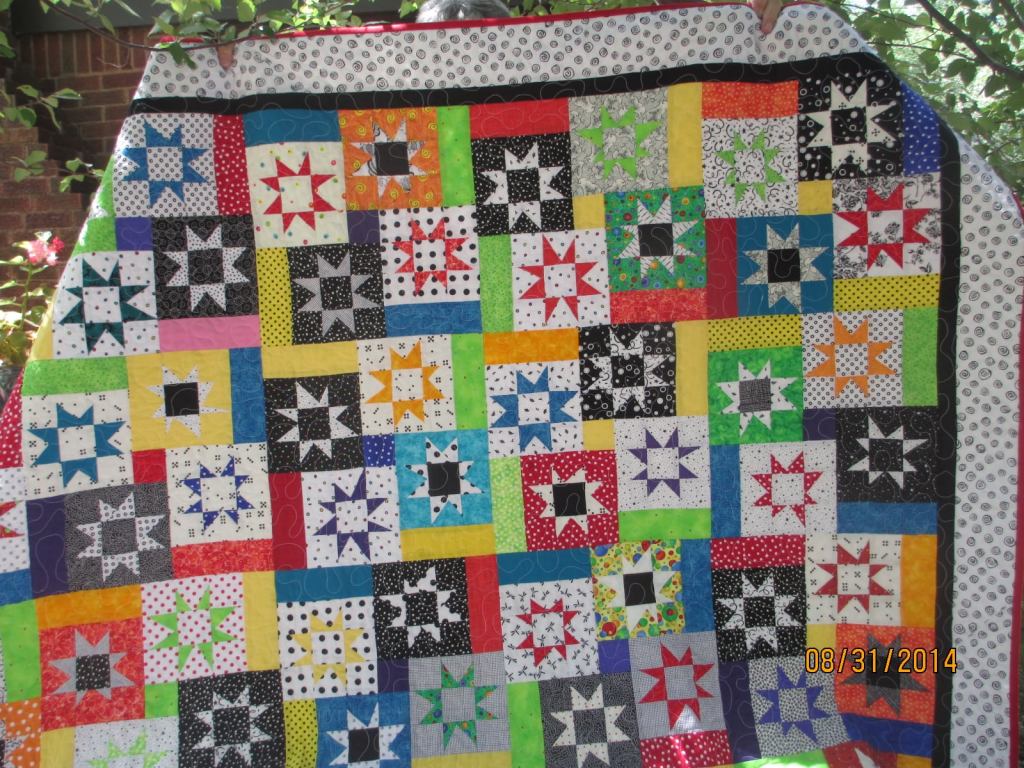
The Sawtooth star is another favorite; simple to make. Four flying geese blocks are attached to the sides of a square. Most of the time the “star” pieces are all the same fabric–but the center square might be a fussy cut design from a “conversation” print.

This table runner made by Vicki uses white sawtooth stars as part of the border. The center panel is stem stitch embroidery. Measuring 22″ x 57″, it is $75.

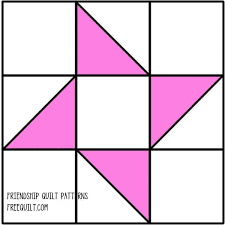
The Friendship Star is the most simple. Why Friendship? Do not know. Maybe this star was simple enough for friends to make to create a “signature” quilt for someone special. This pattern could become more complicated by doubling the points, the color placement, and the addition of other blocks surrounding it.

This table runner by Elaine features gold friendship stars–Measures 18″ x 42″ and is for sale for $45

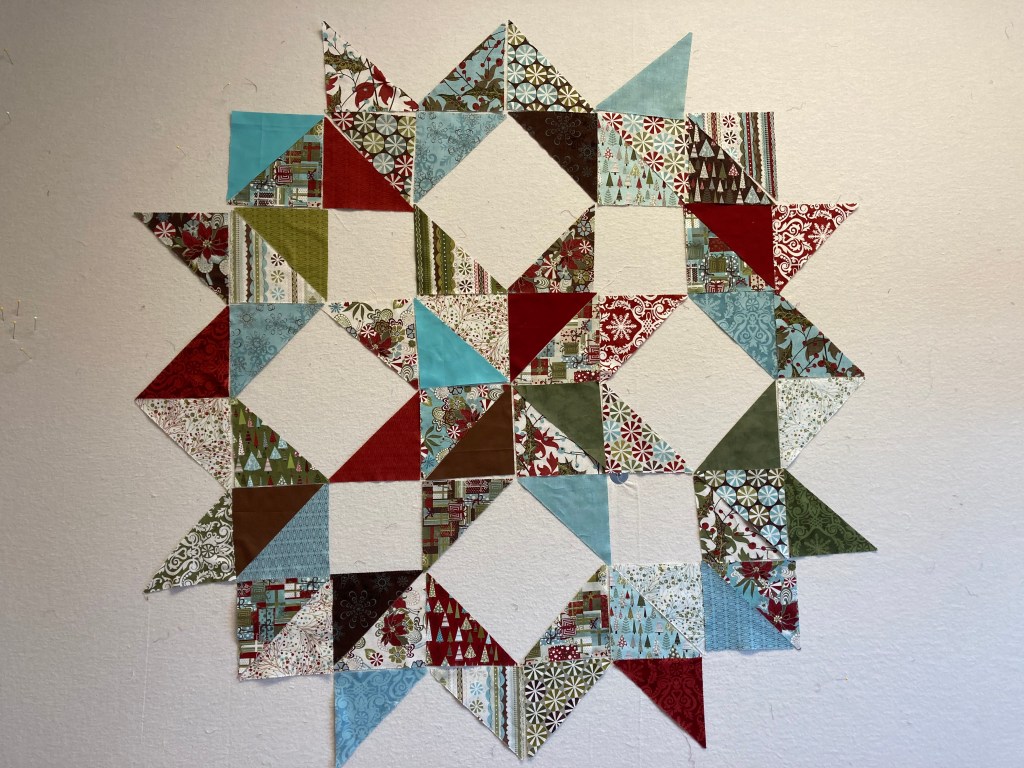
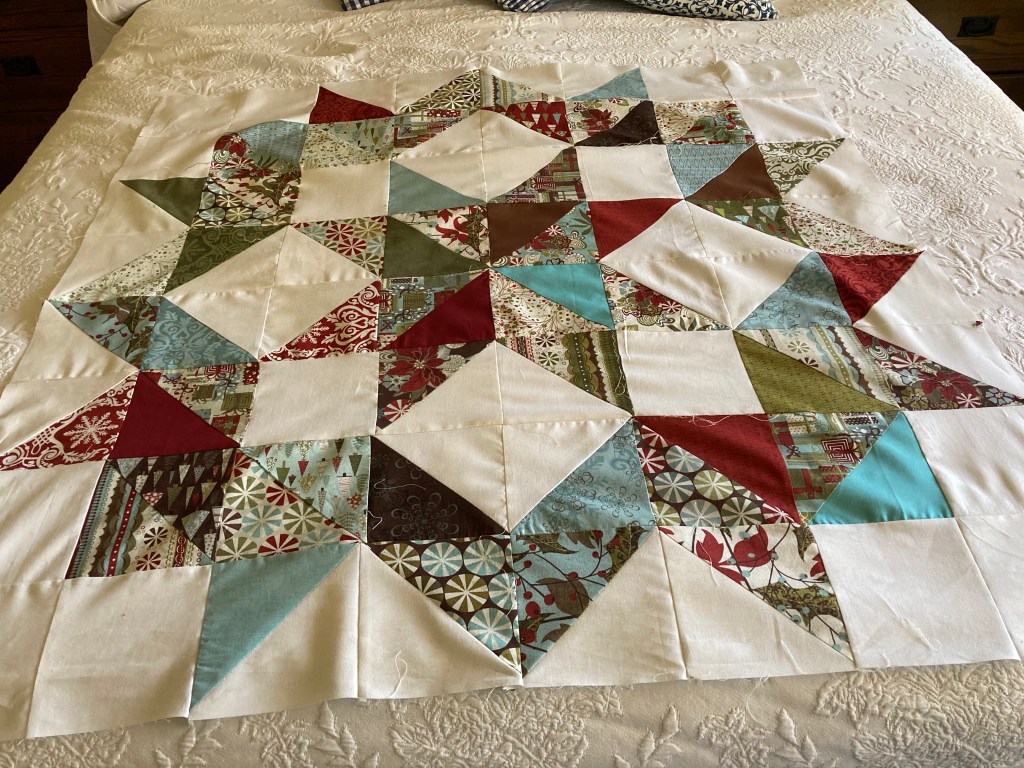
I usually don’t show unfinished projects, but I am making a Carpenter’s Star table topper or wall hanging in Christmas prints.

On the design wall and sewn together–life happened and it isn’t quilted yet.

This quilt needs binding before it is photographed, measured and priced. (Secret–my least favorite part of quilt making is machine sewing the binding before finishing it by hand binding)

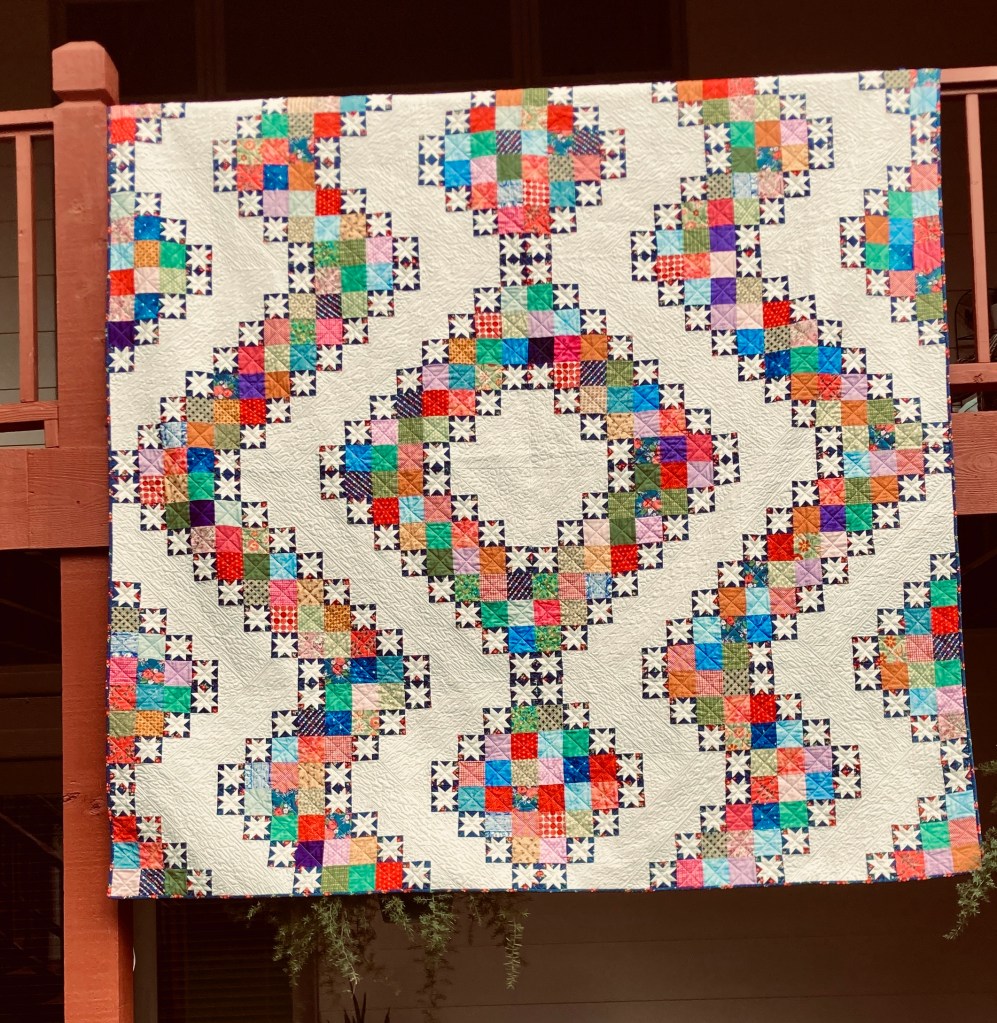
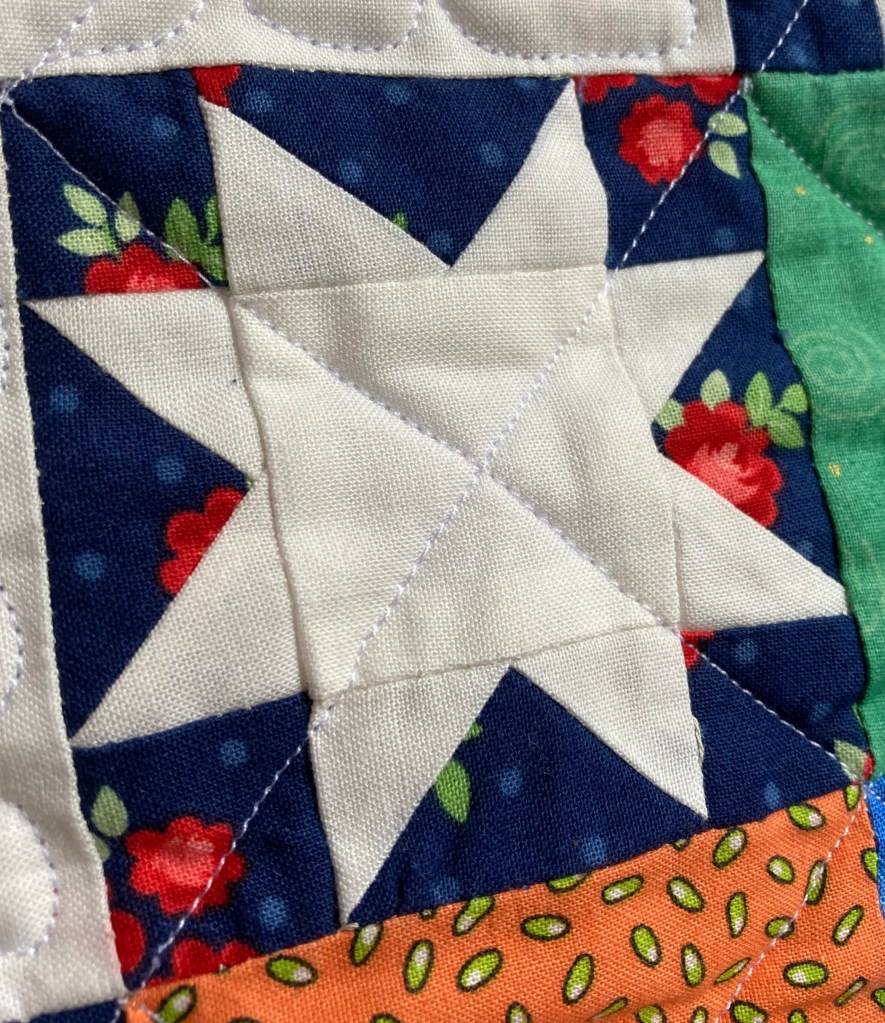
Vintage prints, polka dots, Baptist Fan quilting, 30’s green and stars!

I could not find a name for these stars–it looks like a sawtooth star on top on a ribbon star.

But my favorite star to make is the Wonky Star. Similar to the saw tooth but the points are free hand.

May need to make another one of these—there might be enough fabric in my stash “wink-wink”.

The best sleep comes when one sleeps under the stars–either in the heavens or on quilts!

Bakery Sweets?

If you overheard a couple of quilters chatting, you might think they were talking about sweets from a bakery. “I used two Jelly Rolls to make this.” “Honey Buns make great log cabin blocks.” Or “I have a Layer Cake I want to use up–do you have a great pattern using Layer Cakes.” Huh? What are they talking about? Well, in the quilting fabric world these sweets are names of very popular precuts sold by Moda, a giant among the various companies that mill and market fabric.

Precuts are a marketing tool allowing the consumer to use all or most of the fabrics in a certain line. An artist will design a line and the manufacturer will create up to three dozen different prints and color ways.

For example, this collection is called”Lavender Market, 3Tiles” by Deborah Edwards, Northcott, manufacturer.

If I wanted to make a quilt using all these different fabrics, it would be costly and difficult to find a source of all the fabrics. Precuts to the rescue!!!

Precuts, prepared and bundled by the fabric manufacturer, will use all the fabrics in a line but in a predetermined size or amount. This allows the quilter to use all the different fabrics without having yardage left over–not a bad thing, but an expensive thing!

Fat quarter bundles are the largest precut packages. A fat quarter is 1/4 of a yard but cut 18″ x 21″ instead of 9″ x 42″, giving more useable yardage.

One yd. of 42” wide fabric cut into “fat quarters vs. cut into regular ¼ yard.


18” x 21”


18” x 21”
  

18” x 21”


  18” x 21”
 9” x  42”
 9” x  42”
 9” x  42”
 9” x  42”

Fat quarter bundles can vary in number of quarters included, but in my experience, there is more than enough fabric to make a couple of large tops. Of course, they are the most expensive of the precuts. Most manufacturers have also created “fat-eighth” bundles also.

Jelly Rolls are the most popular of the precuts. A roll consists of forty two 2 1/2 ” strips of one line of fabric.

All you must do to make this pattern is to cut each 42″ strip into the correct length. Well, there is a little more to do, but the strips are already cut exactly 2 1/2 ” wide.

Purple Haze is for sale. It measures 59″ x 68″ and is for sale for $150.

Honey Buns are junior versions of a Jelly Roll. They are 1 1/2 ” wide.

Two plus Honey Buns were used to make this log cabin full size quilt top.

Charms are fun–and just like the charms girls would collect and wear on bracelets–these precuts are just fun to collect and admire! A charm pack is a 5″ square of all the different fabrics in a line.

There are entire books and websites devoted to patterns using charm packs. Charms make fun gifts, or a souvenir from a visit to a new quilt shop.

Batik charms were used to create half square triangles for this Christmas theme quilt. It measures 58″ x 61″ and is for sale for $150.

All these were made using charm packs. Mini Charms are a collection of 42 squares that are only 2 1/2 “.

Layer cakes reminds me of my new favorite cake–Hummingbird Cake with at least three layers of cake with delicious cream cheese frosting between the layers! I gain weight thinking about it, but so worth it! I digress— Layer cakes are 10″ squares– with each fabric in a line being used.

I have this treat waiting for me to use this fall. I have not decided what pattern to use, but there a many options.

This would quick and easy!

Most all of the manufacturers besides Moda have precuts–they just call them by different names. Wilmington Prints calls their precuts Karat Crystals–5″ or 10″ squares. Cotton+Steel offers precuts, simply calling them 5 ” or 10″ squares. If you are interested in creating a quilt top, precuts are excellent choice with which to begin.

So, if you see a photo of a quilt top and it is described as using a couple of Jelly Rolls, you will know exactly what was used. It will not be a sticky mess!

Island dreaming…

My son and his family are spending Spring Break in Hawaii—again. This trip is much easier to do if one lives on the west coast! Their photos this year are showing me a different side of the islands . If it wasn’t for a few glimpses of the ocean and beach, I would think they were somewhere in the southwestern states. I am learning Hawaii has a lot more to offer than sandy beaches, palm trees and aqua coves. But I still think of all those travel poster scenes when I dream of visiting Hawaii.

Maybe because Hawaii is on my mind, this quilt made me think of the Islands. The colors are the blue/aqua of the ocean and the white of the sands of the beach. The floral pinwheels suggest the breezes and the tiny flowers are in the blocks and the borders.

The back of the quilt is a batik fabric with a tropical leaf print. The backing is so attractive it could be used as the top for a change.

The machine quilting is very relaxed which allows a great drape.

The binding is a “split” binding–two different fabrics were used for an accent.

The quilt measures 84″ x 96″ which would fit a queen size bed but could be used on a king. It is for sale for $450.

For now I will enjoy Hawaii second hand via photos and stories. And I will continue to dream of aqua water, white beaches and ocean breezes.

Check out the photo gallery post for other offerings.

Log Cabins

My cousin likes to say, “Abe Lincoln and I were both born in a log cabin!” Eighty nine years ago she was born in a rustic log cabin in southwest Missouri. She was the first child of a very young couple starting out in the middle of the Great Depression. I would have been fascinated by it, but it was gone by my teen years.

I did see the replica of Abe Lincoln’s at the approximate location of his birth site. Log cabins represent something very “American” and in some form will always be present.

My favorite quilt block is “log cabin”. I suspect the pattern was the result of quilters using fabric scraps that were very narrow and short. This pattern utilized every bit of their precious fabric.

This is the basic pattern. Any different sizes of strips may be used as long as they follow the formula. The center block (red) is a square–the size will determine the width of the remaining pieces. Another square of the same size is sewn to it. The next piece is the same width as the original square but the length of the two squares sewn together. Continuing in a circular pattern (left to right), the next piece is the length of the center square with the addition of the first rectangle. This pattern continues until a quilt block of a preferred size is completed.

Some log cabins are “paper pieced”, especially when using very small strips of fabric. (Paper piecing is a topic for another blog post!). I paper pieced this table runner. It is14″ x 26″ and $30.

Most log cabin quilts use color to emphasize the design. In the example above, dark colors were used on the right, light colors on the left. But traditionally, the center block is always red to symbolize the hearth of a home.

The simple, basic log cabin block can be layout in many patterns–it is fun to play with the blocks, but I often agonize over the “best” design for my blocks.

Log cabin is a very traditional block, but modern quilters have adapted it to suit their vibe.

Traditional blocks made the original way is my favorite. Log Cabin blocks can be very soothing to make. A good afternoon is sewing together strips of fabric while listening to an audio book!

Sandy Klop, a big name in quilting world, designs a line of fabric called American Jane. To quote the website it is “an upbeat, happy look rich in primary colors”. American Jane fabrics suggests the vintage fabrics of the 30’s and 40’s, but has more intense colors versus the pastels of that period. I chose two jelly rolls of “Hop, Skip and Jump” plus some coordinating solids and low volume prints to make this log cabin quilt.

The quilt measures 60″ x 80″ fitting a twin bed or full size well and serving as a topper on a queen size bed.

It looks great on this queen size bed ( with the iron head board) and wrinkly embroidered pillowcases).

Bound in a solid red to match the center of each block, the quilt is backed in a tiny floral geometric. The quilting pattern is “Baptist Fan”, a long-arm side to side design, copying an old-fashion hand quilted design.

This quilt just makes me happy! It is for sale by Quilters at First for $300. Leave a comment please, if you are interested.

Do you see the “other” pattern?

I am fascinated by drawings that upon a second examination, a new design or face or animal appears. The drawing becomes much more complex than it first appeared. After you have discovered the more intricate design you will never see original the same way again. Some quilt blocks are designed so that when they are sewn together a secondary design appears. For example, this quilt photo I pulled off Pinterest is a great example of a secondary design forming.

This simple two color quilt top has one block pattern, but half of the blocks are with a white center and half of the blocks are with a red center. The basic block of this top looks like a stylized flower.

When the blocks are sewn together in alternating colors, another design appears- it is a circle, and the circles overlap. This could be a puzzle on Facebook, “How many circles do you count?”

The following top is an example of two different block sewn together that create a third design.

The top block is a “sawtooth” star, very common in quilt patterns. The lower block is one version of “puss in the corner” made up of four simple four patch blocks.

But when the two blocks are sewn together in an alternating pattern, a third pattern appears.

A modified “Irish Chain” appears. Of course the use of color is very important in creating another pattern. But even with the one color, a secondary design can appear.

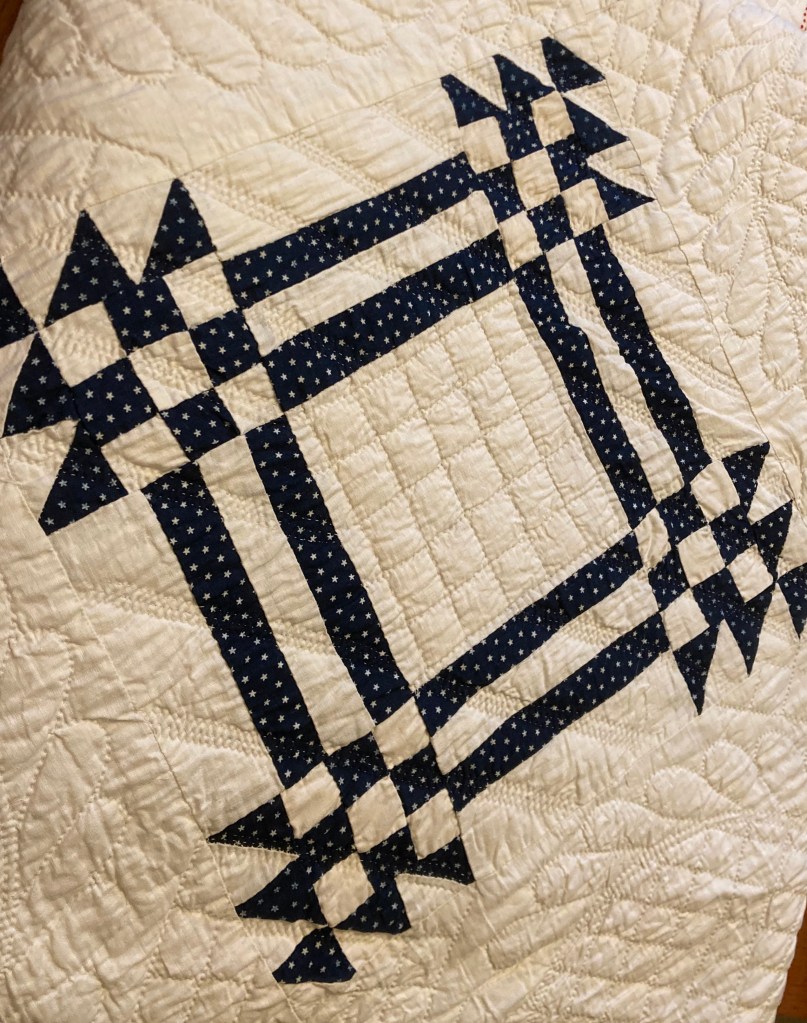
Can you tell which design was “the” block for this quilt top?

Was it this block made up of a green center block with “flying geese” radiating out and the half-square triangles in each corner?

Or was it the “Shoo Fly” block with “Flying Geese” used for the sashing?

We don’t know—this quilt top was made by an unknown artist. A member of Quilters at First found this completed top in a thrift store and I quilted it and added the binding from the fabric that was sold with it. I would like to meet the person who pieced this sweet top. The points are perfect. (when the top is machine quilted on a domestic machine, the quilter sees every inch of the top!) Every corner of the half-square triangles and the flying geese is present–none were cut off.

Reproduction fabrics of the 30’s and 40’s were used masterfully. The green corner stones make the coral shine. The background fabric is a vintage looking cream color.

The quilt measures 45″ x 60″ and for sale for $75. If you are interested in this quilt, please leave a comment or DM me on Facebook.

Perhaps now you will start looking for bonus designs or patterns in quilt tops–or in the tile on floors or walls!

Please enjoy it now!

Each time I place this saucer in front of my husband for his dessert or salad, he protests. He doesn’t want to use it because it was my Grandpa Van’s saucer and he is afraid he will break it. I have explained over and over that if it has lasted well over 100 years, it is unlikely he will break it. And if it is broken, that is OK–I can not believe my children will want it. It isn’t conventionally pretty and it is chipped, so even though my friend who knows about these trends says Ironstone is “hot stuff” now, it has no monetary value to me. I keep it because I remember my Grandpa pouring coffee out his mug into the saucer to cool and drink. If the saucer breaks, I still have the memory. And by using it every day, it is a tangible link to my heritage-and a man who was very practical, hardworking frugal and a believer in education.

Too often, I hear people express this same sentiment about a quilt or hand embroidered towels or some other handcrafted item. The item must be carefully saved so it won’t get worn or damaged. When I give a baby quilt to a new mother, I want the baby to be wrapped in it, or crawl on it on the floor or used later as part of a quilt fort the child makes. My grandson’s first large quilt is quite faded now since it has been on his bed for over 15 years and therefore had to be laundered multiple times. That makes me happy.

True, I have been guilty of “saving” items away in a box. My grandmother’s wedding quilt is safely stored in an acid free box for my daughter, but my mother continued on the preservation that her mother started, I can’t stop the practice. But more and more, I display the quilts or keepsakes in my home so I can admire and enjoy them.

My mother-in-law once said to me “Are you saving these for your husband’s second wife?” But when we were going through her things we found many items that had not been used. So I think everyone pays homage to the “enjoy it now” belief but just can’t bring themselves to use some items for fear of damaging them.

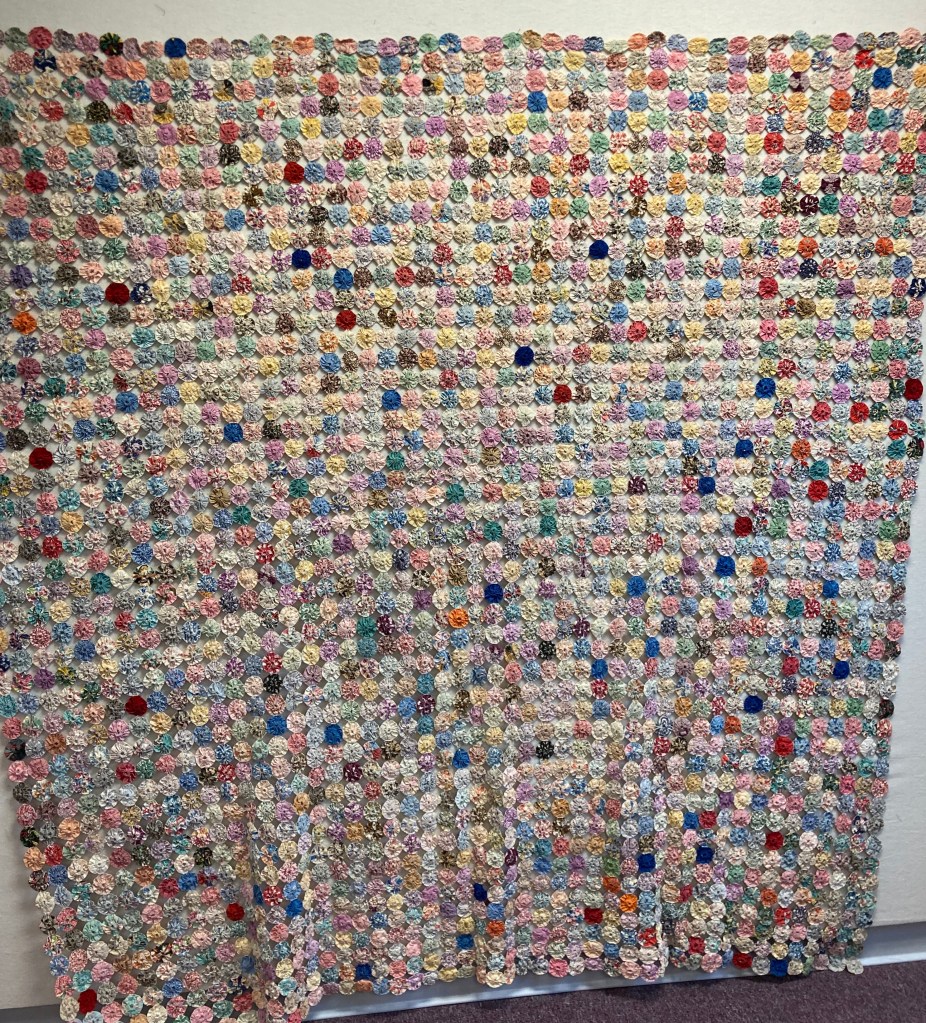
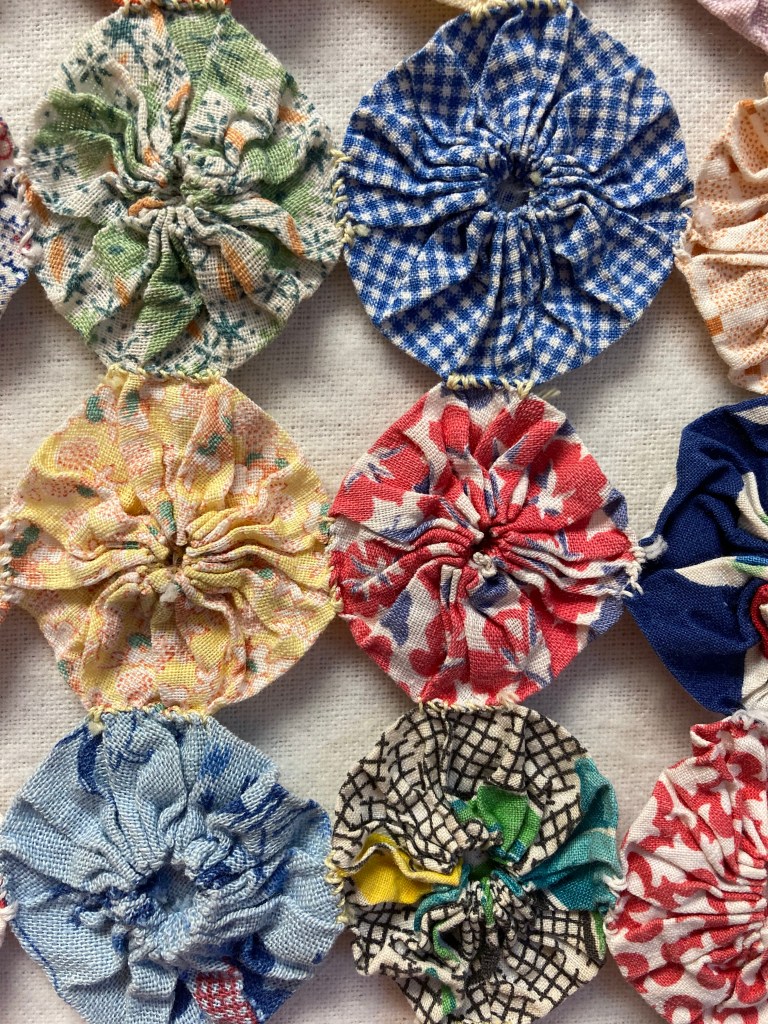
Finding quilts at auctions and at antique shops has become a treasure hunt for some folks. Who doesn’t like to brag about a heirloom found for very little money? I found this beauty at a relative’s estate auction. It isn’t a family piece according to the owner, but one they had purchased. I would have paid much more than I did to have this pastel grandma’s flower garden in my collection.

The Quilters at First will have a Vintage Corner at the annual Quilt Sale in October. We will have donated quilts, aprons and table linens. Lucky for us, most of the items are in great shape, they just need a new home.


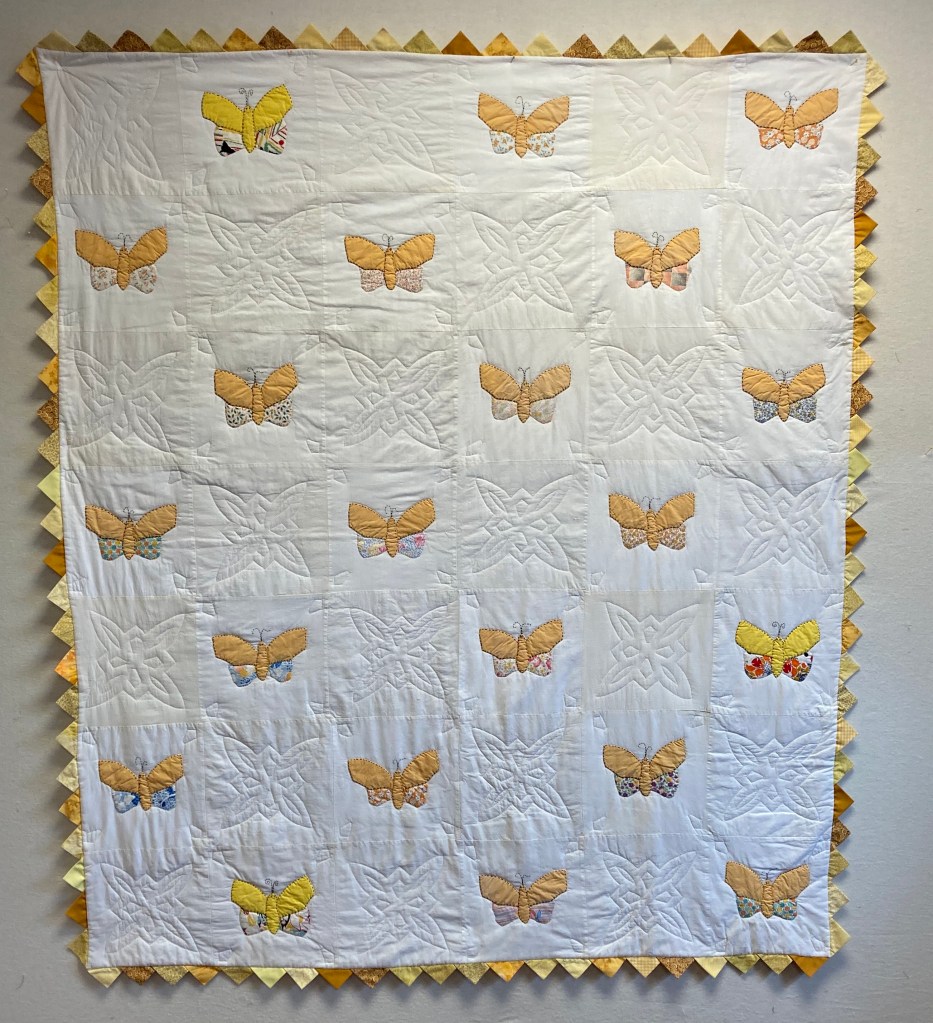
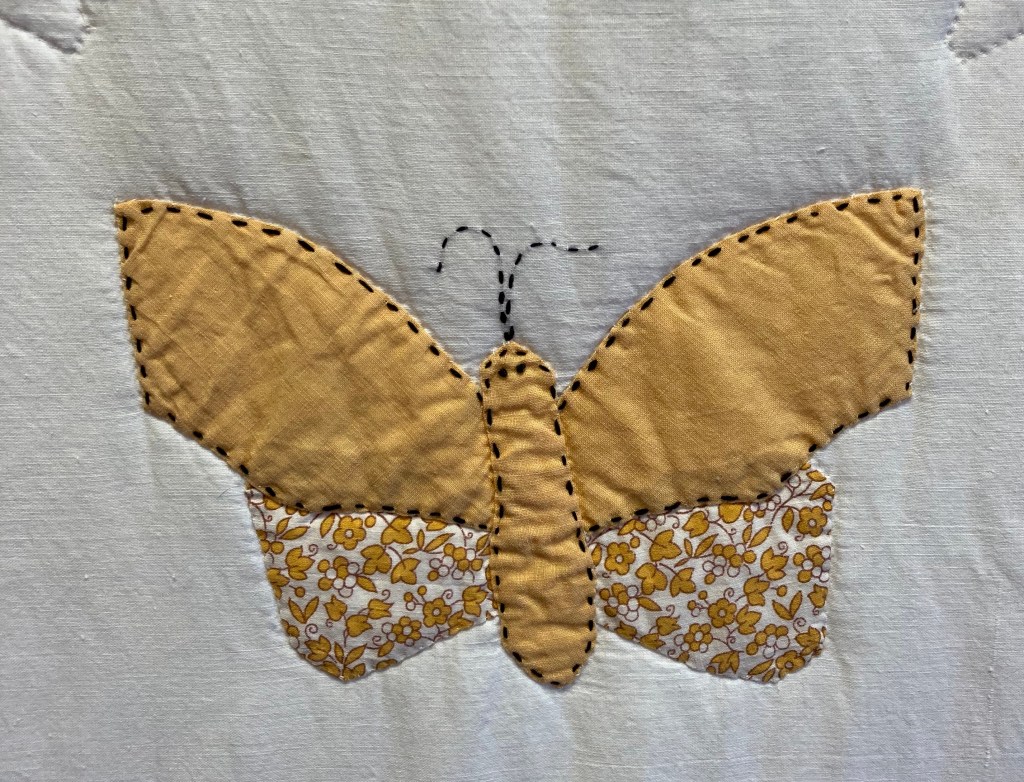
Ida donated this vintage butterfly quilt. We are not certain about the quilt’s age, but the butterfly motif was popular in the 1930’s and 40’s. The fabric is certainly of that period—the simple tiny prints and the solid yellow.

Prairie Points surround the quilt, adding color and a feminine look. The quilt measures 65″ x 74″.

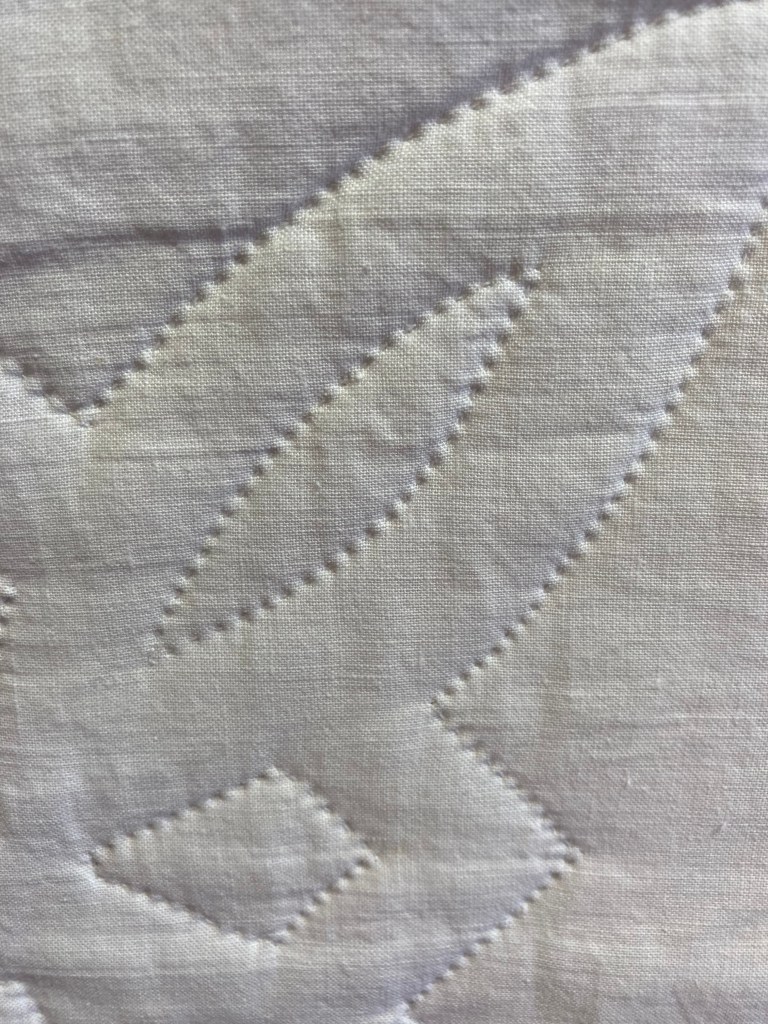
The hand quilting is exquisite. There are 10 to 12 stitches to the inch. This stylized butterfly in stitching into the solid blocks and there is stitching around each appliqued block.

The quilt is being offered for $200 and you may buy it before the sale. Please leave a comment if you are interested.

National Quilting Day

Happy National Quilting Day! The actual date jumps around but it is always the third Saturday in March. Interesting that is just before the start of official spring. Winter and quilting go together in my world. Of course, I quilt year around, but in spring, summer and fall, I must give up time from my sewing room to work in the yard and the flower beds. Some quilters have a passion for gardening. I don’t–I do enough so that I don’t embarrass the neighbors. But I am off track. I want to share some of my favorite quilts (random photos that don’t correspond to the text) and the reasons I am an obsessed quilter.

I love the Log Cabin block. I love American Jane fabric. I love the Baptist Fan quilting design. I guess this makes this about my favorite quilt.

Six reasons I quilt/sew:

  1. I love to sew and for years made most of my clothing. I sewed for both of my children–shorts and shirts for my son and most of my daughter’s clothing plus some very clever Halloween costumes. I made dresses and tops for my Mom. But, the children were easy to fit and my Mom wasn’t very particular. I hate to buy fabric, cut and sew together and THEN discover it just isn’t a good match of fabric to garment or fit to my body or I just didn’t like it. As fabric became more expensive, I swore off making garments and never wearing the item. I embraced quilting!
  2. I taught Family and Consumer Science(Home Ec.) for 32 years and made the circuit of foods, family living, home decor, child development and consumer science but discovered that sewing classes were the most fun. (In the beginning classes the projects didn’t require much fitting, so there!). The pride a student felt after making their first “learn to sew bag” was wonderful to watch. I am still in awe of some of the quilts my upper class students created. They proved the saying “They did it because they didn’t know they couldn’t”.

Sometimes I have a pattern, sometimes I don’t.

3. I love making something out of scraps; that knowledge that some saw it as a pile of leftovers but I created a useful item. I will admit I have spent enough money on fabric to pay for a small vehicle, but I save every scrap. I have made aprons out of thrift store finds. I made table runners out of leftovers from a quilt top. I have made a queen size top with 2.5 inch square saved over the year.

Made from 2.5 inch blocks saved from scraps

4. I love to create. I can’t paint or draw. I am not a musician. My flower bed evoke pity from my friends—but I can quilt really beautiful quilts, and who needs a pattern! Plus the object of my creativity lasts. Cook a meal and it gone in minutes. My great grandmother made a quilt, and I still enjoy it.

Made by Grandma Claudia around 1900

5. The quilting community is a great support system. Every Wednesday I join a dozen other women to sew from 11 am to 5 pm. I could get a lot more done if I stayed home. But as Susan said to me once when I complained about only getting one border on a top, “that isn’t the reason we come together”. The first hour or so each week is an informal session of “what do you think” questions…do you think this quilt needs a border? do you think this print is too large for the block? do you think I need to make the top bigger? Husbands are not known for giving very good answers to these sort of questions, I need these people.

I enjoy novels set in the 1930’s and 1940’s. Makes sense I would enjoy sewing with reproduction fabric.

6. I do realize the last reason is rather flippant–I mean no offense. But many a time, I have said “it is better to quilt, than to murder!” Sewing/quilting soothes my soul, calms my nerves, lifts my spirits—-and to be honest, gives my self-esteem a boost when I am falling into that trap of feeling inferior.

Realistically, not everyone is going even like quilting….my son in law is a football fanatic. I do not see the point! Fishing? no thank you. Collecting fine art, ok but collecting quilts is better.

I would rather hang quilts in my house than any other art medium.

Happy National Quilt Day!