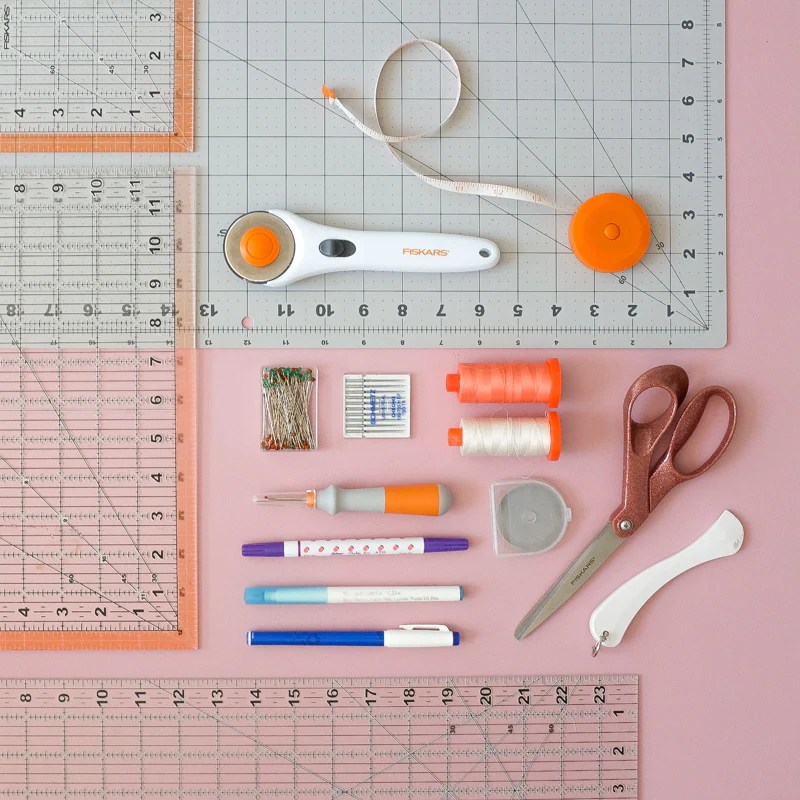
Both my grandmothers quilted–because they needed warm covers for their families in the winter and because it was a creative outlet in the Depression/World War II era that did not offer women many opportunities to brighten their world. They used scraps left over from making garments for their families supplemented with some yardage they purchased. Much of the fabric at their disposal came from cloth sacks that held chicken or animal feed and flour or sugar. The most basic sewing tools were used. All that was needed was a pair of shears, a 12 inch ruler from the school room, a pencil, cardboard from a cereal box to create a template, short straight pins that could rust easily and needle and thread. Both of my grandmothers had treadle sewing machines.
Patterns were traditional ones that didn’t require printed instructions or was copied from a finished quilt seen at a neighbors or family member’s home. In the early 1920s, quilt patterns began to be published in newspapers and women’s magazines.
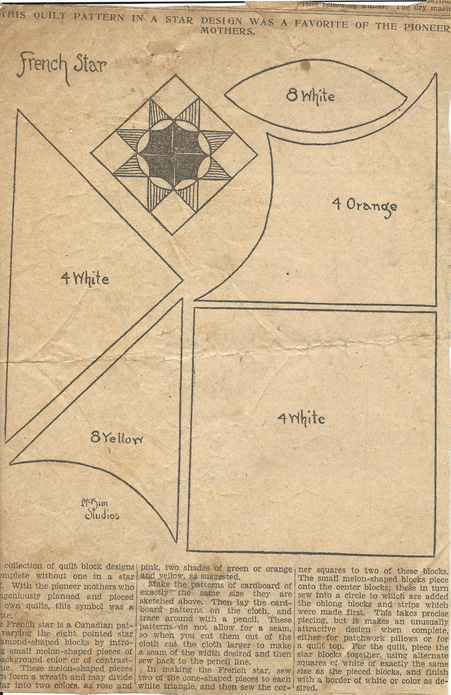
The most notable ones were from the Kansas City Star. (I still have many clipped patterns on yellow brittle newsprint that my grandmother saved.). Some current quilt historians suggest that many of these patterns were drawn by persons who had never quilted due to their intricate designs. Today a quilt pattern may be a dozen pages of measurements, instructions and layout suggestions. The Kansas City Star pattern was a half of two columns on one page!
I quilt because I enjoy the process–selecting a pattern, choosing fabrics, challenging myself to be accurate when cutting out the pieces and sewing them together. I find it fascinating to observe how a quilt changes after each step of the production–blocks look different when combined with other blocks and sashing, quilting gives the quilt substance, and binding frames it. Each step in “quilting” seems to change what I thought it would look like and how I would feel about it. I quilt not of necessity but to satisfy a creative need.
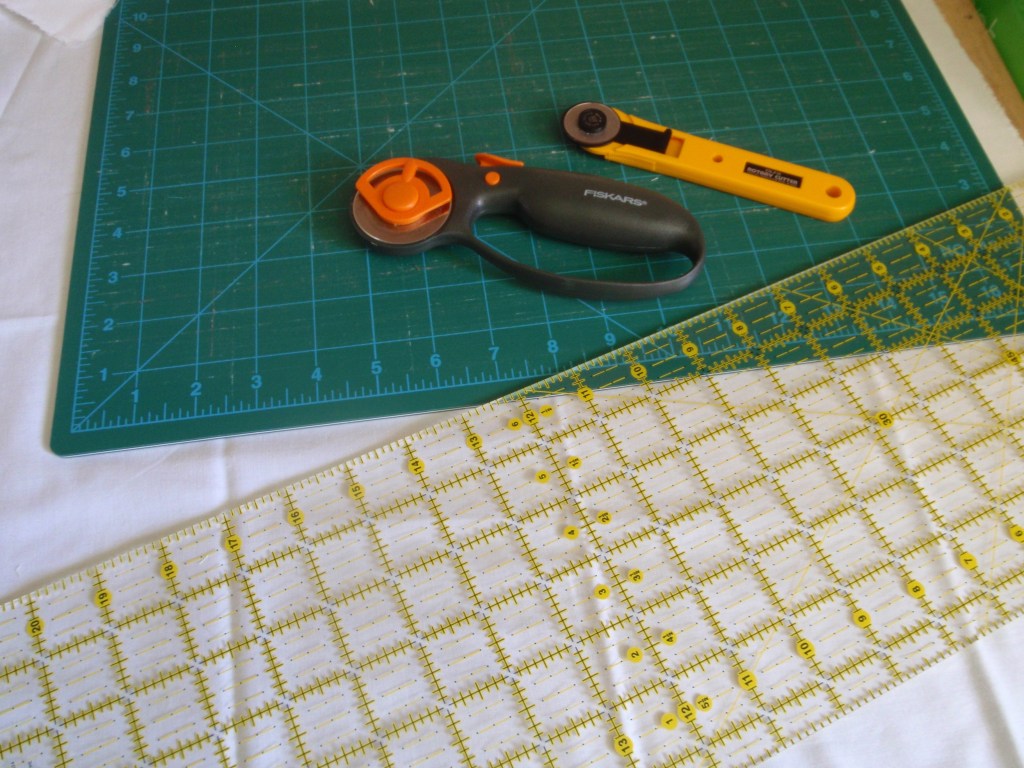
Just as my grandmothers and I quilt for different reasons, the tools I use have changed also. I still use shears but mainly to clip threads. Most of the cutting of pieces for the blocks are cut with a rotary cutter, acrylic rulers and a cutting mat. Very seldom do I used a template to draw around and cut by hand. My sewing machine is electronic with seam width guides. And the only hand sewing I do on my quilts is the binding. I even have a selection of “straight pins” to use depending on the purpose.
The evolution of quilting tools seemed to be to speed up the process. The value of making quilting less time consuming is debatable but most of us in 2026 would not quilt if all we had were our grandmothers tools.
The first huge change was the invention of the rotary cutter. It was introduced in 1979 and allowed quilters to cut out pattern pieces more quickly and more accurately. This new tool resulted in old and new quilt patterns being made more streamlined.
But the evolution of quilting tools is continuing! Just less than a couple of decades ago, Gudrun Erla, a quilter from Iceland, and Creative Grids 9 (well known specialized ruler manufacturor) developed THE STRIPOLOGY RULER.
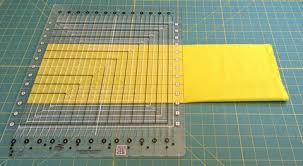
This tool was designed to cut fabric even more efficiently and accurately. In fact it is advertised to reduce cutting time by 75%. The ruler is made from a transparent high quality acrylic. The ruler is a large square or rectangle with premade slots in increments of an half inch. The non-slip surface and the weight of the ruler allows multiple accurate cuts without moving the ruler or fabric.
With practice and the instructions included with the ruler, strips, squares, triangles and diamonds may be cut. The ruler may be used to trim blocks to a prescribed size.
The Stripology Ruler has become a life saver for me. I cut up old sheets, pillowcases, curtains and dated fabrics into 2 inch strips for others to make crochet rugs. Using the larger stripology ruler, I can reduce a queen size sheet into a pile of strips in ten minutes. Just imagine how my grandmother felt after tearing or cutting rags into strips…achy shoulders and hands!
The rulers are expensive. The largest ruler, there are four sizes, is $82– the mini is $50. And truthfully, I use it more for cutting the strips for rugs than I do for my quilts. But in the evolution of tools, it is brilliant. What will be next?
To learn more about the rulers check out the unbiased review on http://www.thecraftyquilter.com. Check out the many YouTube videos illustrating how to use one.
*********************************
What did we finish and bring to share?
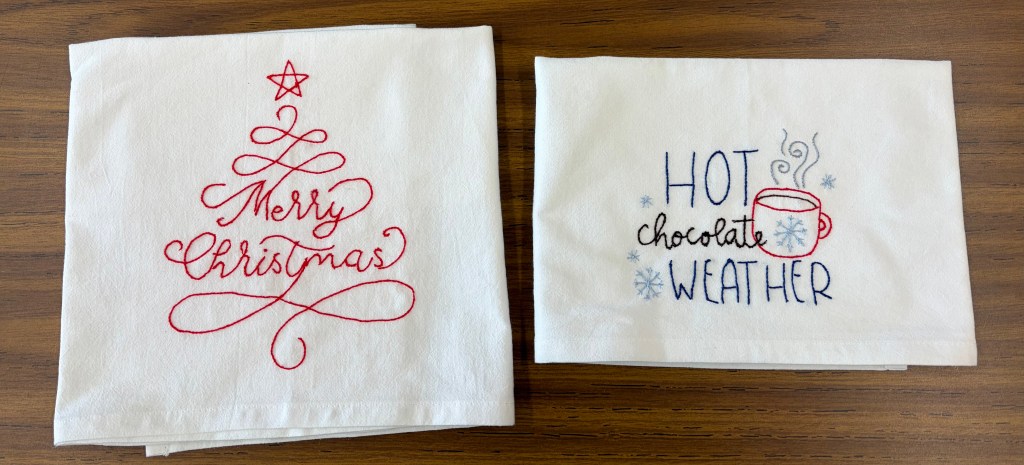
Tea-towels 27″ x 27″ 100% natural sustainable cotton, hemmed w/ hanging loop $9 each
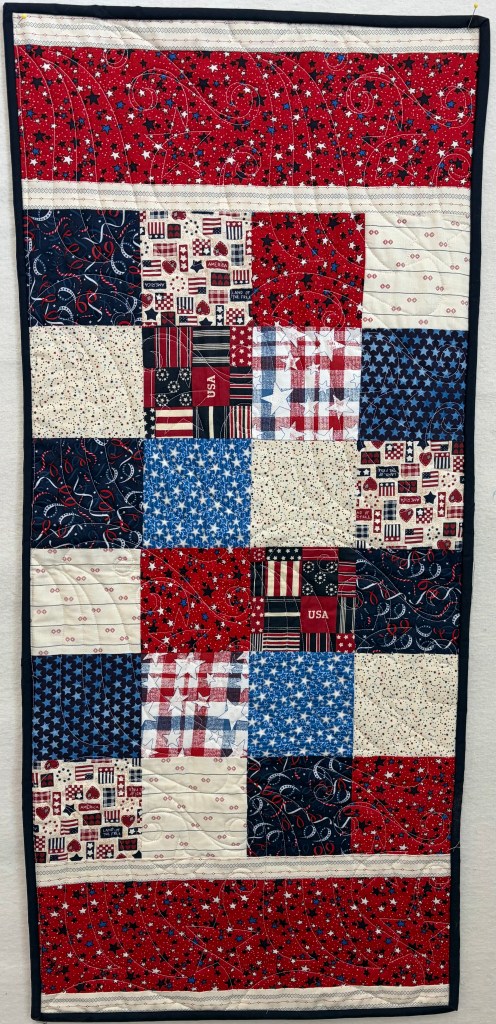
Another table runner celebrating the very special Fourth of July this year! The backing is a patriotic print which would make a great table runner by itself.
18.5″ x 41″. $40
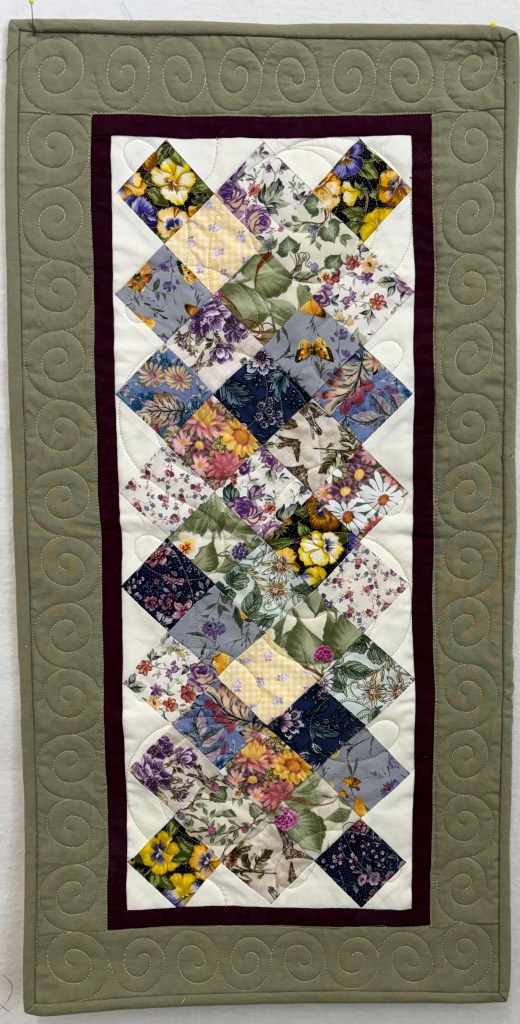
Different floral prints were set on point for this 14″ x 28″ table runner. The outer border is machine quilted in a very classic style. $40
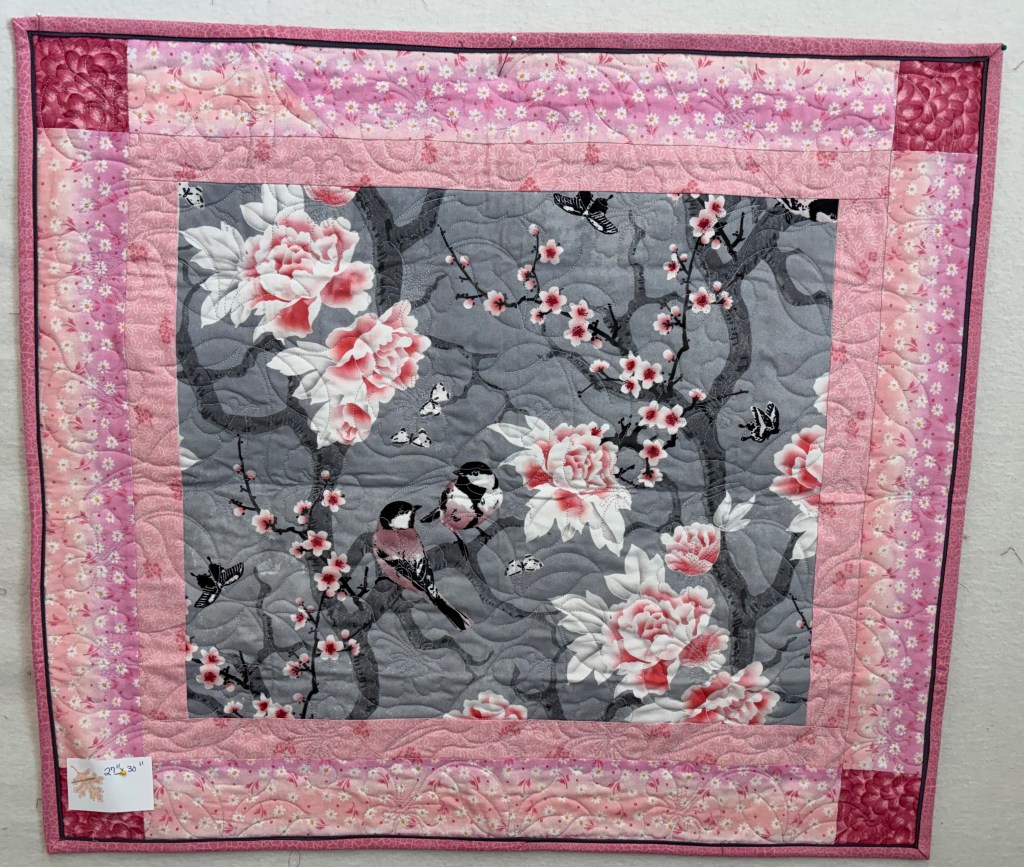
This preprint panel has a Far Eastern feel. The fabrics used in the borders compliment the colors in the panel. Elaine made two nearly identical wall hangings using the same fabrics–the backing are different. Each wall hanging has a hanging sleeve, making it easy to display it on a wall in your home. The machine quilting pattern echos the flowers in the panel. 27″ x 30″. $50.
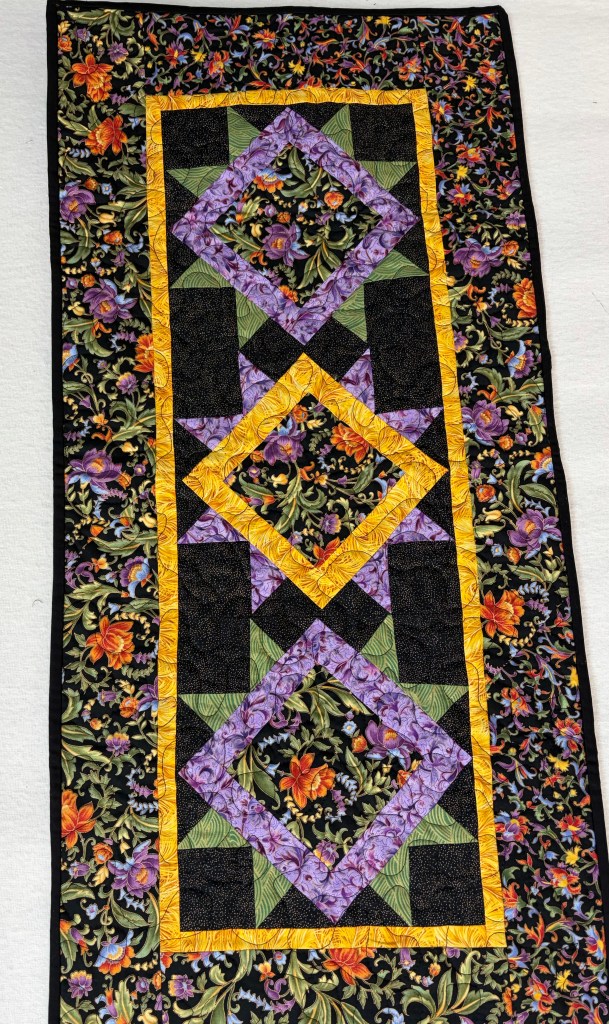
This table runner reminds me of a tapestry hanging on a castle wall. (Yes, I read a lot of fiction.). The colors in the border print are used again in the center stars. The black background helps make the colors sparkle. 16″ x 34″. $40
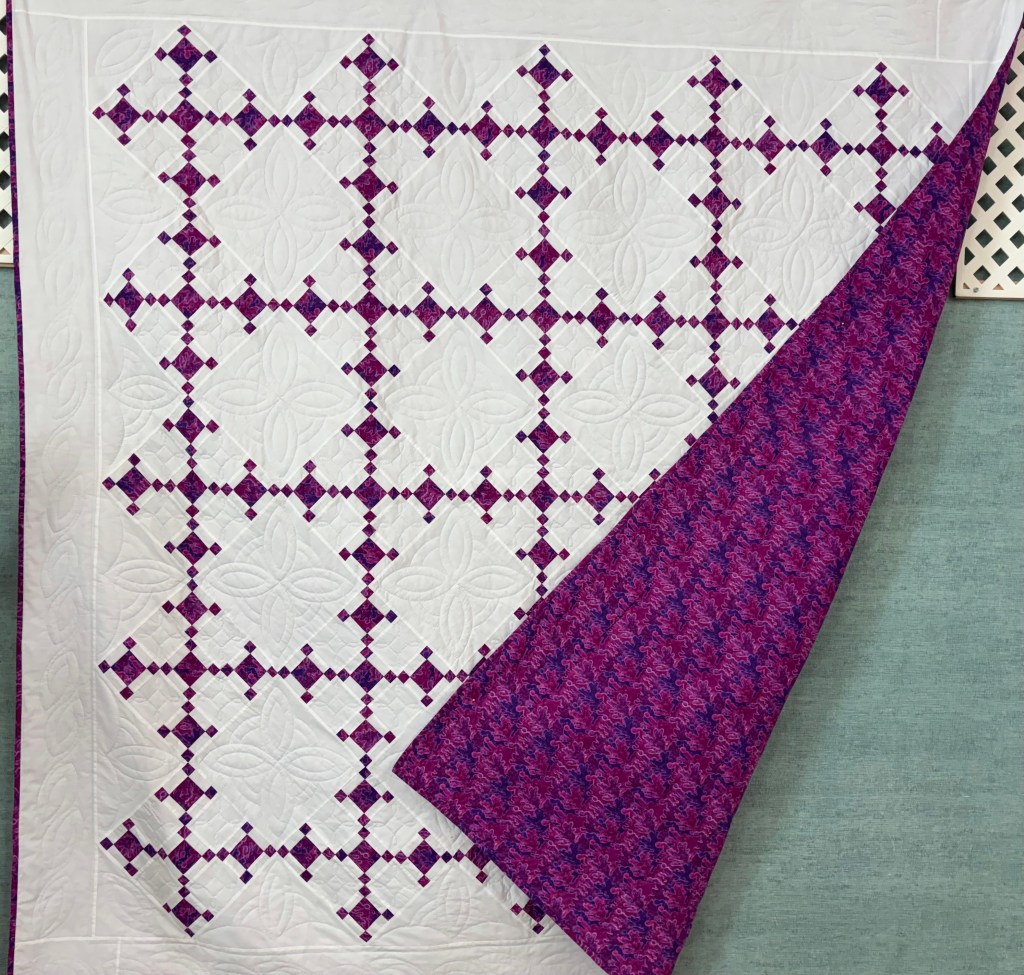
Something very special was completed this week after hours and hours of hand quilting.
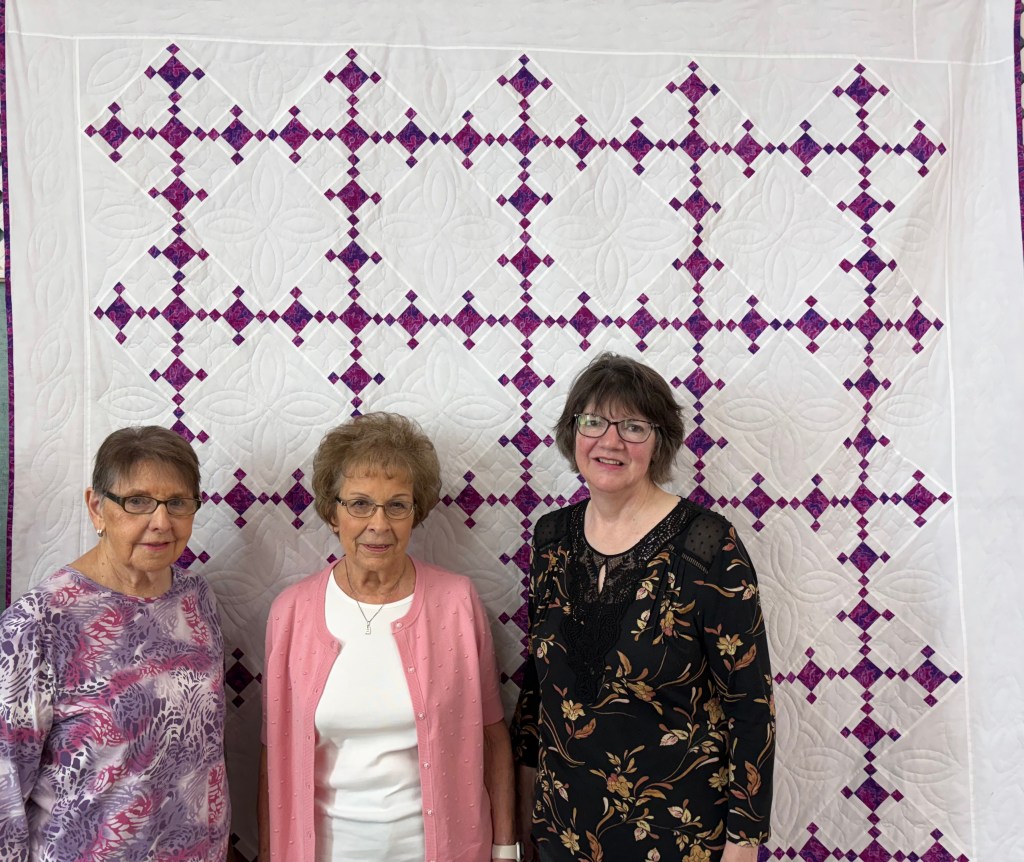
These three quilters spent hours bent over a quilting frame taking tiny even stitches to create this keepsake. The quilt is just like them–traditional but would grace any modern style home.
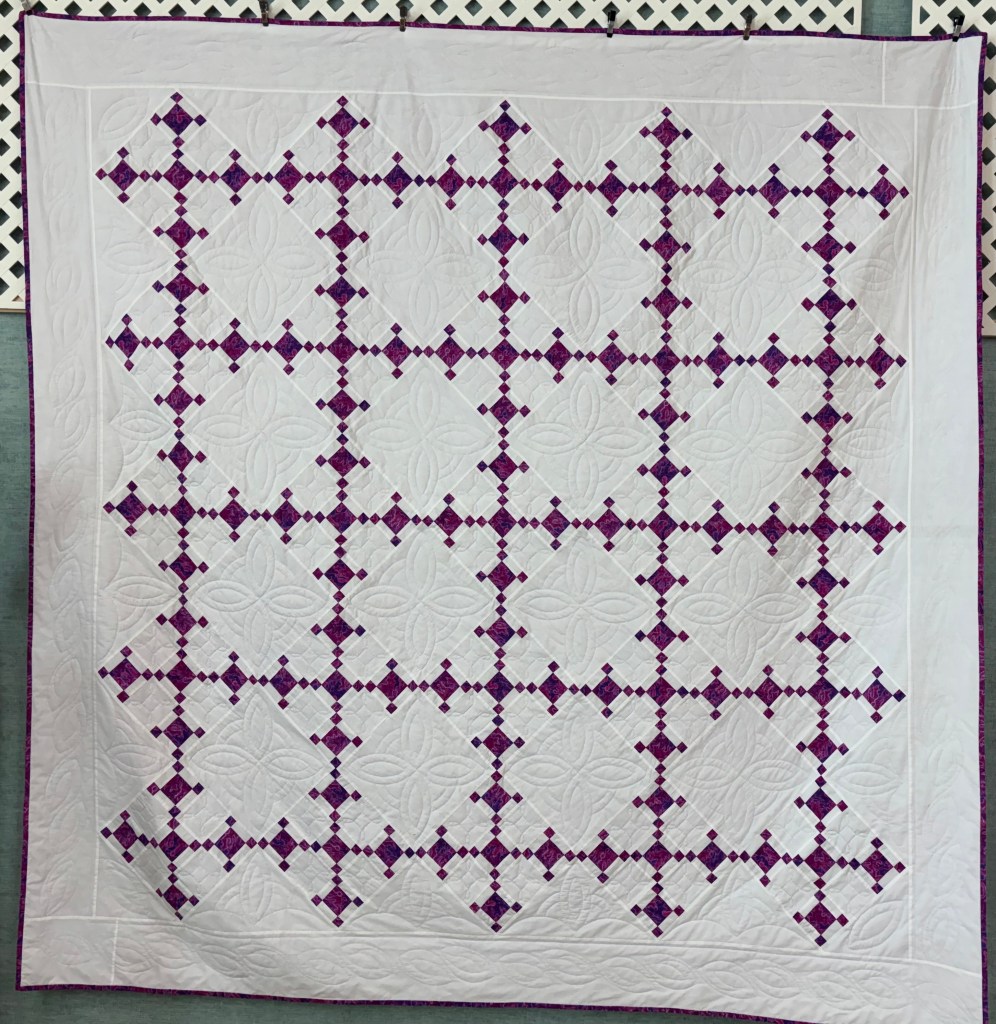
The block is a variation of a nine patch and is set on point. The fuchsia print is an abstract print and was also used on the back.
Measuring 82″ x 82″, it would fit nicely on a queen size bed.
This beauty will be entered in the Prairie Quilt Guild show this summer. –where I am expecting it to receive a ribbon!
This quilt could become a treasured heirloom, passed from generation to generation. $500
Wonderful textile art are can be made with very simple tools or with the most advanced tools designed to facilitate the process and to insure the best accuracy. This is an individual choice. Remember there are no “quilt police” that enforces the use of any one tool or technique. Enjoy the process no matter what route you take.


Do you still have red/white/blue table runners available?
I would like to purchase one.
Thanks Clairissa Maddy 316-210-4367
LikeLike